claude code
Claude Code vs Codex: Which One I'd Pick, and When Codex Wins
Claude Code vs Codex comes down to which company's plan you already pay for and which tool your project's instructions are written for. Prices, limits, instruction files and what I've used both for, checked 28 October 2026.
The short answer: Claude Code and Codex are the same kind of tool. Both are coding agents that read your project, edit files and run commands from your terminal. Claude Code runs on Claude models and a Claude plan, Codex on OpenAI's models and a ChatGPT plan. I run my workspace on Claude Code. Pick Codex if you already pay for ChatGPT and want to start free.
Claude Code vs Codex at a glance
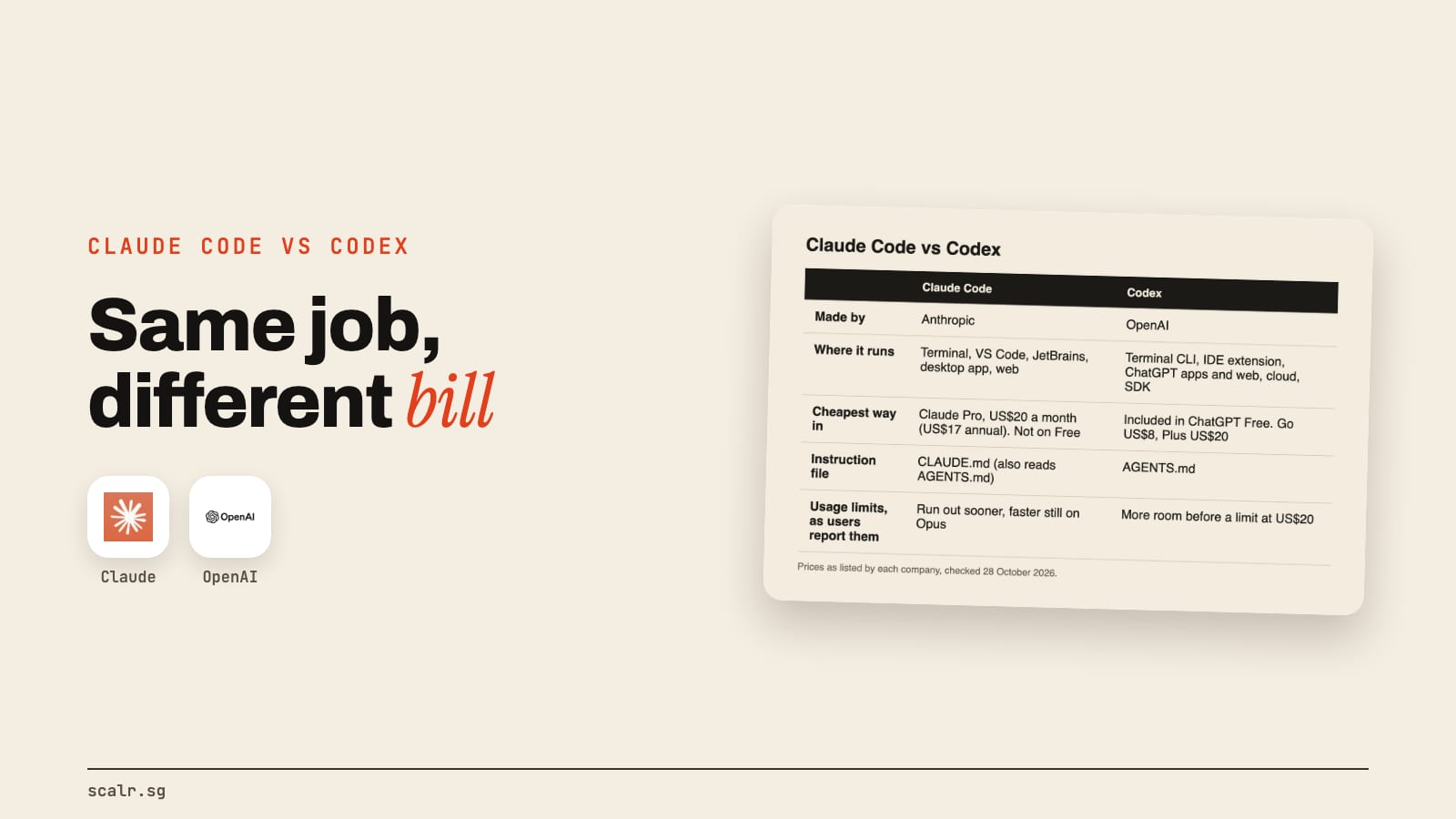
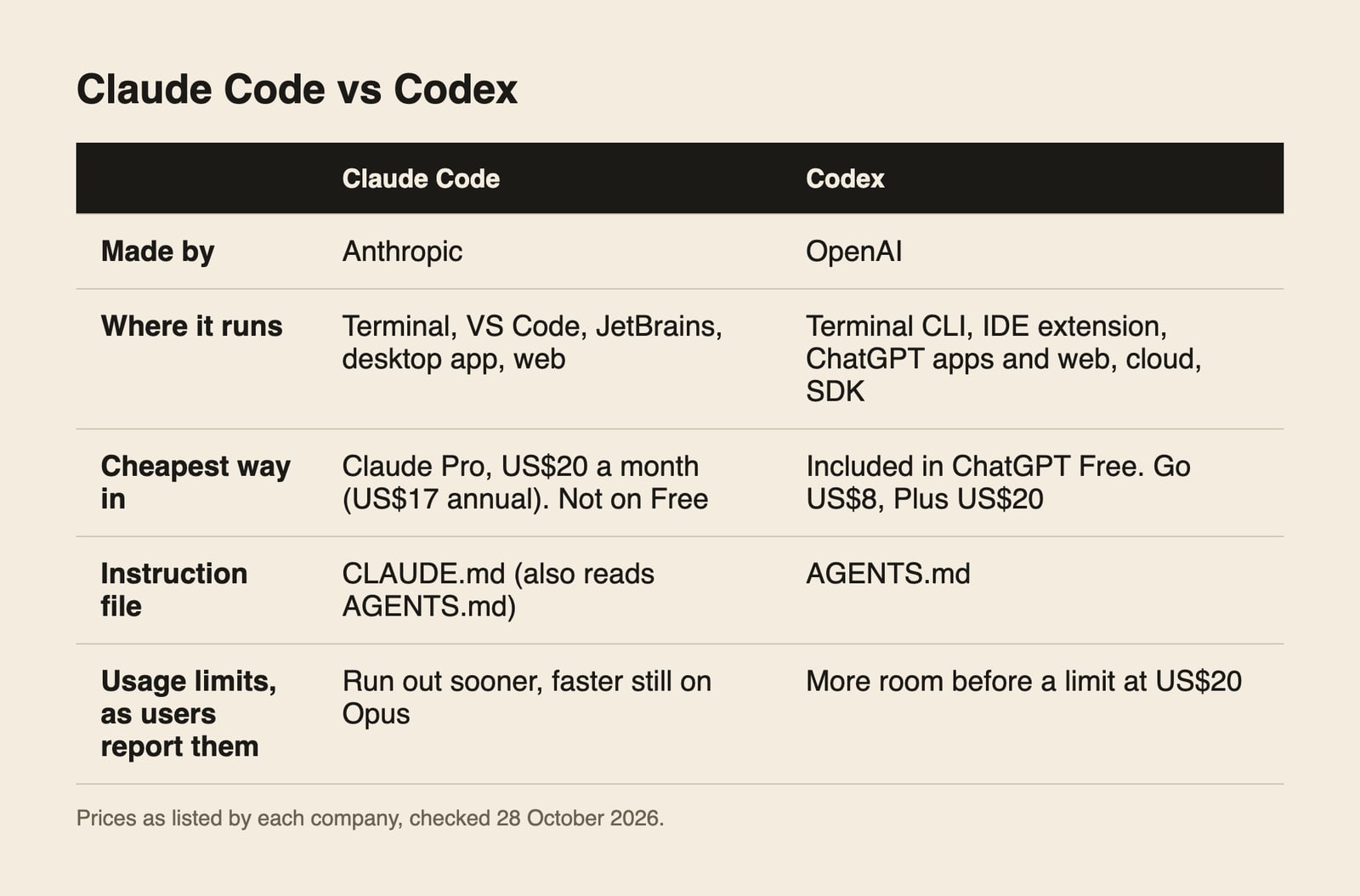
Here's the verdict table, with prices as listed on each company's own pages on 28 October 2026.
| Claude Code | Codex | |
|---|---|---|
| Made by | Anthropic | OpenAI |
| Where it runs | Terminal, VS Code, JetBrains, desktop app, web | Terminal CLI, IDE extension, ChatGPT apps and web, cloud, SDK |
| Cheapest way in | Claude Pro, US$20 a month (US$17 on annual billing); not on the Free plan | Included in ChatGPT Free; Go is US$8, Plus US$20 |
| Instruction file | CLAUDE.md (also reads AGENTS.md) | AGENTS.md |
| Usage limits, as users report them | Run out sooner, faster still on Opus | More room before a limit at US$20 |
The rest of this page is the four differences that actually matter, where the two overlap, and a rule for choosing. Cursor gets its own short section, because people search for it next to both.
Is Codex cheaper than Claude Code?
At the entry level, yes, because Codex has a free door and Claude Code doesn't. OpenAI's pricing page says Codex is included in ChatGPT Free, Go, Plus, Pro, Business, Edu and Enterprise plans, and you can use an API key instead. On 28 October it listed Go at US$8 a month, Plus at US$20, Pro from US$100, and Business at US$20 per user on annual billing or US$25 monthly.
Anthropic's pricing page puts Claude Code in Pro, Max and Ultra, and not in Free. Pro was US$20 a month billed monthly or US$17 a month on the annual plan (US$200 up front), Max US$100 and Ultra US$200. Ultra is the plan that was called Max 20x until Anthropic renamed it at the end of October.
So at US$20 the two are level, and below that only Codex exists. If you want to find out whether a coding agent suits you before paying anything, Codex is the better pick, full stop. If you want the full numbers on Claude's side, I broke them down in Claude's plans and usage limits.
That also answers the "openai codex pricing" question people search for. There's no Codex price of its own: you pay for the ChatGPT plan it comes with, or you pay API rates with a key. Credits are a third route, billed per million tokens by model.
Which one lasts longer before you hit a limit?
Codex, by most accounts, and this is the difference I'd weigh most if you plan to use one all day. OpenAI's page gives estimated ranges of local messages per five-hour window. For Plus, on 28 October, that was 35 to 285 for GPT-6.1 Terra, 15 to 160 for GPT-6.1 Sol and 350 to 3,000 for GPT-6 Luna. OpenAI says these are estimates, that weekly limits may also apply, and that Pro plans currently have no five-hour limit.
Those ranges are wide, and they move with the model and the size of the task. They're still numbers you can plan around. Claude's plans are described in relative terms (Max is a multiple of Pro), and the real ceiling is whatever the usage screen shows you.
People who use both say the same thing. Prathit Joshi, who compared them over 100+ hours for Composio (18 August 2026), wrote that "Claude Pro goes through usage fast, sometimes inside the first hour", while ChatGPT Plus "rarely makes me think about limits". In the same write-up's test across 47 workflows, Codex used about 19% fewer tokens and finished about 6% faster. Part of the gap is the model you pick: the piece says Opus drains Claude's allowance 5 to 10 times faster than Sonnet.
That matches my own experience. When I've used Codex, its tokens went a lot further. On Claude, the top models eat the allowance fast, Fable especially, and long multi-agent runs most of all: they take their time working, and they can use up a week's limit before you notice. That's my read from using both, not a measurement.
So if your days are long and your plan is US$20, Codex is the one less likely to stop you mid-job. I stay on Claude anyway, on Ultra and mostly on Opus, for the reasons in Claude's plans and usage limits.
Does the instruction file differ?
Barely, which is the good news if you're unsure. Codex builds its instructions from AGENTS.md: a global file in ~/.codex, then a file in each folder from the project root down to where you're working, with the closest one winning. It stops adding files at 32 KiB by default.
Claude Code reads CLAUDE.md, and Anthropic's memory docs say it can read a repository's AGENTS.md in place of one. I use that overlap in my own workspace. AGENTS.md in my repo root is a symlink to CLAUDE.md, so a single 205-line file briefs whichever agent opens the folder.
If you want the longer version of what goes into that file, I wrote one out in a real CLAUDE.md example.
Which one carries more of your setup with it?
Claude Code, in my case, and I can show the cost of the other direction. My workspace has 56 skill folders, the saved procedures Claude Code loads when a request matches. Both tools list skills, subagents and MCP servers as features. OpenAI's CLI page confirms all three, so the feature lists look alike.
What doesn't travel is your own setup. My reels pipeline is a skill, and Codex doesn't load it. So I keep a Codex runbook in the repo, which says it plainly: Claude drives the pipeline through a skill, and Codex doesn't get that skill, so everything it needs is ported into one document, with three human checkpoints it must never skip.
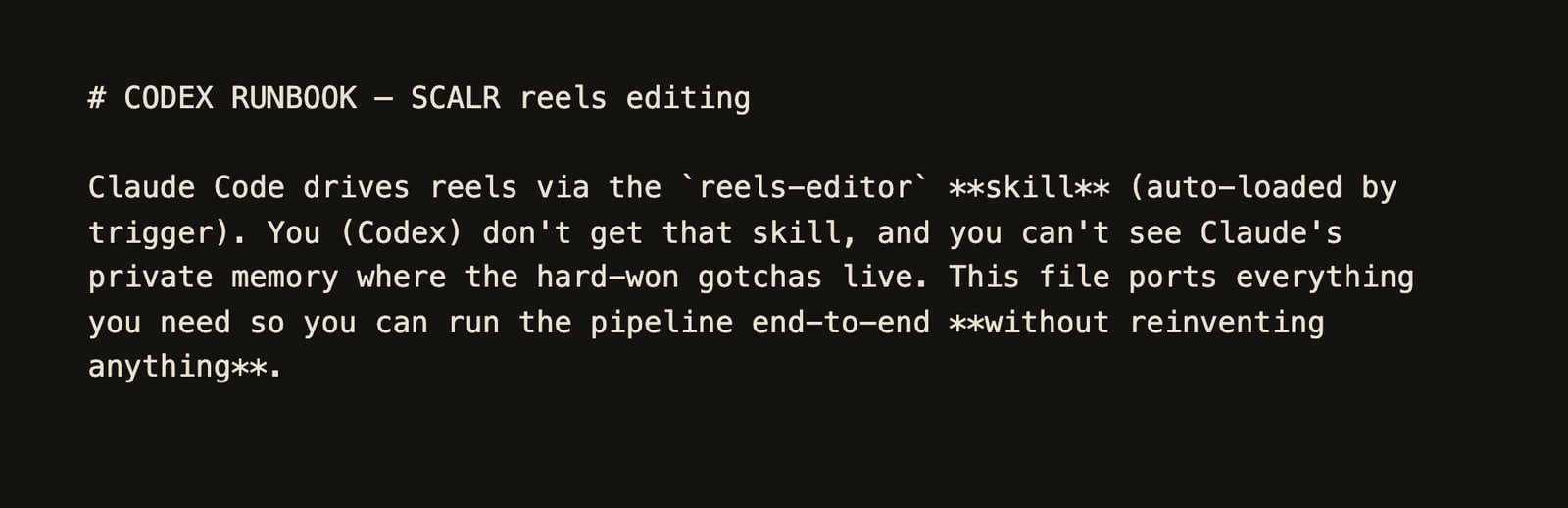
That's the real cost of switching: not the model, but porting your procedures to a tool that doesn't load them. If you haven't built that setup yet, the cost is zero and this difference doesn't apply to you. Claude Skills, explained covers what I mean by a skill.
Can you read and change the tool itself?
With Codex, yes for the command line. OpenAI publishes the CLI on GitHub under the Apache-2.0 licence, and it had 131.3k stars on 28 October. Install is one line: npm install -g @openai/codex, or the installer script on OpenAI's CLI page.
Claude Code installs with a one-line script too. If reading and forking the agent matters to you, Codex's command line is open for it. For me it doesn't matter day to day, because I configure these tools rather than edit them.
Where do Claude Code and Codex overlap?
More than the search results suggest. Both are agents in your terminal that read a codebase, edit files and run commands. Both also run in an IDE, in the cloud and on your phone. Both take MCP servers, skills and subagents, and both read AGENTS.md. Neither is a chatbot you paste code into.
The same goes for the safety model. Each has permission settings for what the agent may do without asking, and I'd treat both as a drafter you review, not an autopilot. My own agents prepare and draft, and nothing goes out without my yes.
Some people use them together. Claudex is a free skill that has Claude plan and Codex review. It shows the two are not rivals so much as two pairs of eyes.
What about Cursor?
Cursor is a separate product from a separate company, and its structure is what sets it apart. Cursor's own site now says "Cursor is your coding agent for building ambitious software", and it offers a command line, cloud agents and its own plans.
On 28 October, Cursor's pricing page listed Free at US$0, then Plus at US$8, Premium at US$30, Super at US$100 and Ultra at US$200 a month, with Teams from US$30 per user. It also notes that third-party model usage is billed separately.
The structural difference is the account. Claude Code is a feature of a Claude plan and Codex is a feature of a ChatGPT plan, while Cursor is its own subscription that sits in front of models. The two aren't exclusive either: Anthropic's docs list a Claude Code extension you can install inside Cursor, so "Claude Code vs Cursor" and "Cursor vs Claude Code" can end with using both.
Which should you pick?
Pick by situation.
Pick Codex when:
- You already pay for ChatGPT and want a coding agent at no extra cost
- You want to try an agent for free before spending anything
- You want the most usage for US$20 a month
- You want a command line you can read, fork and audit
- You care about published usage estimates before you commit
Pick Claude Code when:
- You already pay for a Claude plan, or you're building skills, hooks and a workflow you plan to keep
- You want one tool across terminal, desktop, web and scheduled tasks on a single plan
- You're not a coder and want a no-code route, which is covered in using Claude Code without coding
Run both when: you want a second opinion on a plan or a build. One tool does the work and the other reviews it, so neither grades its own homework.
Codex is the better pick for anyone who hasn't paid for either yet, and for anyone whose team is already on ChatGPT. For me it's Claude Code, because that's where my setup lives.
Key takeaways
- Claude Code and Codex are the same type of tool, a coding agent in your terminal, and differ mainly in the company, models and plan behind them.
- Codex is included in ChatGPT Free, while Claude Code needs Pro at US$20 a month or above (prices checked 28 October 2026).
- People who use both report that Codex lasts longer before a limit, and Claude runs out sooner, especially on Opus.
- Both read
AGENTS.md, so one instruction file can brief either agent. - The real cost of switching is your own setup, not the model.
- Cursor is a separate product with its own plans, and Claude Code can be installed inside it.
FAQ
Is Codex better than Claude Code?
Neither wins everything. Composio's 100-hour comparison scored Codex 3 to 2, mostly on cost and limits, and its author still said Claude Code is the one he'd keep if he had to uninstall one. Codex is the better pick if you want a free start or already pay for ChatGPT. Claude Code is the better pick if your skills, hooks and instruction files already live there, as mine do.
Is OpenAI Codex free?
Yes, up to a point. OpenAI's pricing page says Codex is included in the ChatGPT Free plan, as well as Go, Plus, Pro, Business, Edu and Enterprise, with usage limits that rise with the plan. You can also use an OpenAI API key and pay API rates.
Can I use Claude Code and Codex together?
Yes. Both read AGENTS.md, so one file can brief both, and tools like Claudex have Claude write a plan and Codex review it. Mine is a symlink from AGENTS.md to CLAUDE.md. Running both means paying for two accounts and two usage allowances.
Is Codex CLI open source?
Yes. OpenAI publishes the Codex CLI on GitHub under the Apache-2.0 licence, and the repository had 131.3k stars on 28 October 2026. Install with npm install -g @openai/codex.
Is Cursor the same as Claude Code?
No. Cursor is a separate product with its own subscription and its own plans, and Claude Code is part of a Claude plan. They can be used together, since Anthropic provides a Claude Code extension that installs inside Cursor.