deepseek
DeepSeek's Free Version of Claude Code: What It Is and How to Run It
DeepSeek's open-source agent app, DeepSeek Harness, does the job Claude Code does and costs nothing to install. The one command that opens it, what the model behind it really costs, the free trial route, and what to check before business data goes near it.
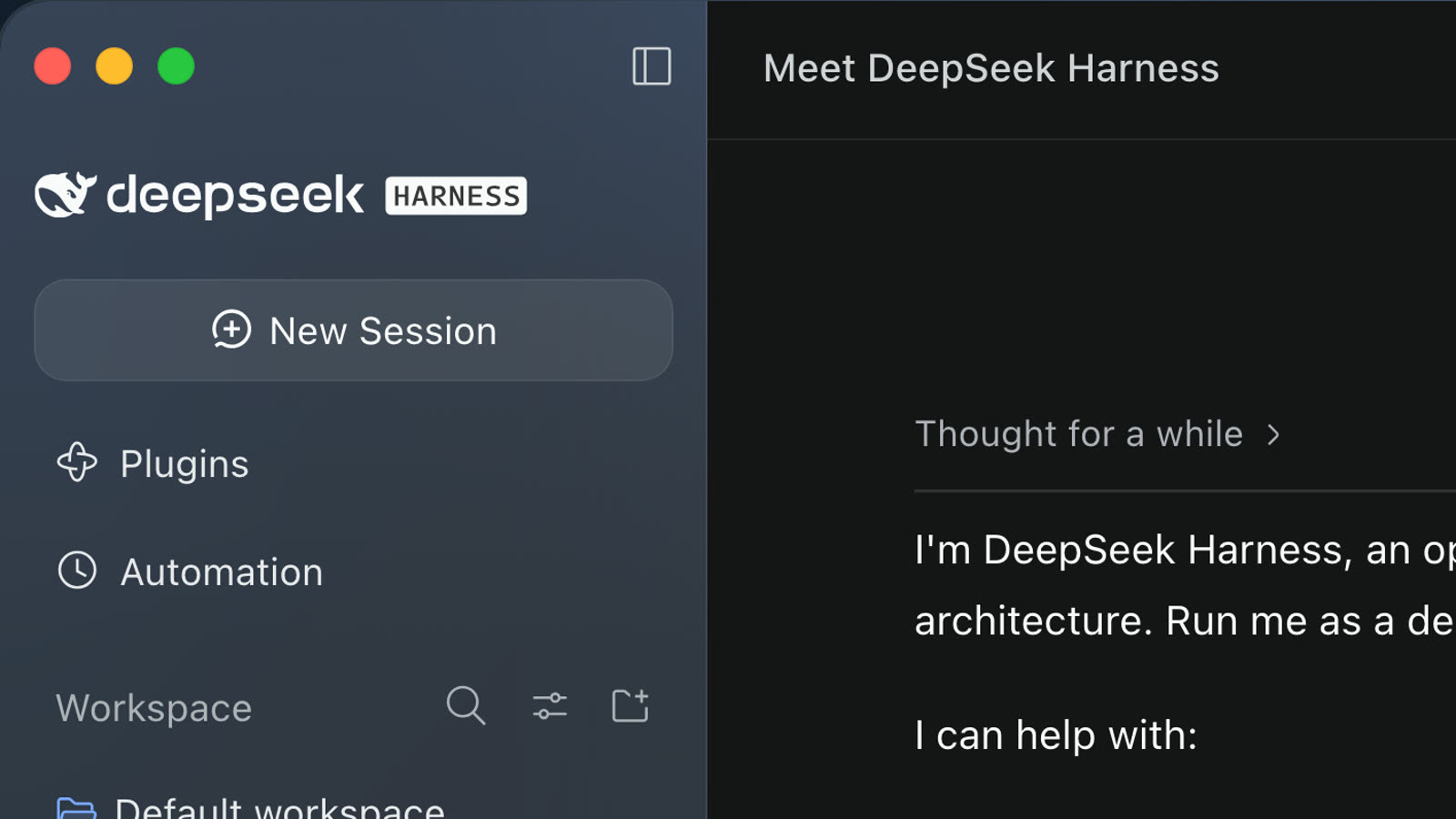
DeepSeek has released its own agent app, the same kind of tool as Claude Code: you tell it what you want, and it reads your files, writes code, runs commands and checks its own work. The app is free and open source under the MIT licence. What you pay for is the model behind it, by the token, and on DeepSeek's cheapest model a task costs a few cents.
Put in one line, it's the app around the model, and you pick and pay for the model separately.
DeepSeek shortens the name to dsh, which is also the command that starts it. The GitHub repository had 244,335 stars when I checked on 6 October 2026, less than two months after it went up on 13 August, which is why it keeps landing in my feed.
Is it the same thing as Claude Code?
It does the same job, on a different deal. Most people get Claude Code through a paid Claude plan, where Pro is $20 a month billed monthly, or $17 a month on the annual plan and the free plan doesn't include it. One flat fee covers the app and Claude's models together, though developers can also run it on an Anthropic API account and pay per token.
DeepSeek's app splits the two apart. The app costs nothing and the model is a separate bill per task. It's set up for DeepSeek's own models, and per its model configuration guide it also takes keys from Anthropic, OpenAI, Kimi from Moonshot AI and GLM from Z.ai, plus any custom endpoint that speaks the OpenAI or Anthropic format. So you're getting the workbench, and the brain is whatever model you plug in.
| Claude Code | DeepSeek's agent app | |
|---|---|---|
| Who makes it | Anthropic | DeepSeek |
| What the app costs | Included with Pro ($20/month) or Max | Free, MIT licence |
| What the model costs | Inside the plan, or per token on an Anthropic API account | Per token, billed by whichever provider you plug in |
| Which models | Claude | DeepSeek by default, plus other providers and custom endpoints |
| Where it runs | Terminal, code editors, a desktop app and the web | A web page served from your own machine, or a desktop app for macOS |
| How settled it is | A shipping product | Developer preview, with breaking changes promised |
The last row matters more than the price row, and I'll come back to it.
How do you open it with one command?
There are five steps, and only the second one is the command.
- Install Node.js, the free runtime a lot of developer tools run on. The command below doesn't work without it.
- Open Terminal and run
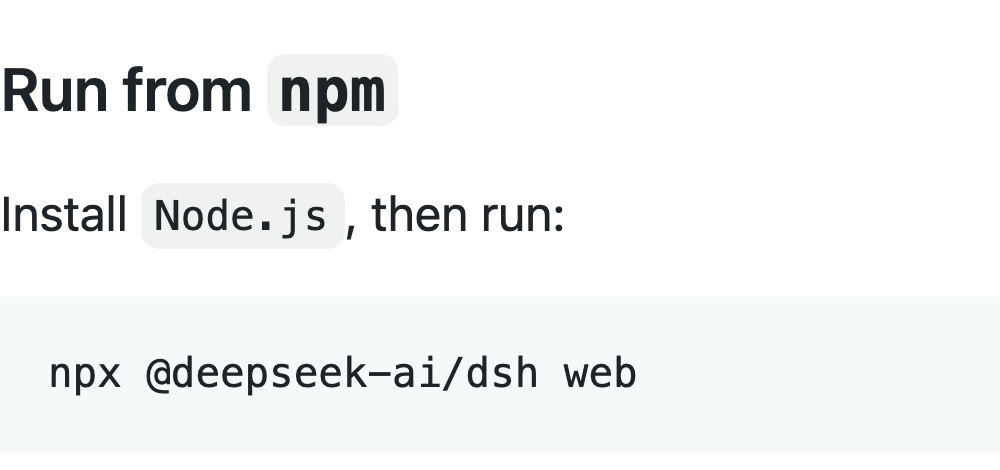
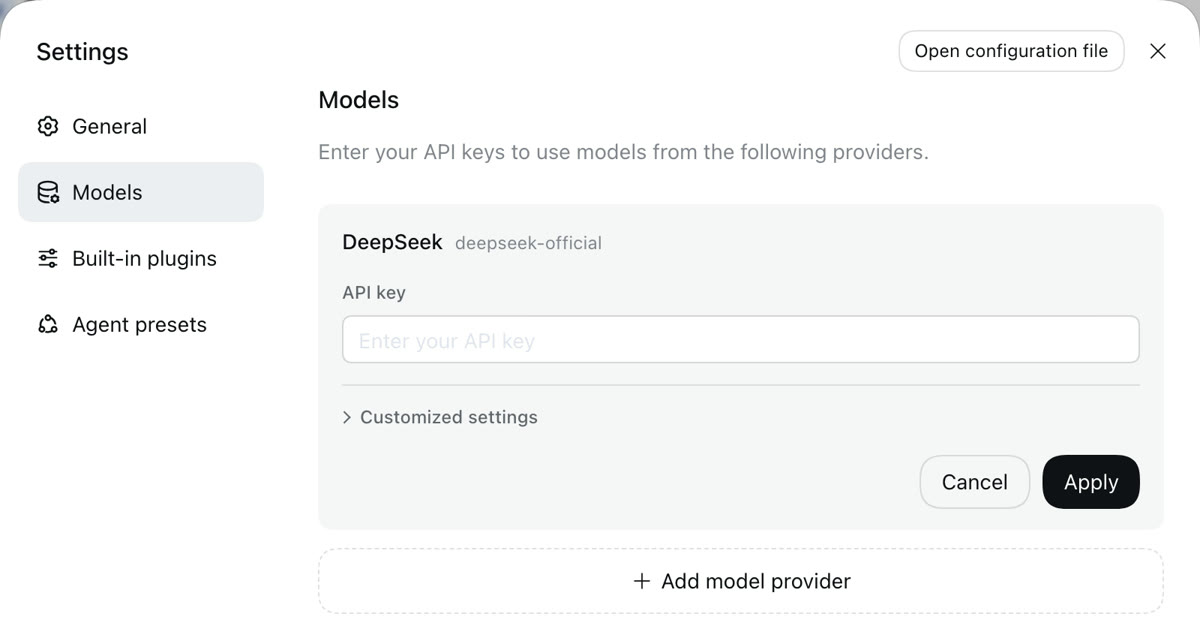
npx @deepseek-ai/dsh web. Per the README, this starts the web interface athttp://127.0.0.1:3080and opens it in your default browser. That address is your own computer, so the app itself runs locally. - In the app, go to Settings, then Models, paste a DeepSeek API key into the DeepSeek card and save. You get the key from your account on DeepSeek's developer platform, and the change applies on the next request without a restart.
- Click Choose workspace and add the folder you want it to work in. The message box stays locked until you pick one, so point it at a folder made for the job rather than your whole Documents folder.
- Start a session and type what you want done.
From there, DeepSeek's own guide says the agent "can read and edit workspace files, run commands, delegate work, and maintain a plan", and asks before anything that needs your approval. If you'd rather skip Terminal, the product page also offers a macOS desktop download.
What does it look like when it builds something?
The clearest example is DeepSeek's own demo on its product page, which is their recording rather than my machine. Someone types "Write a Pomodoro timer plugin for me." The agent loads a skill for writing plugins, writes two files, installs what it built, fixes one file, then checks the live result, and five minutes and 24 seconds later it reports "The floating Pomodoro timer is built, installed, and verified."
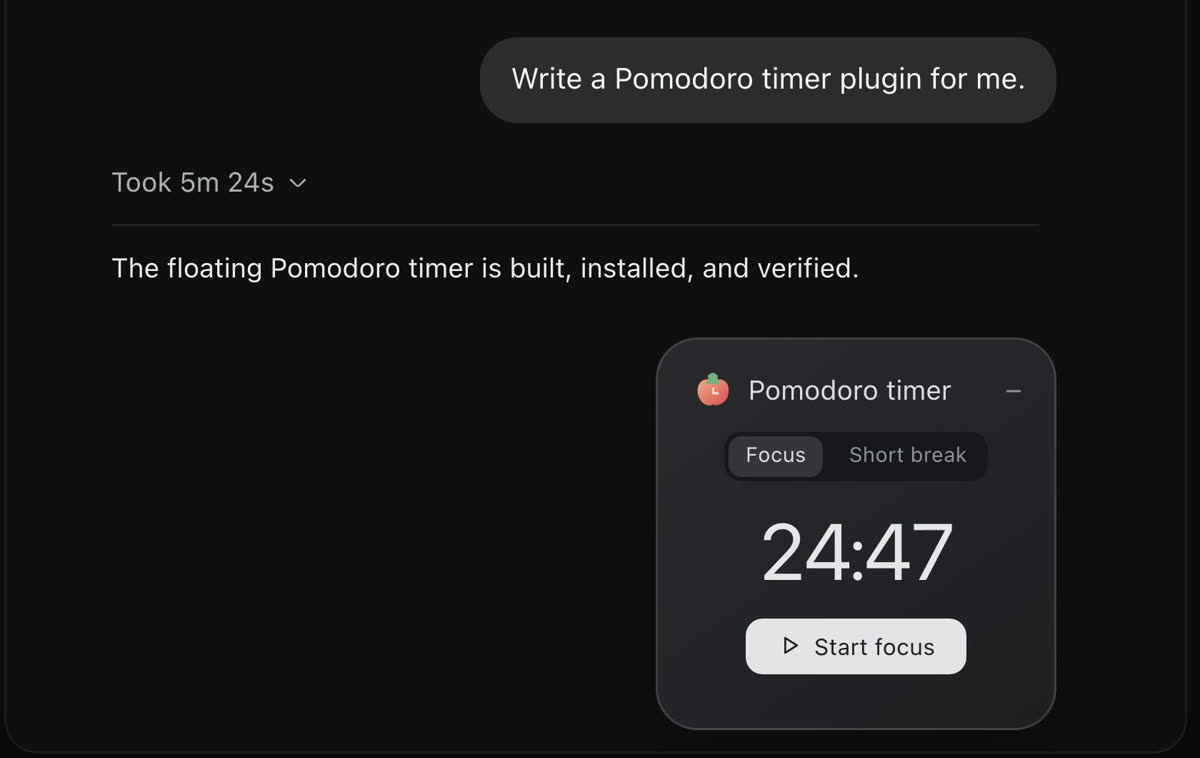
I'd pay most attention to that last check, because verifying its own work is what separates an agent from a chatbot that pastes code at you, and Anthropic describes Claude Code the same way. DeepSeek also pitches the app for office work like organising documents and analysing spreadsheets.
What does it actually cost to run?
You pay DeepSeek per million tokens, from a balance you top up in advance. The default model is deepseek-flash, and this is its row on DeepSeek's pricing page as of 6 October 2026.
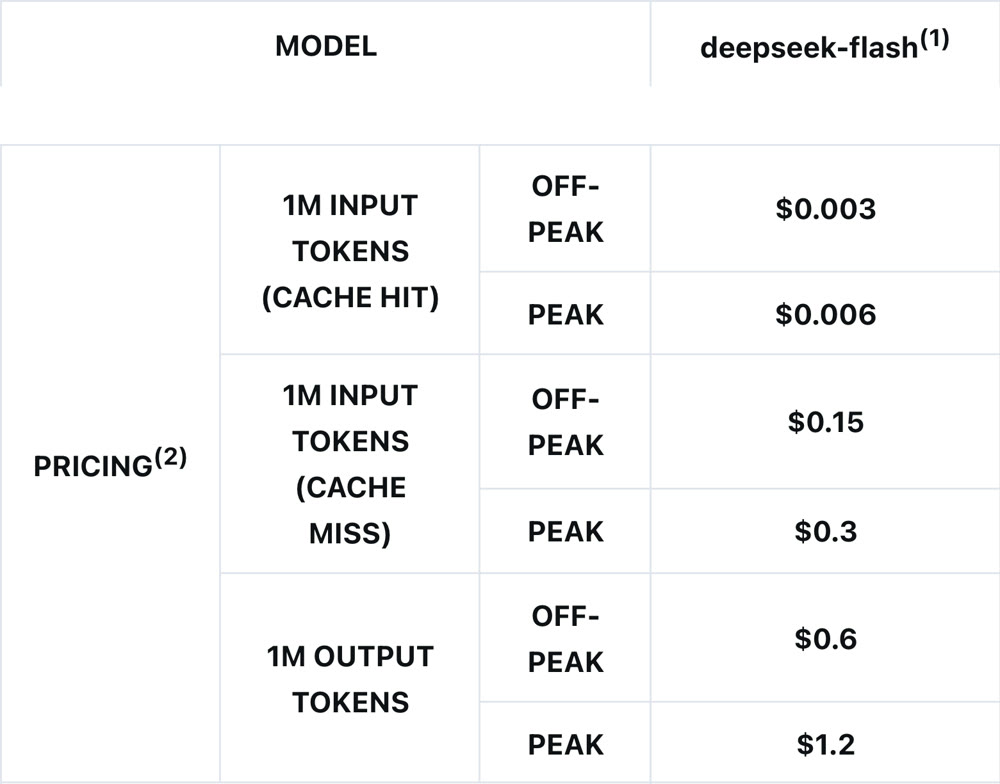
Two details change the maths. Peak hours are 01:00 to 04:00 and 06:00 to 10:00 UTC on weekdays, which in Singapore is 9am to noon and 2pm to 6pm, and peak doubles every price, so a Singapore weekday afternoon is the most expensive time to build. Going the other way, input DeepSeek has already cached, like the start of a conversation it has seen before, bills as a cache hit at one fiftieth of the fresh price.
Here's a worked example, with my own assumed token count. Say an afternoon of building sends 2 million tokens in and gets 500,000 back, which is far more than a chat would use, because an agent resends the whole conversation on every step.
- On deepseek-flash off-peak: $0.30 for the input plus $0.30 for the output, so $0.60.
- On deepseek-flash during a Singapore weekday afternoon: $1.20, roughly the price of a kopi, the hawker-centre coffee that goes for a dollar or two.
- On DeepSeek's stronger model, deepseek-v4-pro, at its off-peak rates of $0.66 in and $1.98 out: $2.31, or $4.62 at peak.
Those figures assume none of it was a cache hit, so a real afternoon should come in lower. Against a $20 Claude Pro subscription, you'd need around 16 of those peak afternoons on flash in a month before DeepSeek cost you more.
Is there a free way to run it?
There is for trying it out, and it goes through NVIDIA. The app accepts any custom endpoint that speaks the OpenAI format, and NVIDIA's API catalog hosts DeepSeek's V4.1 Flash model with a trial key you get by joining its developer program. The setup takes a few minutes:
- Sign in at NVIDIA's DeepSeek V4.1 Flash page and generate an API key.
- In the app, go to Settings, then Models, then Add model provider, and switch the card to Custom model API.
- Fill in the three values below, leave the protocol on OpenAI Chat Completions, paste the key and save.
Provider ID   nvidia
Base URL      https://integrate.api.nvidia.com/v1
Model ID      deepseek-ai/deepseek-v4.1-flash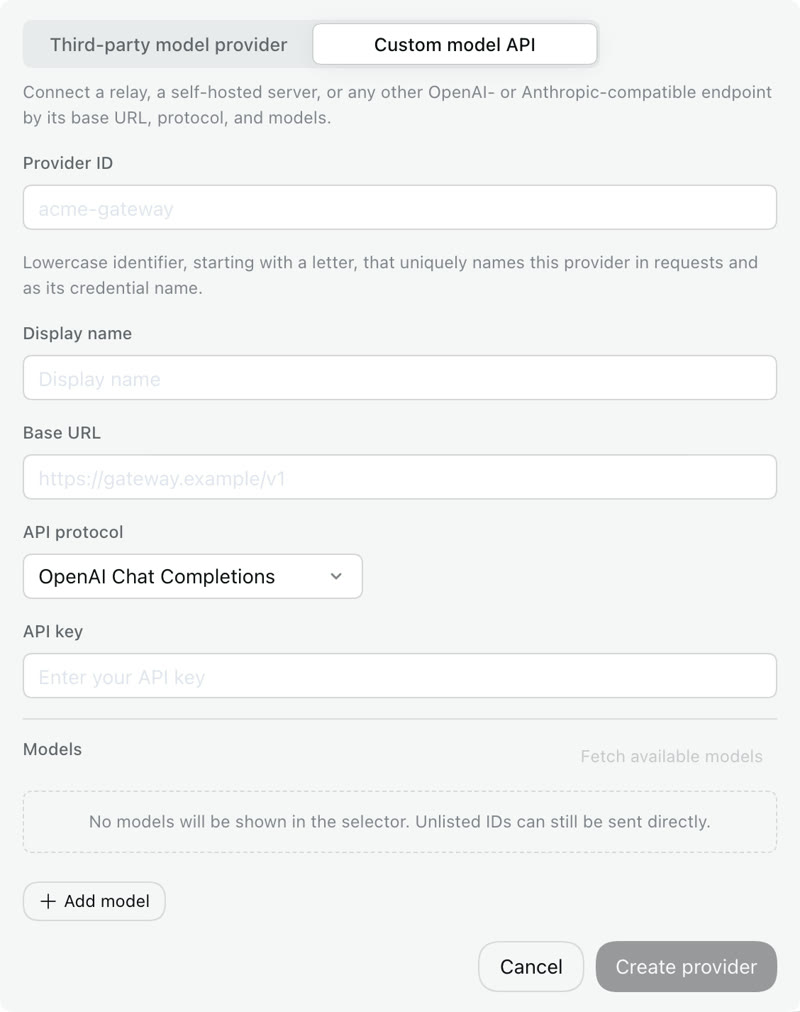
If every request gets refused even though the key is right, DeepSeek's troubleshooting notes say to start with two settings in the app's config file, supportsDeveloperRole: false and maxTokensField: max_tokens, because most OpenAI-style gateways reject at least one thing OpenAI itself accepts.
NVIDIA calls this a trial service under its API Trial Terms, sized for evaluation and prototyping, with rate limits that vary by model and by load. It's fine for seeing what the app can do, and for real work a few dollars of DeepSeek credit on flash is the cheapest route that stays dependable.
What should you check before using it on real work?
Start with the README, which says in capital letters that "THERE WILL BE COMPATIBILITY-BREAKING CHANGES." The app is in developer preview, so a setting or a workflow that works this week can stop working after an update.
The safety notice goes further. DeepSeek says the app "has not undergone a security audit and must not be treated as secure or production-ready", and because it runs model-generated commands, a bad output or an untrusted plugin may delete files or leak credentials. Their advice is least access, a disposable virtual machine or container where possible, and backups of anything it can reach, and I'd follow it to the letter.
Then there's where your data goes. The app runs on your computer, but every prompt, and whatever file contents it reads for the task, goes to the model provider you configured, which with a DeepSeek key is DeepSeek's API (on the NVIDIA route it's NVIDIA). DeepSeek's privacy policy says it stores the personal data it collects in the People's Republic of China and lists training its models among the uses, with a right to opt out. If you run a business, read that before any client file, contract or credential goes near a session.
When is it the wrong tool?
If you already pay for Claude Pro and use Claude Code every day, switching saves you $20 a month at most and swaps a settled product for one that promises to break things. It's also the wrong place for client data under contract, regulated data or your business logins, and a developer preview is a poor foundation for a process your team relies on, however cheap the tokens are.
Where it fits is a side project, a disposable folder, or a test of how much of your simpler work a cheaper model can handle, and that last one is the question I'd actually use it to answer.
FAQ
Is DeepSeek's version of Claude Code free?
The app is free and open source under the MIT licence. The model costs extra: on DeepSeek's API, deepseek-flash is $0.15 per million input tokens and $0.60 per million output tokens off-peak, doubled at peak hours.
What command opens DeepSeek's agent app in the browser?
The command is npx @deepseek-ai/dsh web, and it needs Node.js installed first. It starts the web interface at http://127.0.0.1:3080 on your own computer and opens it in your default browser.
Can I use Claude models inside DeepSeek's agent app?
Yes, Anthropic is one of the providers in the app's model settings. You add an Anthropic API key and pay Anthropic's API rates for those requests.
Where does my data go when I use DeepSeek's agent app?
To the model provider you set up, even though the app runs locally. With a DeepSeek key, prompts and the file contents the agent reads go to DeepSeek's API, and DeepSeek's privacy policy says it stores the personal data it collects in the People's Republic of China.
Is DeepSeek's agent app safe to use for business work?
Not for anything sensitive yet. DeepSeek calls it a developer preview that hasn't had a security audit and shouldn't be treated as production-ready.
My short take
What caught my attention is the split between the app and the model. Once the app is free and the model costs cents, the real question for a business owner is how much of your work is simple enough for a cheaper model to handle. My guess is more than most people think, and less than the hype says.
I'd treat this as a place to experiment rather than somewhere to run anything important, at least until it's out of preview and someone has audited it. And if you're staying on Claude, the habits that bring its bill down are in the piece on running Claude at a quarter of the price.