claude code
Claudex: The Free Skill That Has ChatGPT Check Claude's Work
Claudex Loop is a free, MIT-licensed skill that makes Claude Code and OpenAI's Codex review each other. Claude plans, Codex argues with the plan in rounds until it's approved, and whoever builds never inspects its own build. The full setup, what each side needs, and when a second model is worth paying for.
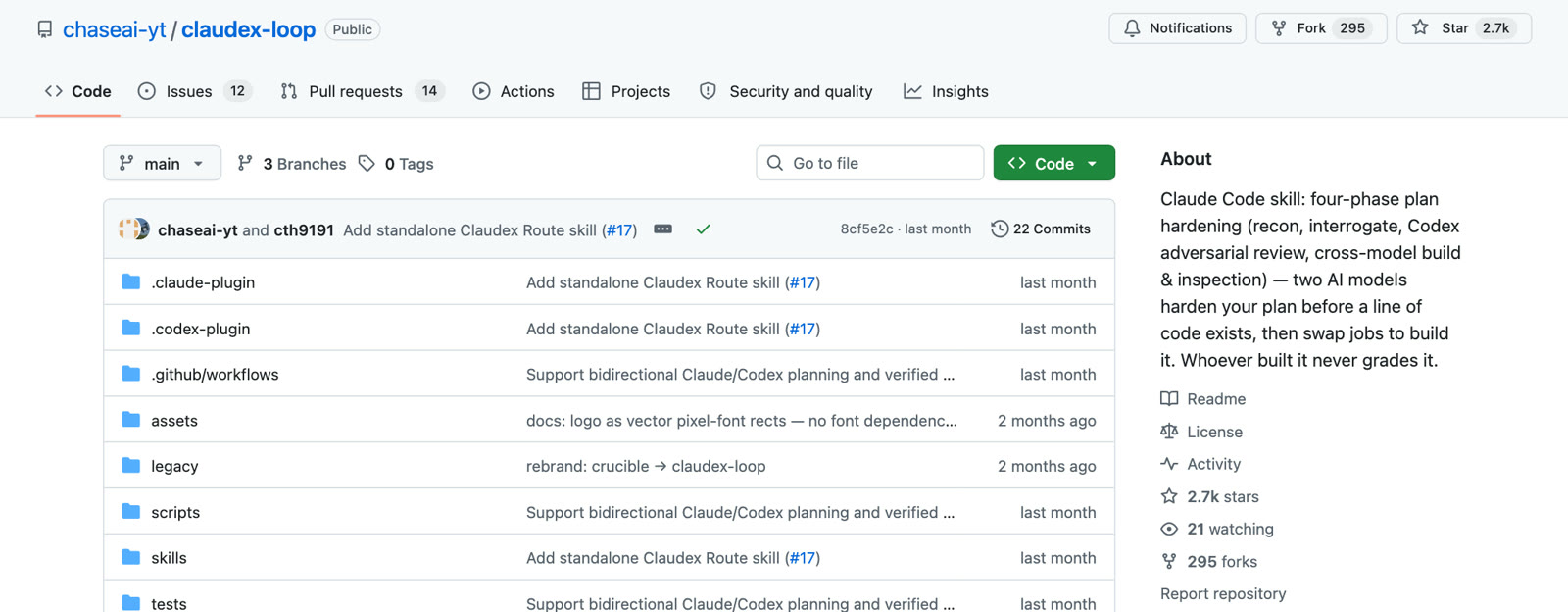
Claudex Loop is a free, open-source skill by Chase AI that gets two different AIs to check each other's work. Claude writes the plan, OpenAI's Codex reviews it and sends back findings, and the two go round by round until the reviewer approves. Then comes the build, and the rule the whole thing is built around: whoever builds the code never inspects it. It's MIT licensed, and it had 2,749 stars on GitHub when I checked on 6 October 2026.
The "ChatGPT" part needs one line of translation. The model doing the checking is Codex, OpenAI's coding agent, which you sign into with your ChatGPT account. So when people say ChatGPT checks Claude here, Codex is the thing actually running.
How I looked at this, and what I haven't done
I read the whole repository before writing this: the README, the runtime reference that explains exactly what each side is allowed to touch, and the validation record where the author logs what was actually tested. Every claim about how it behaves below comes from those files, and I link them where it matters.
I haven't run Claudex on my own work yet, so treat this as a careful read of the tool rather than a field report. What I can speak to first-hand is the idea underneath it, because the pipeline that edits my videos runs on the same rule, and I'll get to that further down.
Claudex at a glance
| Piece | What it does here | Cost | The one gotcha |
|---|---|---|---|
| Claudex Loop | Runs the plan, review, build and inspect loop | Free, MIT | It's only as useful as the plan you give it |
| Claude Code | Writes the plan, and builds by default | Needs a paid Claude plan, from US$20 a month | The free Claude plan doesn't include it |
| Codex | Reviews the plan and inspects the build | Included in every ChatGPT plan, Free upward | Usage limits rise with the plan |
| Python 3.10 or newer | Runs the small script that passes work between the two | Free | Easy to miss on an older machine |
Prices checked 6 October 2026, in US dollars.
How does the split actually work?
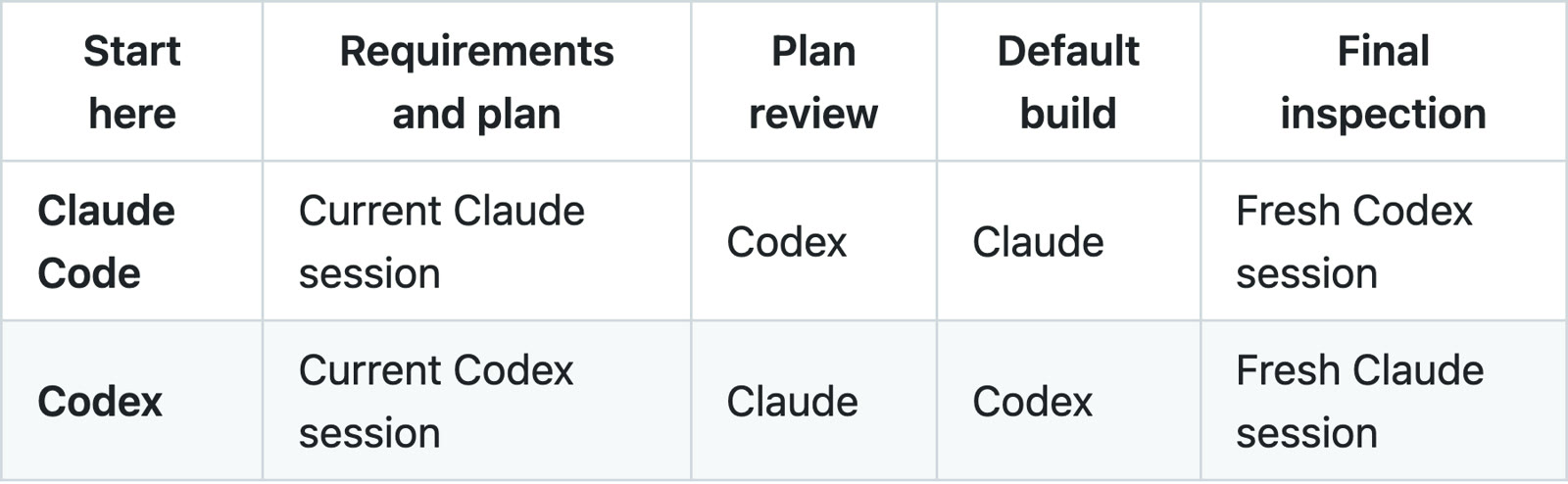
You start the loop from whichever tool you normally work in, and the README sets the roles from there. Start in Claude Code and your current Claude session writes the plan, Codex reviews it, Claude builds, and a fresh Codex session does the final inspection. Start in Codex and every role flips.
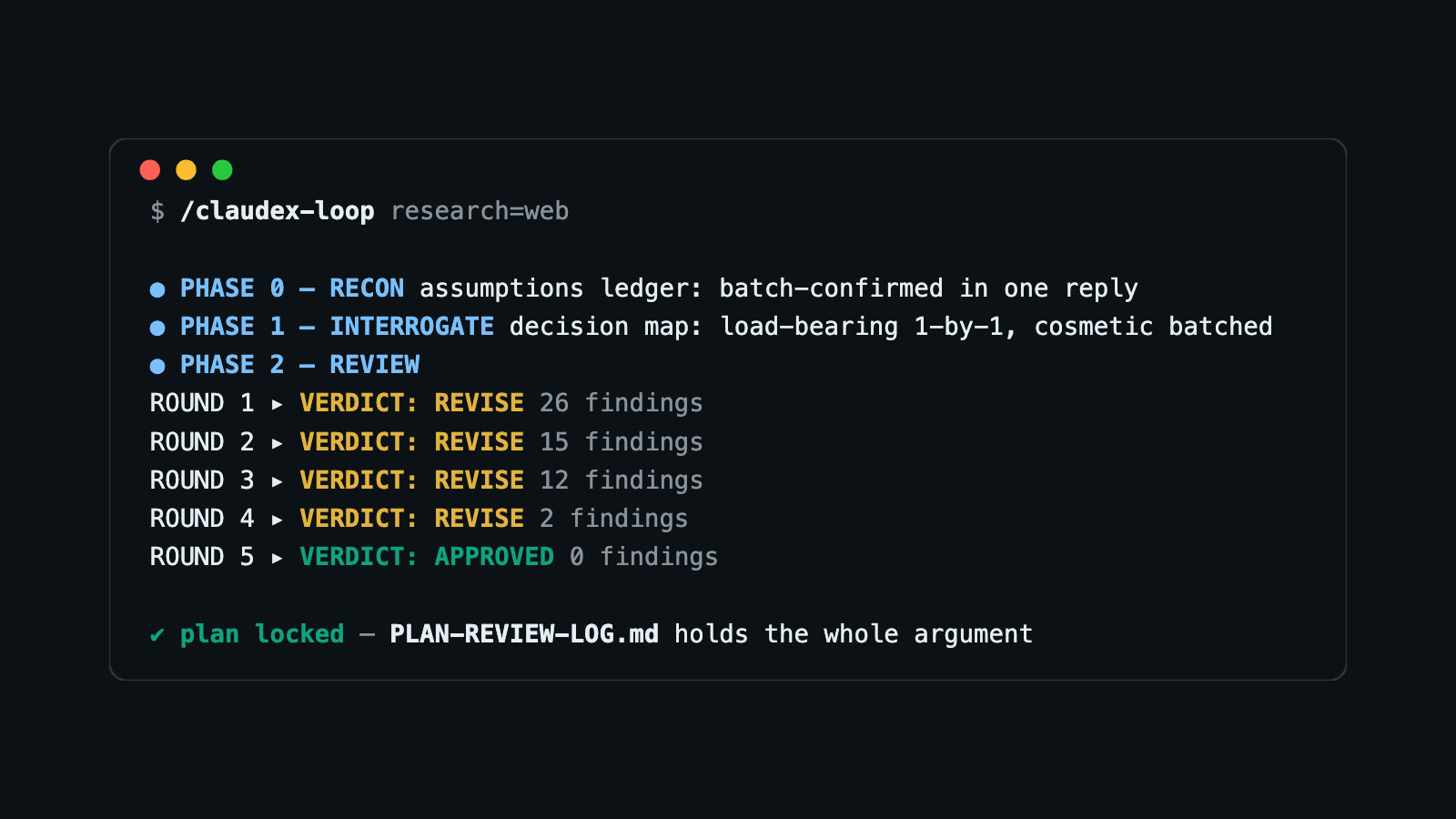
Inside that, there are four phases. First it scouts your existing code and lists its assumptions with sources. Then it settles the decisions that would change the outcome and writes a plan with checks you can actually observe. Then the other model reviews that plan, reading the relevant code as well, and returns one of three verdicts: APPROVED, REVISE or BLOCKED. Your session sorts through the findings, updates the plan and sends it back, and that repeats until it's approved or it hits the round limit, which defaults to five.
The swap works like this. Starting from Claude Code, the default is Claude building and Codex inspecting. If you'd rather have Codex build and Claude check it, you say so with builder=codex, and the inspector follows that choice and always uses the other provider. Either way the builder never grades its own build, and if your main session steps in to fix something afterwards, the README says those new edits need another independent inspection too.
The review side is locked down on purpose. Per the runtime reference, Codex reviews in a read-only sandbox, and Claude reviews with only file reading and search available, with no shell, no editing and no MCP tools, so the reviewer can report what it found but can't quietly change anything itself.
What do the review rounds look like?
The image at the top of this page is the repository's own example run. Round one came back REVISE with 26 findings, then 15, then 12, then 2, and round five was APPROVED with zero. The README describes it as the first reported end-to-end run, on a CRM plan, with 55 findings over five rounds, and it's careful to call it an illustrative run, not a controlled benchmark of which models pair best.
I like that the author says this out loud. The README also says that zero findings is a valid result and that a large number of findings is not a quality score, which is the right instinct. I'd trust a reviewer that found twenty things on every plan about as much as one that never found anything.
Two details make the approval mean something. The approval records a fingerprint of the exact plan file, so if anyone edits the plan after it was approved, the approval no longer counts. And the final inspection records which code it looked at, so later changes need a fresh inspection. Everything lands in a file called PLAN-REVIEW-LOG.md, which holds the findings, what was decided about each one and which model said what.
What do you need installed?
Two command-line tools, both signed in, plus Python. The README is explicit that Claudex itself needs no separate API keys and no extra Python packages, because it drives the two tools you already log into.
Claude Code. Anthropic's install for Mac and Linux is one line:
curl -fsSL https://claude.ai/install.sh | bashThen run claude and log in through the browser. Per Anthropic's setup page, Claude Code needs a Pro, Max, Team, Enterprise or Console account, and the free plan doesn't include it. Claude's pricing puts Pro at US$20 a month billed monthly, and Max from US$100.
Codex. OpenAI's install for Mac and Linux is also one line:
curl -fsSL https://chatgpt.com/codex/install.sh | shThen run codex and choose Sign in with ChatGPT. OpenAI says Codex is included in the ChatGPT Free, Go, Plus, Pro, Business, Edu and Enterprise plans, and Codex shares its usage allowance with the rest of ChatGPT, so the cheaper the plan, the sooner a long review loop runs into its limit. You can use an OpenAI API key instead, in which case you pay standard API rates.
Python 3.10 or newer runs the script that hands work between the two. Before you start, the README suggests confirming all of it with claude --version, claude auth status, codex --version and codex login status.
How do you set it up?
Inside Claude Code, it's two lines:
/plugin marketplace add chaseai-yt/claudex-loop
/plugin install claudex-loop@claudex-loop
Then /claudex-loop:claudex-loop starts the full workflow. If you want it inside Codex as well, the README has you clone the repo and copy the whole skills folder into both ~/.agents/skills/ and ~/.claude/skills/, then start a new session. Copy every skill folder together, because the helper commands share one runtime and copying one alias on its own won't work.
From there you just describe the job. The README's examples are a good guide to the switches:
claudex this plan, mode=review, plan=docs/migration.md, rounds=3
claudex this feature, builder=codex, reviewer_model=gpt-6-astra
The first line is the gentle way in, because it only reviews a plan you already have and builds nothing. Asking for a review doesn't authorise any building, which the README spells out.
You can also pick the models. The README suggests Claude Fable 5.1 and GPT-6 Astra where your accounts have them, or it uses whatever each tool is already set to.
What annoys me about it
It spends two allowances at once. Every round uses your Claude limit and your ChatGPT limit, and the default allows five plan rounds plus a build and up to two inspections. On a big plan that adds up on both sides, so check your usage before a long run instead of after.
The live testing is narrow. The validation record says the live model checks were run on Windows, on small deliberately broken test plans, and that the automated tests use fake versions of both tools. The author is upfront that this proves the plumbing works, and makes no claim about which model pairing catches more.
Codex's sandbox has a gap you need to know about. The read-only setting limits Codex's shell, but the runtime reference warns that it doesn't stop any MCP integrations you've already connected to Codex from writing elsewhere. If your Codex has tools that can post, send or edit, switch them off before you let it review.
Builds need a clean checkout. Delegated builds want a clean git state, so expect to commit or stash your work before it'll hand the build over.
Why I already work this way
The pipeline that edits my reels follows the same rule. Every stage is checked by something that didn't do the work. A separate pass listens to the whole cut end to end before I see it, and every render is checked against a fixed set of rules by something other than the part that built it. I walked through that whole system in every stage my AI runs to edit a video.
That check catches what the builder talked itself past, which in my experience is most of what goes wrong. An AI asked to review its own work tends to find the mistakes it already knew about. Claudex takes that one step further than I do, because its checker is a different model from a different company, and two models trained differently tend to disagree in different places.
When is a second model worth the extra cost?
My take is that it pays off when a mistake in the plan is expensive to undo later. Anything that touches customer data, payments, a database change, or a build that'll take hours is worth an argument up front, because one finding in round two can save a day of rebuilding. That's the work I'd point it at.
It's overkill for small edits, copy changes or anything you'd redo in five minutes if it came out wrong. Running five rounds of review on a button colour burns usage on two subscriptions for very little.
If you only pay for Claude, you can still try it, since Codex comes with the free ChatGPT plan, but on the free plan's limits a full five-round loop on a real feature may run out partway.
There's also a lighter tool in the same repo. Claudex Route recommends which model should handle a task and can make one handoff, such as a single second opinion on a plan, without the full loop or the Python dependency. If you just want the occasional sanity check, start there.
FAQ
Is Claudex free to use?
Yes, the Claudex Loop skill is free and MIT licensed. What you pay for is the two tools it drives: Claude Code needs a paid Claude plan, from US$20 a month for Pro, and Codex comes with any ChatGPT plan, including the free one, with higher usage limits on the paid tiers.
Does Claudex need an OpenAI or Anthropic API key?
No, Claudex needs no separate API keys. It runs Claude Code and Codex through the logins you already have, so a Claude subscription and a ChatGPT sign-in are enough. Codex can use an OpenAI API key if you prefer, billed at API rates.
Does ChatGPT write the code in Claudex, or only review Claude's work?
It depends on where you start and what you ask for. Starting from Claude Code, Codex reviews the plan and inspects the final code while Claude builds. Add builder=codex and Codex builds while Claude inspects, because the inspector is always the provider that didn't build.
How many review rounds does Claudex run?
Claudex runs up to five plan review rounds by default, stopping early when the reviewer returns APPROVED or BLOCKED. You can change the cap with the rounds setting, and after the build it allows up to two inspections and two fix attempts.
The order I'd try it in
Start with mode=review on a plan you've already written, because it builds nothing and shows you what the second model catches on your own work. If the findings are useful, run the full loop on one small, real feature with Claude building. Only then try builder=codex and see which way round suits the kind of work you do.
Even if you never install it, I'd keep the habit it's built on and have something other than the builder check the work before you call it done. If you're still putting together the basics around Claude Code, the five free tools I plug into it are the layer I'd set up before a second model.