claude
Claude at a Quarter of the Price: The Five Steps I Actually Run
Anthropic cut the price of Claude re-reading something it has already seen by 75%. These are the five moves that put you on the right side of that number, and the one thing the number does not mean.

Anthropic's most expensive model got cheaper in one specific place: Claude re-reading something it has already seen now costs $0.25 per million tokens instead of $1, a 75% cut. That's where "four times cheaper" comes from. Five habits decide whether you ever touch that price, and none of them cost anything to start.
I run all five most weeks. Below is what each one is, where it lives, and what it actually requires, because a couple of them need a paid plan and one of them isn't worth doing at all.
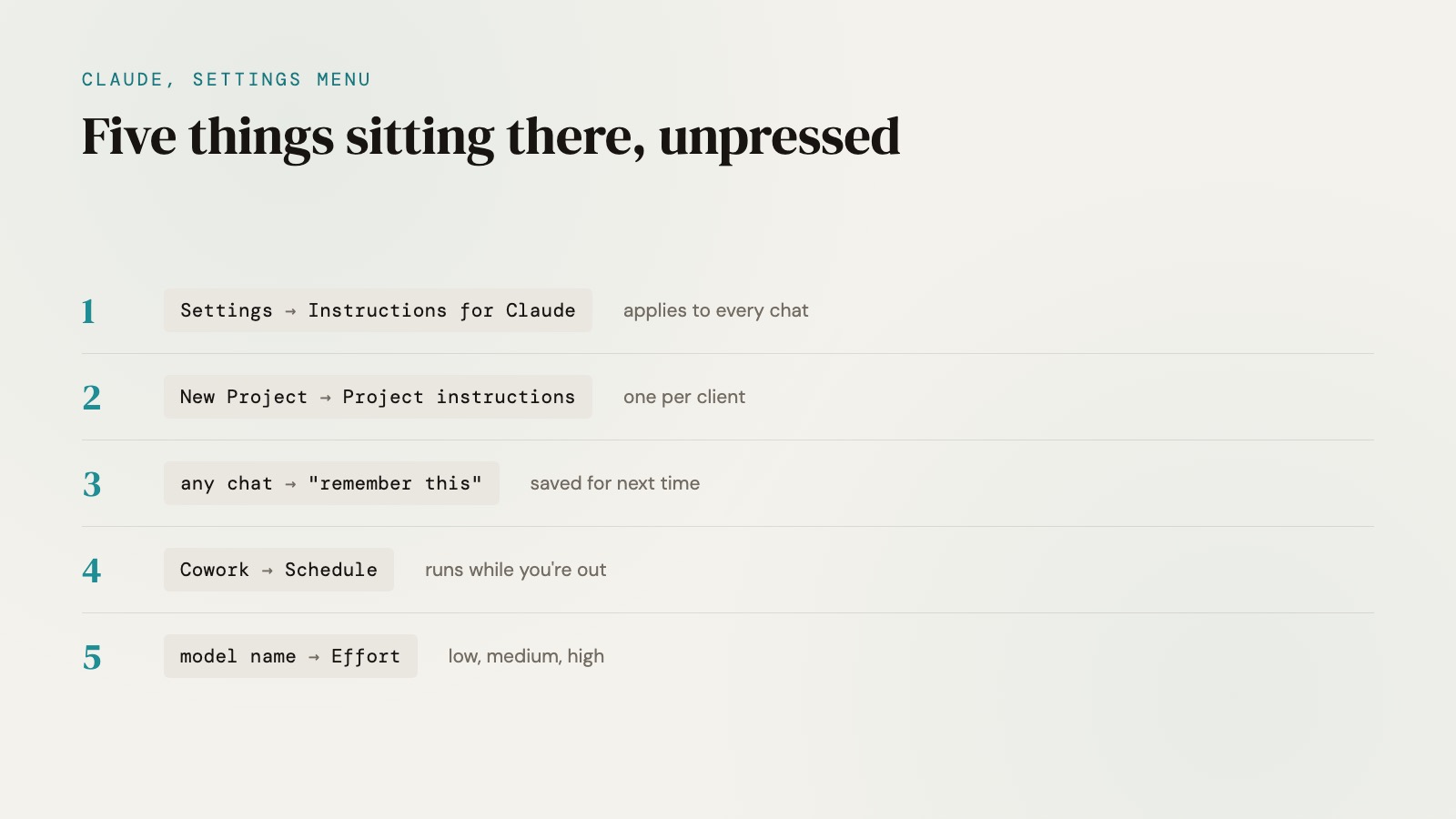
The five, in order
- Turn the effort down for everyday jobs
- Put your standing brief in a Project once
- Ask for everything you need in one message
- Tell it to check its own work before it says it's done
- Send the boring parts to Sonnet or Haiku
The order's deliberate, and it isn't a ranking of importance. It runs cheapest-to-do first: number one is a toggle you can press in about four seconds, and number five asks you to change how you pick a model, which takes a week or two to become a habit. Start at the top and you will have most of the saving before you get to the part that needs any discipline.
1. Turn the effort down for everyday jobs
Click the model name next to where you type, and Effort sits in that menu. It decides how hard Claude thinks before it answers, and it's the single biggest lever on what a message costs you.
Anthropic's own line on the lower settings is that they "work well for routine tasks and stretch your usage further", and their launch note goes further: at lower effort, Fable 5.1 "achieves results similar to or better than Fable 5's at a much lower cost." So today's cheap setting is roughly what the expensive setting was one model ago.
The rule I run is short enough to remember: low for quick jobs, high for the calls that matter. Rewriting a caption, summarising an email thread, tidying a list, none of that needs the model straining.
What it requires: nothing. It's a toggle on every plan, including free.
2. Put your standing brief in a Project once
New Project, name it, and everything you put inside stays inside. Anthropic is direct about what that does to your limits: "When you upload documents to a project, they're cached for future use. Every time you reference that content, only new/uncached portions count against your limits."
That sentence is the whole reason this list exists. Cached content is exactly the thing whose price just fell by 75%. Re-explaining your business at the top of every fresh chat is the most expensive habit most people have, and it's invisible, because it feels like typing rather than spending.
I make one Project per client. Inside it goes who they are, where their brand files sit, and the one number I never want Claude guessing at. After that I stop re-explaining anything.
What it requires: Projects sit on paid plans. If you're on free, skip to number three, which is the version of this that costs nothing.
3. Ask for everything you need in one message
Anthropic's guidance here is plain: "If you have multiple related tasks or questions, group them in a single message", and plan the conversation before you start so you are not spending messages on back and forth.
The mechanic underneath is worth understanding, because it's the same one as number two. Every message you send drags the whole conversation along with it. Ten small messages re-read that history ten times; one clear message reads it once. Being vague isn't free. It just bills later, when Claude has to come back and ask you what you meant.
So instead of "write me a caption", then "make it shorter", then "now add a hook", I write the whole brief once: what it is for, who reads it, how long, what to avoid, and give me three versions.
What it requires: nothing but a minute of thinking before you type.
4. Tell it to check its own work before it says it's done
This is one line at the end of the request: check your own work before you tell me it's done.
It works for the same reason number three does. The expensive pattern isn't Claude being wrong, it's the round trip after Claude is wrong: you read it, spot the problem, explain the problem, and it goes again with the entire conversation in tow. Asking for the check up front moves that pass inside the answer you were already paying for.
What it requires: nothing. It's a sentence.
5. Send the boring parts to Sonnet or Haiku
The published prices make this one arithmetic rather than opinion. Sonnet 5 runs at $2 per million input tokens and $10 output, Haiku 4.5 at $1 and $5, against Fable 5.1's $10 and $50. Ten times the price is worth paying for the call that needs it and wasted on the one that doesn't.
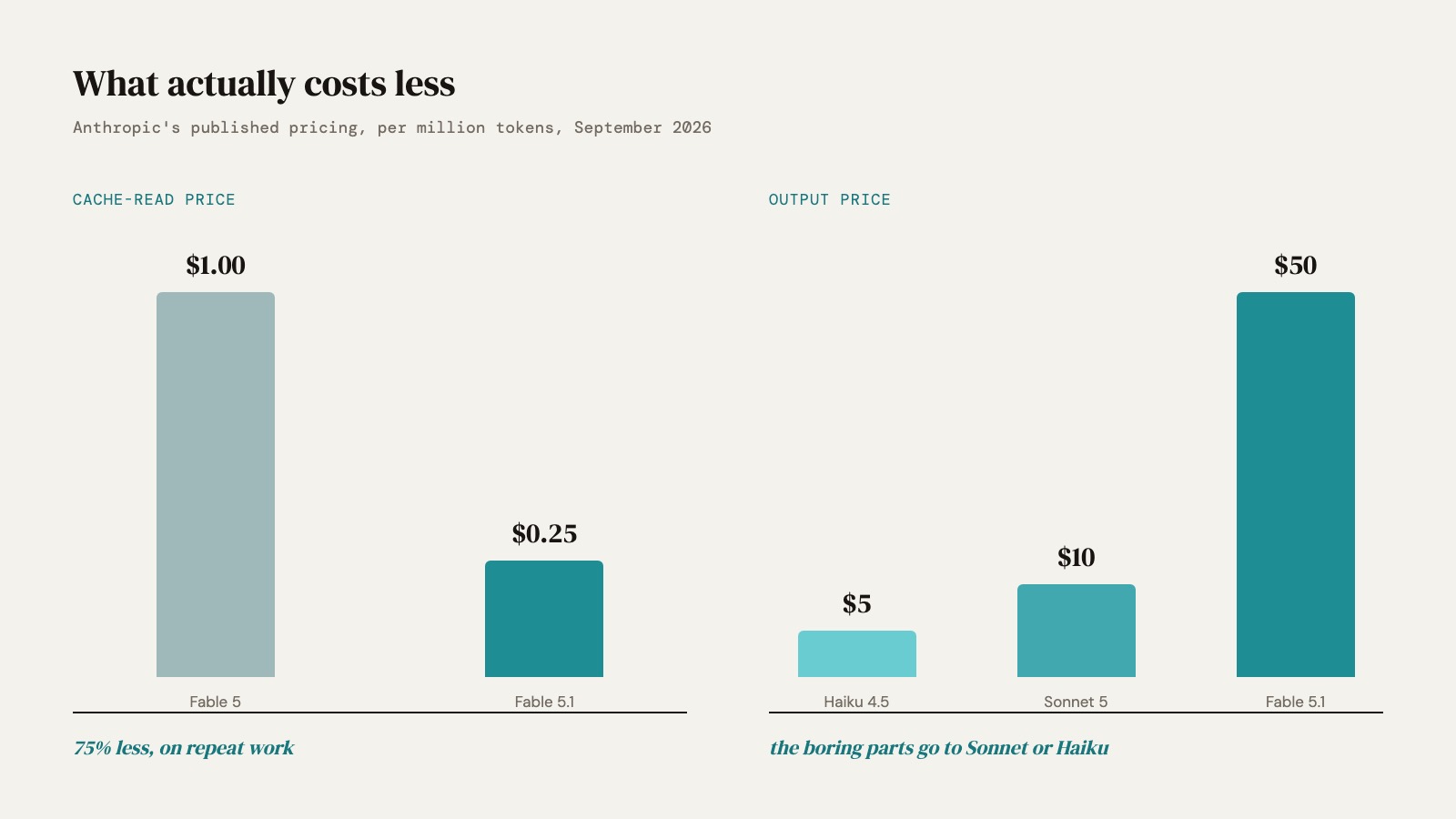
So the most capable model only touches the hardest job. Drafting, formatting, tidying, first passes, all of that goes to the cheaper ones and I genuinely cannot tell the difference in the output.
What it requires: the model picker, which sits in the same menu as the effort dial. This one takes real habit, because the reflex is to reach for the best thing every time.
The one that sounds good and isn't
Turning the effort down on everything.
It's the obvious over-correction once you learn step one, and it quietly costs you more than it saves. Anthropic's own framing is that low and medium suit routine tasks while High is the best overall balance of quality and speed, which isn't the same claim as "low is fine for everything." A hard call answered badly at low effort doesn't end there. You read it, you push back, it goes again, and you have now paid twice for the thing you were trying to get cheaply.
The saving is in matching the setting to the job, not in living at the bottom of the dial.
What "four times cheaper" does not mean
One honest catch, and it matters before you go looking for a 75% smaller bill.
The 75% cut is on cache reads specifically: the price of Claude re-reading something it has already seen. Anthropic's own figure for the whole picture is smaller and they publish it plainly. "For typical workloads, costs are reduced by around 25% relative to Fable 5", rising to "up to around 45%" on complex coding and heavily agentic tasks.
Both numbers are real. They're just measuring different things. If most of what you do is fresh work Claude has never seen, the cache price barely touches you, and 25% is your number. The five steps above are what move you from that world into the other one, where the same brief, the same files and the same Project get asked again and again.
FAQ
Why did Claude get called four times cheaper?
The price of Claude re-reading something it has already seen, a cache read, dropped from $1 to $0.25 per million tokens. That 75% cut on one specific line item is where the four-times number comes from.
Is Fable 5.1 cheaper per token than Fable 5?
No. The headline input and output prices are unchanged at $10 and $50 per million tokens. What fell is the cache-read price, from $1 to $0.25.
Which Claude effort setting should I use?
High, and move it down deliberately for routine work. Anthropic's own default is High in Claude Code and Medium on claude.ai.
Does turning Claude's effort down always save money?
No. Turning effort down on everything is the over-correction: a hard call answered badly at low effort just gets redone at a higher cost once you push back and it runs again. Matching the setting to the job is what actually saves money.
Do I need a paid Claude plan for these five habits?
No, three of the five work on every plan, including free. Projects and the model picker sit on paid plans, so the free plan still gets you most of the habit.
Keith's short take
The bit that surprised me is how much of this is just not repeating yourself. Four of the five are versions of the same idea: say it once, store it once, ask once, check once. The pricing change rewards that habit, it doesn't create it.
I also think the four-times number gets repeated as if it were the whole bill, and it isn't. I'd rather tell you 25% and have it be true than quote you 75% and have you feel lied to when the invoice arrives. The 75% is real, it's just sitting on one line item, and these five steps are how you get onto that line.
If you want the settings themselves, where each one lives and the exact lines I paste into them, that's the settings piece.