Claude
Claude Pricing in 2026: Pro, Max and Ultra, and What the Limits Actually Mean
Claude pricing starts at $0 for Free, $17 a month for Pro on annual billing, $100 a month for Max and $200 for Ultra, the plan that used to be Max 20x. Prices checked 10 November 2026, plus how the 5-hour and weekly limits work and what I see on Ultra.
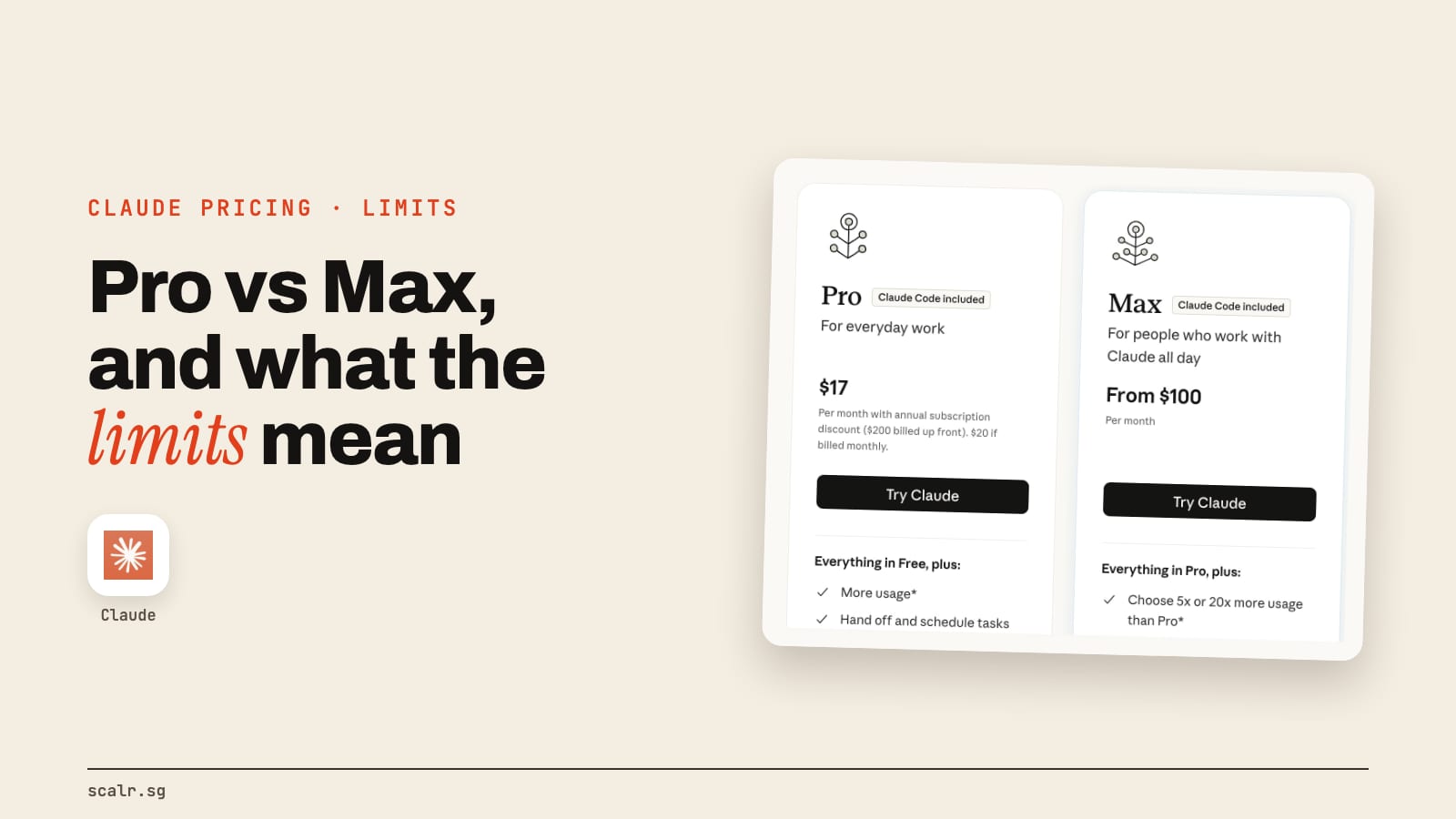
Claude costs $0 on Free, $17 a month on Pro if you pay annually ($20 monthly), $100 a month on Max and $200 a month on Ultra. Max gives five times Pro's usage every five hours and every week, and Ultra gives ten times Pro's weekly usage with no five-hour limit once your account is verified. Claude Code is included from Pro up. Prices checked 10 November 2026.
I'm on the top tier, Ultra, which was called Max 20x until Anthropic renamed it at the end of October. This guide covers what each plan costs, what the limits are, what happens when you reach one, and what my own usage looks like.
The short verdict. Start on Free to see if Claude fits how you work. Move to Pro the day you want Claude Code or find yourself waiting on resets. Move to Max when Pro's limits stop you in the middle of real work, and to Ultra only if you run Claude all day. Anthropic doesn't publish message counts for any tier, so the only way to know is to watch your own usage.
Which Claude plan should you pick?
| Plan | Price (checked 10 Nov 2026) | Usage | Claude Code | Pick it if |
|---|---|---|---|---|
| Free | $0 | Limited, every five hours and every week, Sonnet and Haiku only | No | You are testing whether Claude fits |
| Pro | $17/month annual ($200 up front), $20 monthly | More than Free, every five hours and every week | Yes | You use it daily and want Claude Code |
| Max | $100/month | 5x Pro, every five hours and every week | Yes | Pro's limits stop you mid-task |
| Ultra (was Max 20x) | $200/month | 10x Pro every week, no five-hour limit for verified accounts | Yes | You work with Claude all day |
| Team | $20 to $25/seat (Standard), $100 to $125/seat (Premium) | Premium seats get 5x Standard | Yes | A team of 2 to 150 |
Those figures come from Anthropic's pricing page, its Max plan article, which says the Max price applies to web subscriptions only, so an app-store purchase can differ, and its Ultra plan article. The pricing page also says plans and prices are subject to change, which is why every number here carries a date.
How much does Claude Pro cost?
Pro is $17 a month when you pay for the year up front ($200), or $20 if you pay monthly. That is the whole price, tax aside. Pro adds Claude Code, Projects, Opus, Research and Claude in Chrome on top of Free, and the pricing page describes its usage only as more than Free's, every five hours and every week.
If you're in Singapore, the sticker price isn't always what you pay. I wrote up how Singapore pays part of an AI subscription through UTAP and the SkillsFuture route that covers six months, and both are worth a look before you enter a card.
What do you get on Claude Max and Ultra?
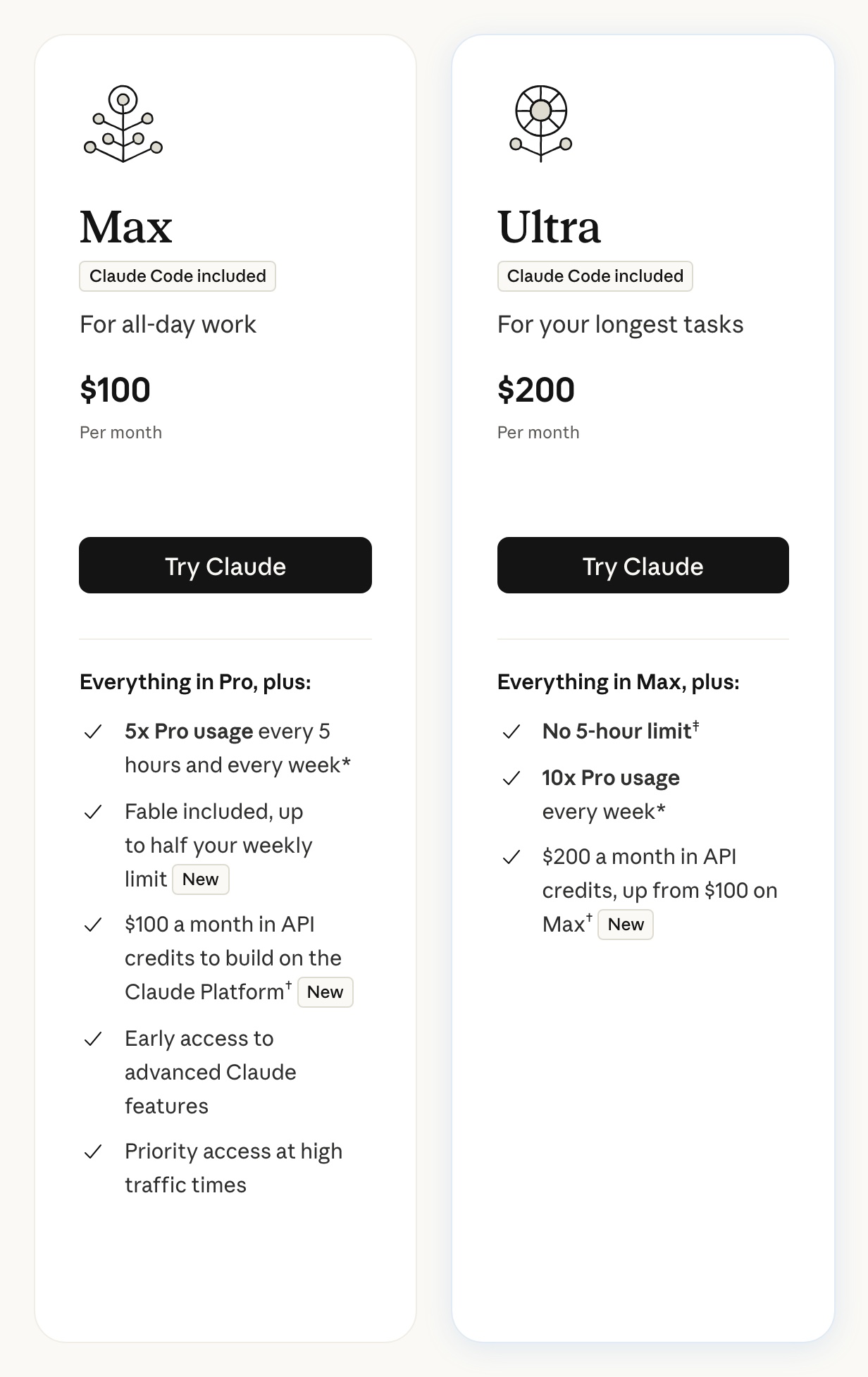
There are two plans above Pro, and both are defined against it. Max is $100 a month and gives five times Pro's usage every five hours and every week. Ultra is $200 a month and gives ten times Pro's usage every week, with no five-hour limit once your account is verified, which Anthropic says it does automatically from things like your account and payment history. Ultra is the plan that used to be called Max 20x, and existing Max 20x subscribers were moved across at the same price. Max adds early access to new features and priority at busy times, and Ultra includes everything in Max.
Two details trip people up. Max includes $100 a month in API credits and Ultra $200, but Anthropic's Claude Code article says those credits can't be spent inside Claude Code or the Claude apps, so they are for building on the Claude Platform. And Fable, the top model family, is included on Max and Ultra up to half your weekly limit, with a separate weekly Fable limit, while on Pro it's paid with usage credits.
Claude Pro vs Max: which one do you need?
Pro is enough until a limit stops you in the middle of a job, and Max is for the people who keep hitting it. That sounds obvious, so here is the useful part: nobody can tell you the crossover in messages, because Anthropic gives multipliers and not counts. What moves you across it is the kind of work. A chat question costs very little. A Claude Code session that reads a project, edits files and runs tests sends the whole conversation with every step, and uses far more of the same allowance.
So the honest rule is to run Pro for a week, open your usage, and see how often you were told to wait. If it's never, stay. If it's twice a day, Max pays for itself in recovered hours.
How much does Claude Code cost?
There's no separate Claude Code subscription. Claude Code comes with Pro, Max and Ultra, and its usage draws from the same pool as chat on claude.ai and Claude Desktop. Free doesn't include it. Team and Enterprise seats include it too.
The cost question gets a different answer if you pay by the token instead. Anthropic's own cost guide says that across enterprise deployments the average is around $13 per developer per active day and $150 to $250 per developer per month, with 90% of users under $30 a day. That is API-rate spending, and it shows why a flat $20 or $100 plan is the better deal for a heavy individual user.
One trap is worth knowing. If an ANTHROPIC_API_KEY is set in your environment, the same article says Claude Code will use that key instead of your subscription, and you will be billed per token. If a bill surprises you, check that first.
How much does the Claude API cost?
The API is priced per million tokens, separately from any plan. These are the current rates on Anthropic's pricing page, checked 28 October 2026:
| Model | Input | Output | Cache read |
|---|---|---|---|
| Claude Fable 5.1 | $10 | $50 | $0.25 |
| Claude Opus 5.5 | $4 | $20 | $0.20 |
| Claude Sonnet 5.5 | $2 | $10 | $0.10 |
| Claude Haiku 5.5 (prompts up to 100K tokens) | $0.10 | $0.50 | $0.01 |
Prices are dollars per million tokens. The Batch API takes 50% off both input and output for work that can wait. The spread is the point: Fable costs a hundred times what Haiku does per input token, which is why picking the right model matters more than picking the right plan. I went through that gap when Fable 5 launched.
How do the 5-hour and weekly limits work?
Paid plans have a session limit that resets every five hours and a separate weekly limit. Ultra is the exception: a verified Ultra account has only the weekly limit. On Max, the weekly limit resets at a fixed time each week assigned to your account, not on a calendar Monday, and you can see the next reset in Settings, then Usage.
Three things decide how fast you burn through either one, per Anthropic's help article: which model you choose, the effort level you set, and how long the conversation is. Heavier models and higher effort draw more, longer conversations draw more, and tools and connectors are described as token-intensive. Everything shares one pool across claude.ai, Claude Desktop and Claude Code.
That last part matters for anyone who uses all three. A long Claude Code session in the morning leaves less for chat in the afternoon.
What happens when you hit the Claude limit?
You can wait for the reset, upgrade, or turn on usage credits. Anthropic's wording is that you can wait for it to reset or upgrade your plan, and an upgrade applies immediately. Usage credits, also called extra usage, let you carry on at standard API rates, billed as separate charges, with a monthly spend limit you set yourself. You switch them on in Settings, then Usage, on the web.
In Claude Code, if you hit the five-hour limit mid-response, it may show "Usage limit reached · wrapping up" to finish the current step. That allowance is small, counts toward your weekly limit, and on Pro applies up to once per weekly period. A message that names a model, such as "You've hit your Opus limit", is different from the all-models messages: Anthropic's cost guide says switching to a model outside that family with /model keeps you working.
If you'd rather not pay Anthropic more, running Claude Code against DeepSeek is the free route I covered, and it's a real fallback, with a real quality gap.
How do you check your Claude usage?
In the web app, go to Settings, then Usage. It shows your limits and your next reset. In Claude Code, run /usage: on a paid plan it shows plan usage bars plus a breakdown of what is eating your allowance, with recommendations such as trimming a long CLAUDE.md or lowering the effort. Anthropic's Claude Code plan article also points to /status for remaining allocation. The /usage figures come from local session history, so use from other devices or claude.ai isn't included in them.
The session cost line at the top of /usage is an API-rate estimate. For a subscriber it isn't a bill, which is the same idea behind the numbers in the next section.
What does heavy Claude use look like on Ultra?
On the top plan, Max 20x until it became Ultra, my usage over the last three full months came to $2,172 in August, $4,735 in September and $4,630 in October (to the 28th) at Anthropic's list prices. That's about $3,850 a month on average, against a plan that costs $200. Those are notional dollars, what the tokens would cost through the API. They aren't money I paid. I pay the flat plan fee.
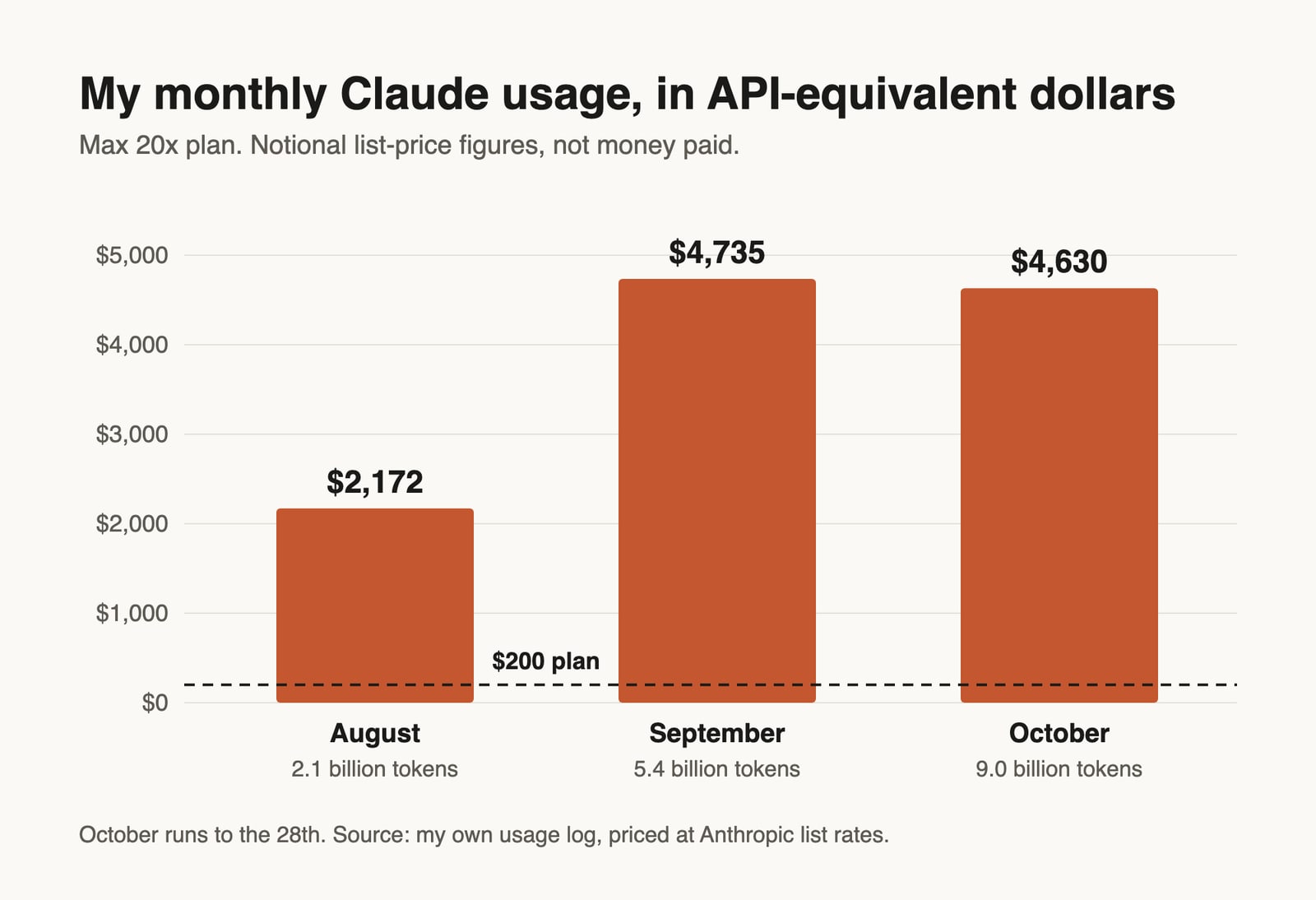
In tokens, that's 2.1 billion in August, 5.4 billion in September and 9.0 billion in October. Across everything my usage log holds, it's at least 17.5 billion tokens, about $12,700 at list prices. Most of that volume is cache reads, Claude re-reading context it has already seen.
The weekly ceiling isn't a fixed dollar figure either. I once measured it at about $1,400 of API-equivalent usage with the open-source ccusage tool, and several weeks since have run well past that. So I treat it as a trend line, not a wall, and /usage stays the only number that matters. Anthropic publishes no token or hour figures for any plan, and the ceiling can move.
It has moved once already. A temporary +50% weekly boost ended on 19 July, and the baseline dropped by about a third. That was a promotion ending, not a fault.
Almost all of it runs on Opus, and that's deliberate. Sonnet would stretch the plan further, but for my work it's slower and not as sharp, and on Ultra Opus 5.5 fits inside my limits. From August to October, Sonnet was 2% or less of my usage each month, and Opus and Fable were the rest.
How do you make a Claude plan last longer?
Pick the model and the effort for the job, and clear the conversation when the topic changes. Anthropic's own advice is that Sonnet handles most coding tasks and costs less than Opus, so if you keep hitting limits, Sonnet is the first lever. I don't pull it, because Opus is the smarter model and it fits my plan, so the dials I use are effort and /clear. Clearing between unrelated tasks stops stale context being re-sent on every message.
The clearing habit matters more than it looks. Across my usage, cache reads are about 96% of token volume, which means most of my spend is Claude re-reading history it has already seen. A conversation left open for days keeps paying that toll on every turn.
I put the cheaper-everyday-use steps in a separate piece, five habits that cut what a message costs: lower the effort, keep a standing brief in a Project, batch your asks, ask Claude to check its own work, and send boring jobs to a cheaper model. If you want to see what you pay when Claude re-reads a long file, that's the one to read next.
Where do the plans overlap?
Most of what you get is the same on every paid tier. Pro, Max and Ultra share the same apps, the same Claude Code and a weekly limit. Max and Ultra differ from Pro in how much room you have, in Fable and API credits being included, and in priority at busy times, and Ultra also drops the five-hour limit. Team changes who manages it: central billing, SSO, and pooled API credits, with Premium seats at five times Standard.
Because of that overlap, the useful comparison between plans is how much real work you can get through before the weekly limit stops you, more than the sticker price.
Which Claude plan is right for you?
Pick Free when you are still deciding. Pick Pro when you use Claude most days or want Claude Code, since $17 on annual billing is the cheapest way in. Pick Max when Pro makes you stop mid-job more than once a week. Pick Ultra when you run long agent sessions all day and the five-hour reset is the thing slowing you down, since a verified Ultra account doesn't have one. Run Pro and add usage credits when your heavy weeks are rare, because paying for Ultra all year to cover three busy weeks is a poor trade. Move to Team when two or more people need to share billing.
And if you're nowhere near a limit, you're on the right plan. That's about as far as I've got with it, and I'd still say the model you point Claude at matters more to your usage than the plan.
Key takeaways
- Claude plans checked 10 November 2026: Free $0, Pro $17 a month annual or $20 monthly, Max $100, Ultra $200. Ultra is the plan that used to be Max 20x.
- Claude Code has no plan of its own. It is included from Pro up and shares one usage pool with chat.
- Every paid plan has a weekly limit, and all but a verified Ultra account also have a five-hour limit. Anthropic publishes multipliers, not message counts.
- At a limit you can wait, upgrade, or turn on usage credits billed at API rates.
- At list prices my usage averages about $3,850 a month on a $200 plan, almost all of it on Opus by choice.
FAQ
How much does Claude Pro cost per month?
Claude Pro costs $17 a month if you pay annually ($200 billed up front) and $20 a month if you pay monthly, as shown on Anthropic's pricing page on 10 November 2026. It includes Claude Code, Projects, Opus and Research, and more usage than Free every five hours and every week.
Is Claude Code included in Claude Pro?
Yes, Claude Code is included in Pro, Max and Ultra, and it shares one usage pool with Claude chat and Claude Desktop. The Free plan doesn't include it. If an ANTHROPIC_API_KEY is set in your environment, Claude Code uses that key and bills per token instead of using your plan.
How much is Claude Max, and is it worth it over Pro?
Claude Max costs $100 a month for five times Pro's usage, every five hours and every week. It is worth it when Pro's limits stop you in the middle of real work more than about once a week. Anthropic publishes multipliers and not message counts, so run Pro for a week and watch your usage first.
What happened to Claude Max 20x?
Anthropic renamed it Ultra at the end of October 2026. It still costs $200 a month, and existing Max 20x subscribers were moved across automatically. Ultra lists ten times Pro's usage every week and has no five-hour limit for verified accounts, and the $100 plan is now simply called Max.
What happens when you hit your Claude usage limit?
You can wait for the five-hour or weekly reset, upgrade your plan, or turn on usage credits to keep going at standard API rates. An upgrade applies immediately. In Claude Code, a small wrap-up allowance may finish the current step first, and it counts toward your weekly limit.
How do I check my Claude usage?
In the Claude app, open Settings, then Usage, to see your limits and next reset. In Claude Code, run /usage for plan usage bars and a breakdown of what is using your allowance. Anthropic's help article also names /status for remaining allocation.