AI tools
MiroFish: The Free Tool That Simulates Your Launch
MiroFish is a free, open-source tool that builds a crowd of AI characters to react to a launch post, a new price or an ad before you publish it. Here is what it actually does, the real setup steps, and the one catch.
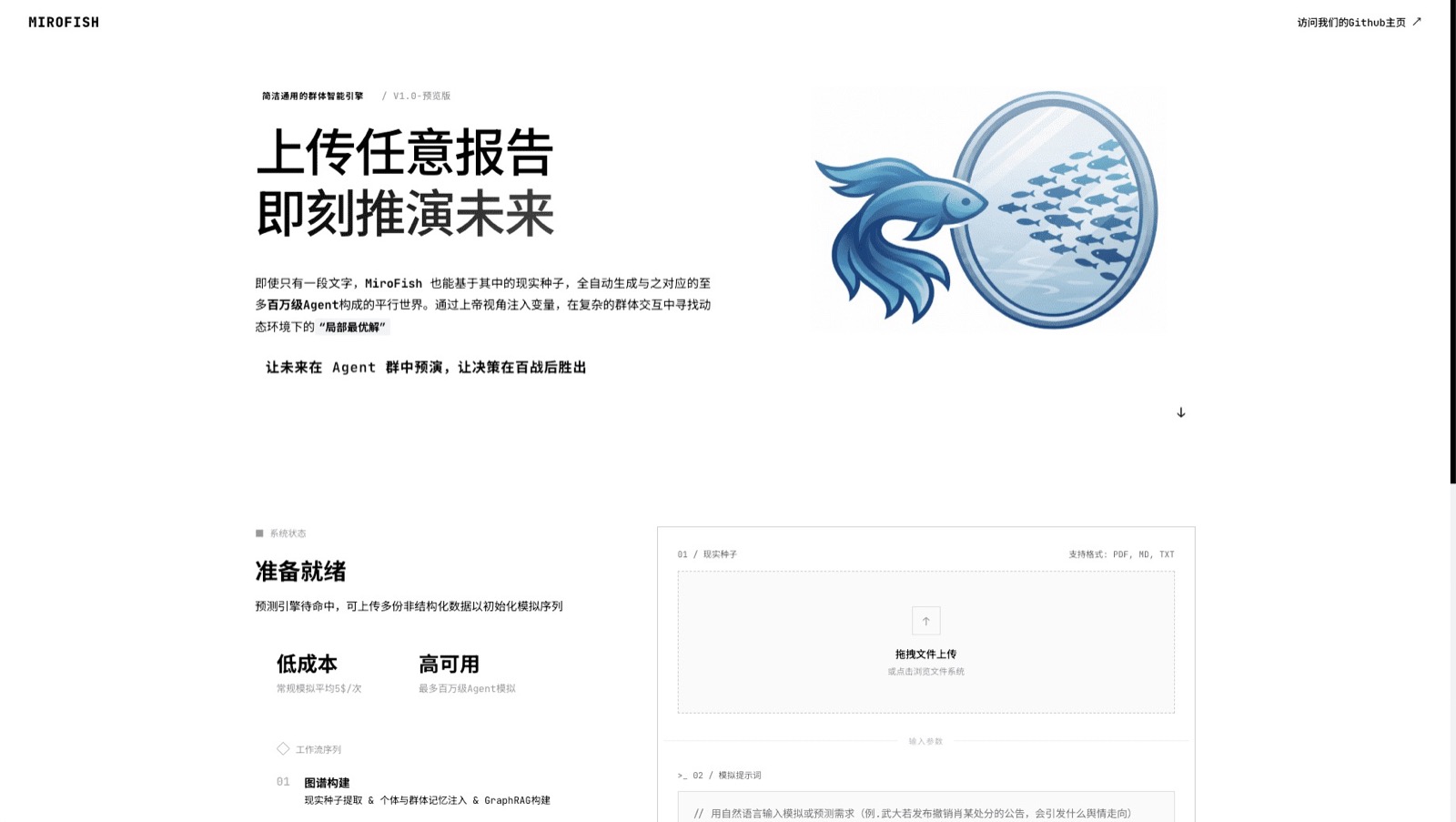
MiroFish is a free tool that builds a crowd of AI characters, each with a different background, and lets them react to something you give it: a launch post, a price change, an ad. They argue with each other the way a real crowd would, and the tool reports back what it thinks happens next.
Here's the one-line version, worth remembering on its own.
MiroFish takes something you're about to publish, spins up a swarm of AI personas to argue over it, and hands you back a written prediction of how a real crowd would react.
It's free to run yourself, it's backed by Shanda Group, and as of 8 September 2026 it has just passed 72,000 stars on GitHub, less than a year after the repo went up on 26 November 2025.
What MiroFish is not
It helps to say what this is not before anything else, because the name invites the wrong comparison.
It's not a focus group. Nobody real is in the room. Every "person" reacting to your post is a generated character with its own persona, memory and behaviour, and none of them are answering a survey question. They're simulating a social feed arguing with itself.
It's not a single opinion from a chatbot either. Ask ChatGPT whether people will like your ad and you get one voice giving you its best guess in one reply. MiroFish runs the same question through a simulated crowd instead, agents with different backgrounds who interact, change their minds and pile on, the way an actual comment section does over hours, not seconds.
And it's not A/B testing. A/B testing tells you what real people did after you already spent the ad budget or already posted. MiroFish runs before any of that, on a fake crowd instead of a real one, which is both its whole value and its whole limit. Keep that trade in mind for the rest of this.
How does MiroFish actually work?
Strip away the interface and it's three moves, in order.
First, you give it the material. Not just a sentence, the actual thing: your launch post as written, the new price sheet, the ad copy, even a long report if that's what you're testing. The README calls this the "seed", and it accepts a PDF, a Markdown file or plain text.
Then you tell it what you want to know, in ordinary language: will people share it, will they actually buy in, will investors read the funding news and get nervous. You're not writing code, you're typing the same question you would ask a colleague.
Third, it goes to work building what its own documentation calls a "high-fidelity parallel digital world." That's not marketing filler, it's a literal description of what happens next: MiroFish generates thousands of agents with independent personalities, long-term memory and behavioural logic who freely interact and undergo social evolution once your material drops into their world, exactly as the README puts it. You can watch this happen. Agents get built out as named personas, a tech journalist, an investor, a government body, a rival founder, each seeded with its own take, and the simulation runs forward in rounds, agents posting, reacting to each other and changing their minds, the way an actual feed does after something real gets published.
The simulation engine underneath isn't built from scratch either. It runs on OASIS, an open multi-agent framework from the CAMEL-AI research group, which is a decent sign this is not a weekend project dressed up as a product.
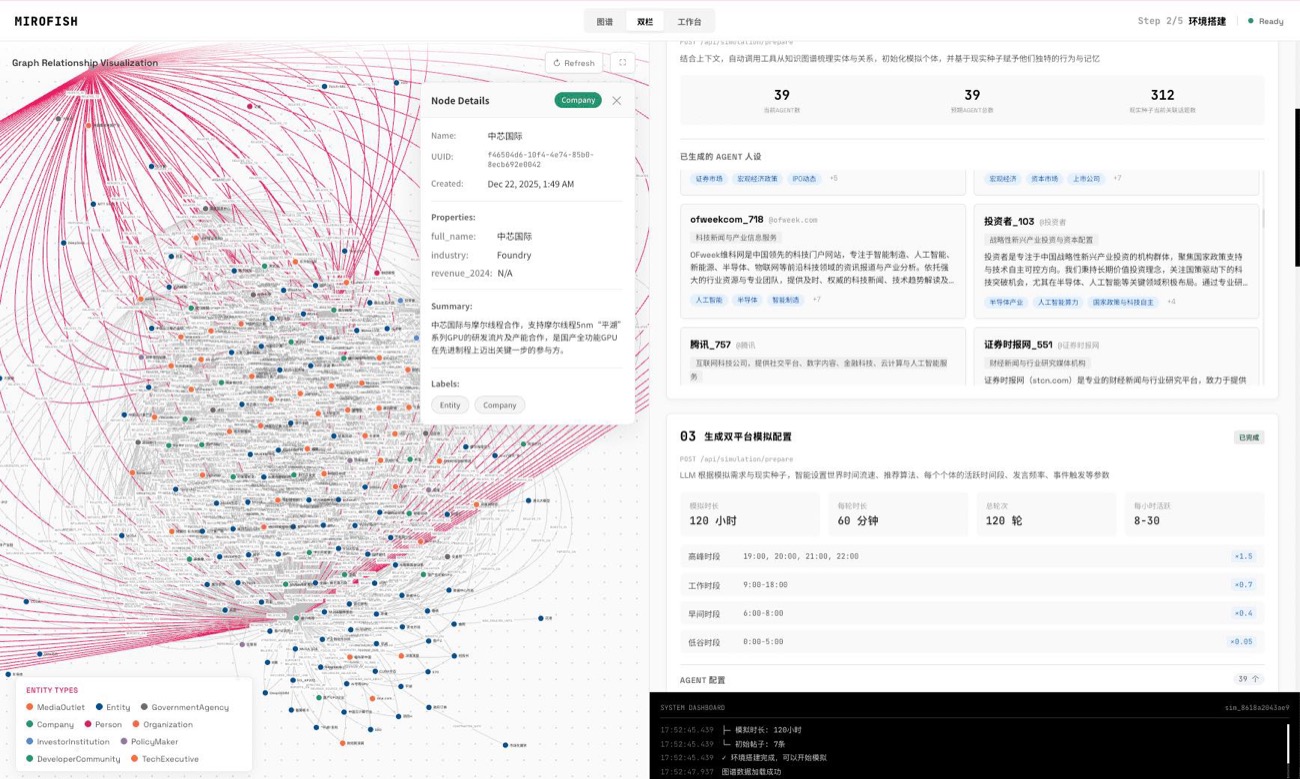
When the rounds finish, MiroFish writes it up. You get a full prediction report in plain language, plus, and this is the part most tools like it skip, a live version of the simulated world you can keep interrogating. You can open a chat with any individual agent it invented and ask it directly why it reacted the way it did.
What do you actually need to run it?
This is the part the reel called the catch, and it deserves the actual detail rather than just the word "technical."
MiroFish is source code you run yourself rather than a website you log into, either straight on your machine or in Docker. Either way, before you touch it, this needs to already be installed:
| You need | Version | What it does |
|---|---|---|
| Node.js | 18 or newer | Runs the frontend |
| Python | 3.11 to 3.12 | Runs the backend |
| uv | the latest release | Installs the Python side |
From there the setup itself is short:
- Copy the example config.
cp .env.example .env, then open that file. - Fill in an LLM key. MiroFish's own docs recommend Alibaba's Qwen-plus model through the Bailian platform, and they are blunt about the cost: "high consumption, try simulations with fewer than 40 rounds first." MiroFish's own landing page puts a typical run at around $5.
- Fill in a Zep key. This one handles the agents' memory, through Zep Cloud, and the free monthly quota covers ordinary use.
- Install everything in one line.
npm run setup:allpulls in the root, frontend and backend dependencies together. - Start it.
npm run devruns both halves at once, the frontend on your ownlocalhost:3000and the backend onlocalhost:5001.
Docker users can skip most of that: fill in the same .env file, then docker compose up -d.
So the honest version of "one catch" is really two catches. It needs a machine you're willing to install real developer tools on, and it needs an LLM key you're paying for by the run, not a flat subscription. One more thing worth flagging if licensing matters to you: it ships under the AGPL-3.0 licence, free to run and modify, though the copyleft terms matter if you ever build a commercial product on top of it rather than just testing your own launch.
If you just want to see it work before deciding any of that is worth your time, there's a hosted demo online that needs nothing installed at all.
What has MiroFish actually simulated?
The project's own demo videos are a decent sense check on what "simulate anything" means in practice, because they are not both the same kind of case.
One runs a real public-opinion report about a Wuhan University story through the system and predicts how it spreads. The other is stranger and, honestly, more fun. It feeds MiroFish the first eighty chapters of Dream of the Red Chamber, the classical Chinese novel that was never finished, and asks it to work out the missing ending. The team also lists financial forecasting and political-news prediction as declared use cases, with more demos marked "coming soon" in their own README.
The screenshot below is from a third run, closer to an actual launch decision than either of those: a simulation of how the market reacts to a chip company's funding news.
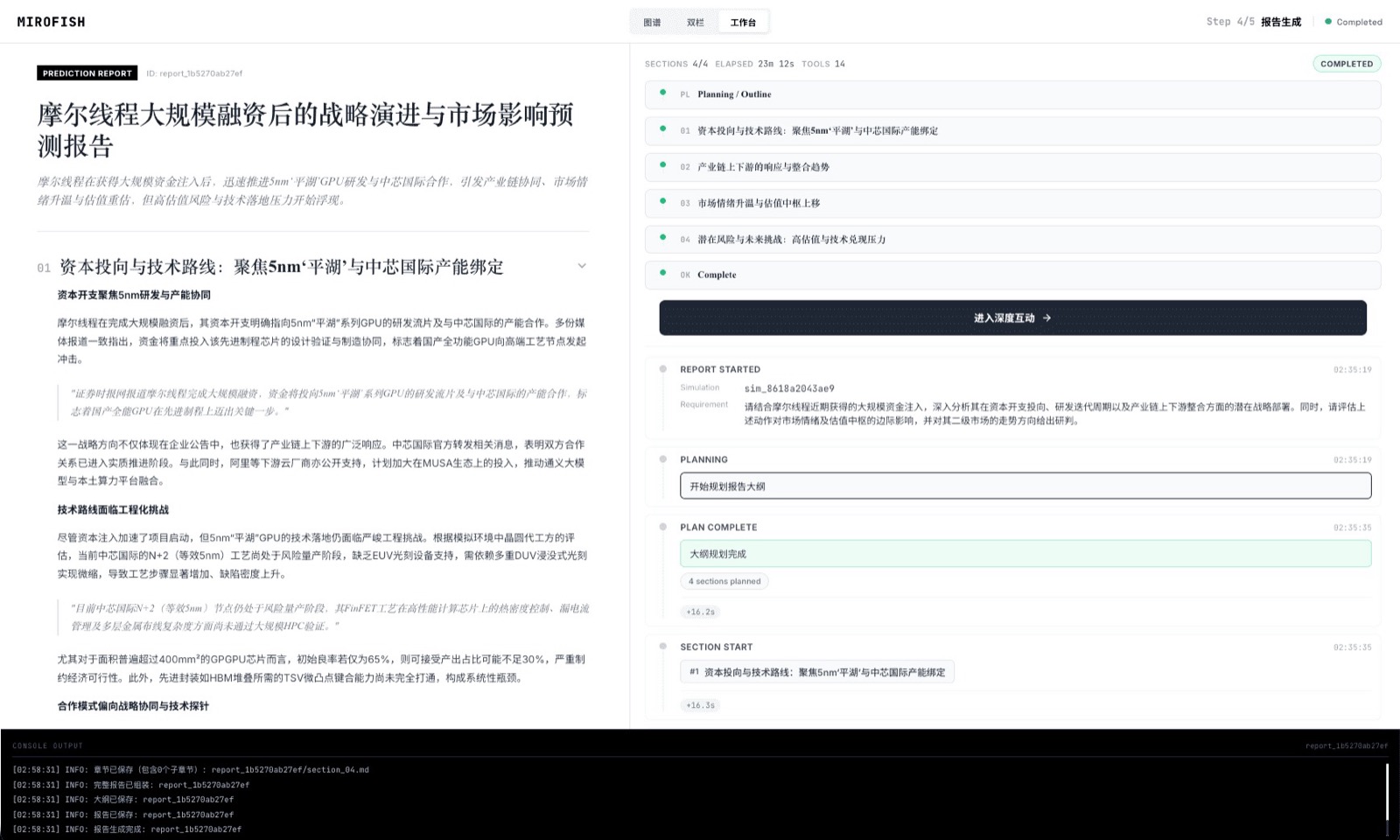
That's the report end of it. Behind it sits the graph of characters shown further up, the investors, government bodies and tech journalists it invented to argue the case out first, each with its own generated persona and its own read on the news.
What I'd feed it first for a Singapore launch
I wouldn't start with anything big. I'd start with something small enough that being wrong costs nothing, like a caption I'm about to post anyway, and ask it the plainest version of the question I always want answered before I hit publish: will people actually share this, or scroll past it.
If I ran a small business here, I think the more useful test is a price change, not a launch post. Feed it the exact wording you're planning to put on the menu board or the price page, and ask whether the crowd reads it as fair or pushes back before you've printed anything. That's a five-dollar way to catch a bad number before real customers do it for you, in the comments, in public.
I'd treat whatever it says as one more opinion in the room, not the final word. It's a simulation built from generated personas, not an actual survey of your actual customers, and that stays true no matter how convincing the report reads. I've written before about why an AI system hands you a confident answer whether or not it has earned it, and a prediction engine is exactly the shape of tool that problem shows up in hardest. Treat the report as a rehearsal, not a verdict.
FAQ
Is MiroFish free to use?
Yes, the software itself is free and open source. Running an actual simulation still costs money, since every round burns API calls against an LLM key you pay for yourself. MiroFish's own landing page puts a typical run at around $5.
What licence is MiroFish released under?
MiroFish ships under the AGPL-3.0 licence, free to run and modify. The copyleft terms only really matter if you build a commercial product on top of it rather than just testing your own launch.
Does MiroFish use real people to test your launch?
No. Every persona reacting to your post is a generated AI character with its own memory and behaviour, and none of them are real people answering a survey question.
How many GitHub stars does MiroFish have?
It passed 72,000 stars on GitHub as of 8 September 2026, less than a year after the repo went up on 26 November 2025.
Where MiroFish does not help
Be honest about the edges and the rest of this is actually usable.
It can't tell you anything your seed material doesn't already contain the shape of. Feed it a thin, generic post and you get a thin, generic prediction back, because the agents can only argue with what you gave them.
It costs real money to run at any scale, since every round burns real API calls against a key you're paying for, and the project's own docs warn that heavy use adds up fast.
And it's Chinese-first in practice. The setup instructions and code are in English, but the screenshots, the demo videos and the community channel are Chinese, so if you don't read the language you'll be matching buttons by position for your first few runs.
None of that makes it not worth trying. It just means the honest way to use it is the same way I'd use any new tool before it earns a permanent spot in how I work: run one small, cheap, reversible test on something that's about to happen anyway, and see if the crowd it builds tells you something you didn't already know. That's what a new tool actually earning a place in how a business runs looks like, one experiment at a time, rather than one more tab you tried once and closed.