AI adoption
The Four Levels of AI Adoption
Most businesses use AI as a chatbox. A few build it into how they run. Here are the four levels of AI adoption, where most owners are stuck, and how to tell which one your business is on.

A few years ago I used to end my day by opening Instagram and scrolling through my competitors, one account at a time, trying to work out what was landing for them and what I should be doing differently. It would be ten at night. I had already done a full day. And there I was, doing research by hand, hoping I'd still remember any of it by the morning.
I'm telling you this because almost every business owner I talk to is doing some version of the same thing. They're not lazy and they're not behind. They're just doing too much by hand, and these days that includes the AI part.
Here is the thing nobody really says out loud. Most businesses are already using AI, and it hasn't changed much for them. They write a few emails with it. They summarise the odd document. They ask it the questions they used to type into Google. Then they quietly wonder what all the fuss was about.
The reason it hasn't changed anything is simple.
Using AI and building your business around AI are two different things. One saves you a few minutes. The other changes what one person can do.
I think of the whole thing as a ladder. Four rungs. Most businesses are standing on the first two without realising there are two more above them.
- 01
Ad hoc
You ask ChatGPT or Claude when you remember to. A smarter search bar. Nothing connects.
- 02
Daily tool
AI all day, but by hand. Prompt, copy, paste, repeat. Every output moves because you move it.
- 03
Owning an agent
Where we take youConnected to your tools and your second brain. It prepares repeated work on schedule. You review and approve.
- 04
AI infrastructure
Where SCALR runsSeveral agents hand work to one another across the business, from one shared memory. You set the goals and approve what matters.
What are the four levels of AI adoption?
I use a practical four-level framework to explain this. Level one is ad hoc use. Level two is AI woven into your daily work, still by hand. Level three is owning an agent: connected to your business memory, tools, and repeated workflows, with important actions prepared for approval. Level four is AI infrastructure: several agents that hand work to one another, while people set the goals and approve what matters. Most owners sit on one and two. The leverage almost every business needs starts on three, and it compounds on four.
The jump that matters isn't from level one to two. It is from two to three, the moment AI stops being something you manually operate and starts becoming an operating layer you own.
Level 1: you use AI when you remember to
This is where most people start, and there is nothing wrong with it. AI is a smarter search bar. You're writing a quote for a customer, you get stuck on the wording, so you paste it in and ask AI to tidy it up. It comes back better. You copy it out, close the tab, and move on.
It helps. But nothing connects. Each session starts on its own, and you carry every answer to wherever it needs to go by hand. There is no compounding here, just small, scattered time savings across your week.
If you're on this rung and paying for the tools out of pocket, check whether you're leaving money on the table first: NTUC members can claim half their AI subscriptions back on 21 approved tools, ChatGPT and Claude included.
Level 2: AI becomes your daily tool
At level two, AI is genuinely part of your day. You draft content with it. You research with it. You think out loud with it when you're stuck. This is also the level where you try a one-off tool like an AI crowd that rehearses your launch before you post it, use it once out of curiosity, and close the tab. You probably have a few prompts saved in a note somewhere that you reuse.
This is a real step up, and it is where a lot of sharp, capable people stop. It feels like the summit, because you're noticeably faster than you were a year ago.
The catch is that it is still you, doing everything, one prompt at a time. You're the one who has to remember to open the tool, ask the right question, and carry the answer to wherever it needs to go. Close the laptop and all of it stops. You're a faster engine. You're still the engine. Even at this level alone, run by one person with real patience, it's enough to cut a TV ad for $2,000 that beat six-figure production quotes.
Level 3: owning an agent
Level three is the first real jump, and it is the one most people never picture, because it stops looking like a chat window and starts looking like part of how the business runs.
Instead of you prompting AI from scratch, you own an agent connected to your data, tools, and business memory. It can prepare the repeated work on a schedule or a trigger: pull numbers into a weekly report, draft follow-ups for your approval, update a tracker, or assemble a brief from the context your business has already stored.
The point isn't that it replaces your judgment. The point is that the repeated layer no longer starts from zero every time. This is the rung where time starts coming back to you, because the agent prepares the work and you approve the decisions.
Honesty matters here. A useful agent still needs boundaries, context, maintenance, and human review. The better claim isn't magic. The better claim is ownership: your business memory, your workflows, your tools, and your approval rules, built into one system you can keep improving with real use. That business memory is the whole foundation, and I wrote about how I built mine in the second brain behind my AI Agent.
Level 4: AI infrastructure, agents that work together
Level four is what happens when one agent becomes several, and they hand work to one another. One answers the new enquiry, the next drafts the quote, another books the follow-up, and you approve what matters. People stay responsible for the goals, the approvals, and the guardrails. Some people call this being AI-native.
The big labs and the largest companies are pushing hard here, but it isn't only for them. A business of one can run on it, and SCALR does. It isn't free, though. I broke down what that frontier access actually costs once the free ride ends, using my own numbers.
The honest part is that you don't need to start here, and you shouldn't try. The gap opening up right now is between the owners stuck on level two and the ones who reach level three, and you can pull a long way ahead of your market on level three alone. Level four is where it compounds, once a second and a third agent are working and handing work to each other. The tools keep arriving regardless: GPT-6 Astra now returns the finished document rather than text about it, which makes level three easier to reach and does nothing at all to move you there on its own.
The words people mix up. These describe how a system is built, not how far a business has adopted it.
- Workflow is a defined sequence of steps.
- Automation is a workflow that runs when triggered or scheduled.
- Agent is software that can choose its own actions within set boundaries.
- AI system is the connected whole: data, tools, memory, logic, and human oversight.
One agent isn't level four. Level four starts when several agents hand work to one another.
One thing worth saying plainly: in the agents I build, important public, paid, or customer-facing actions still wait for your approval. The boundaries are set with you, not by the software alone.
Which level is your business on?
Here is a quick test you can run in ten seconds. If AI only does anything when you open a tab and type, you're on level one or two. If a repeated workflow can prepare useful work from your business context before you manually assemble it, you've started to climb into level three. If several of those workflows hand work to each other without you carrying it between them, you're on level four.
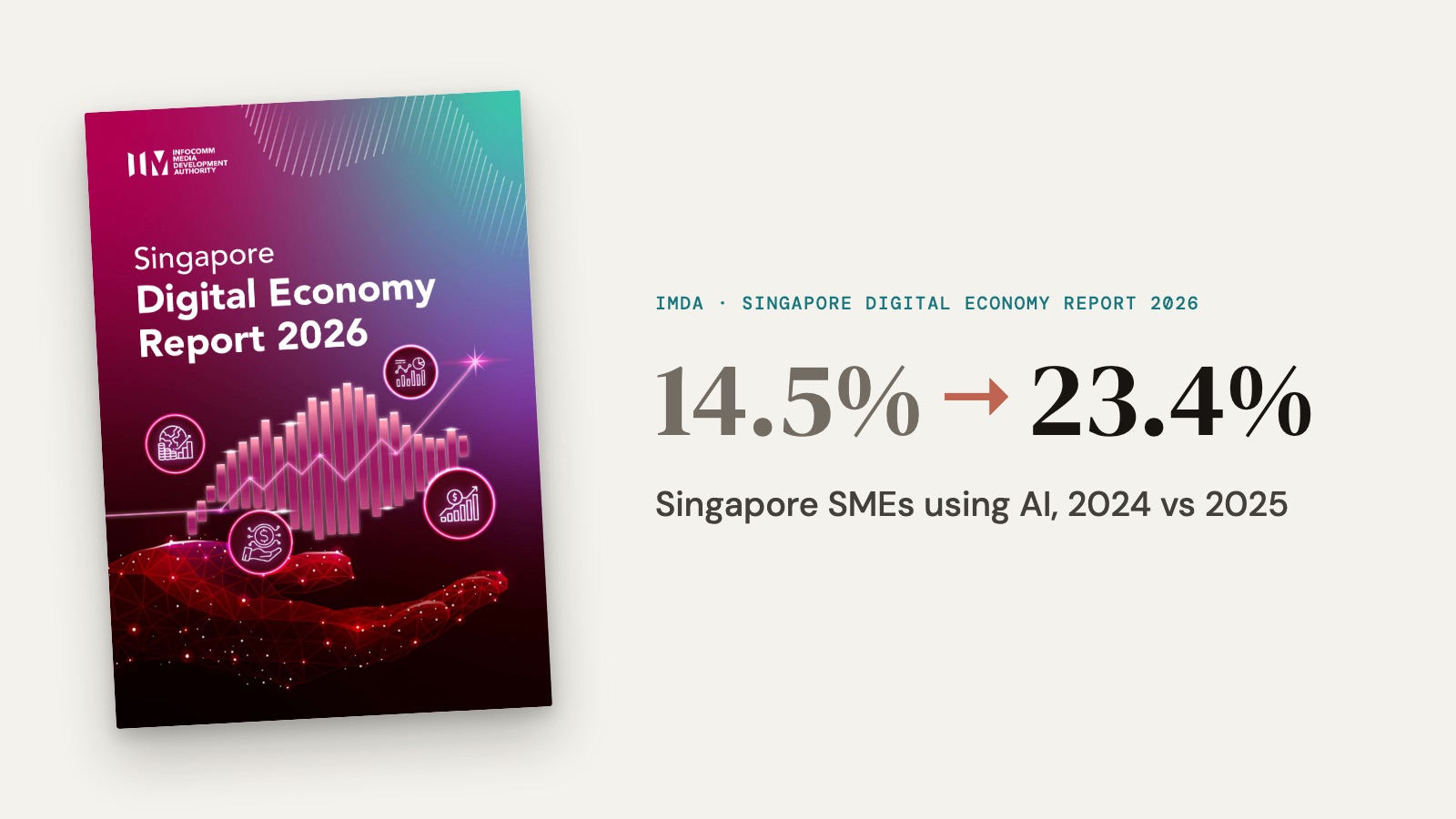
Many owners I speak with are firmly on level two, often without realising there is anywhere else to go. IMDA's own numbers say the same: in its 2026 report, 89.6% of Singapore firms using AI run off-the-shelf tools with no customisation, and only 6.6% say it's fully built into the company. That isn't a failure. It is just the ceiling of what using AI by hand can reach, and almost everyone is pressed up against it.
How do you actually move up a level?
You don't leap straight to level three overnight, and you shouldn't try. The businesses that climb the ladder do it one rung at a time, and they always start in the same place: the one job where moving up earns back the most, soonest.
For many founder-led businesses that job is marketing and growth. It is repetitive, it never ends, and it almost always runs through one person, you. That is the work I help businesses climb the ladder on, as both the strategist and the builder, starting with the rung that pays for itself fastest, then building from there.
How I run SCALR on level four
I run SCALR on level four, and I keep building it, because systems are built over time, not overnight. So I'm not describing a theory I read somewhere.
It started with one agent, which is level three. I call it Steve. It works from my business memory: offers, positioning, writing style, decisions, and operating notes. When I trigger a competitor scan, it pulls together what moved and what might be worth testing. When I ask for a brief, it starts from stored context instead of a blank chat. I can reach it from my laptop or my phone, and it becomes more useful as the business memory becomes more complete.
Level four is what grew around it. A video I film goes from raw footage to an edited, captioned reel, then gets scheduled and posted to seven platforms, and its numbers are tracked every day. When someone takes one of the free checks on this site, their result is written up as a report, emailed to them, logged, and flagged to my phone without me touching it. Expenses get logged from a single message, and the whole workspace checks its own records every night. Anything new that goes public, like a post or a message to a client, still waits for my approval.
Those aren't products I sell. They're examples I built for myself, and a preview of how I work. What I'd build for your business depends entirely on yours.
And I want to be honest about where the result behind all this came from, because it matters.
SCALR grew out of work I began inside a traditional Singapore auto workshop and still support today. Handling its marketing as a team of one, I used AI-assisted systems to carry a far broader workload than one person normally could, and that engine helped the business reach a S$700,000-a-year run rate in new sales within seven months. The judgment and execution were mine. AI supported the workload and multiplied my leverage; it didn't create the outcome by itself.
What is different today is that I can take the same thinking and build it into a system someone else owns, far faster than I could ever do it all by hand.
FAQ
What is level 3 of AI adoption?
Level three means owning an agent connected to your business data, tools, and memory, so you're not prompting AI from scratch every time. The agent prepares repeated work on a schedule or trigger, pulling numbers into a weekly report, drafting follow-ups for your approval, updating a tracker, or assembling a brief from context your business already has stored. Time starts coming back to you because the agent prepares the work while you approve the decisions.
What is level 4 of AI adoption?
Level four means AI infrastructure: several agents that hand work to one another across the business, while people stay responsible for the goals, approvals, and guardrails. Some call it being AI-native. It isn't only for big companies: a business of one can run on it, and SCALR does.
Do I need to reach level 4 AI adoption to compete?
No. Start with level three, where most of the hours come back. The real gap opening up right now is between the owners stuck on level two and the ones who reach level three. Level four is where it compounds, and you can grow into it one agent at a time.
What's the difference between a workflow, an automation, and an AI agent?
A workflow is a defined sequence of steps. An automation is a workflow that runs when triggered or scheduled. An agent is software that can choose its own actions within set boundaries. A single agent is level three; level four starts when several agents hand work to one another.
The gap is about to get wide
The businesses that climb this ladder now, while most of their competitors are still typing into a chat window, are going to be very hard to catch. Not because they have a secret tool, but because their week quietly does more than everyone else's.