automation
ManyChat vs OpenReply: The Real Cost of Free
A free open-source alternative to ManyChat exists and it genuinely works. Here is the real price ladder, what self-hosting actually requires, and who should pick which.
Short answer: if you have nobody to look after a server, keep paying. If you already run infrastructure, OpenReply does the same job for the cost of hosting. The software being free is the least interesting part of this, because the bill was never really the expensive bit.
Both do the same thing. Someone comments a keyword under your post, and a second later a link lands in their DM.
The short version
| ManyChat | OpenReply | |
|---|---|---|
| Price | $17 to $199 a month by plan, plus per-contact overages | Free software, you pay hosting |
| Who runs it | They do | You do |
| Setup | Sign up | Meta app, database, Redis, your own domain |
| Scales by | Active contacts, so a viral post raises the bill | Your server, so a viral post costs roughly nothing extra |
| When it breaks | Their support | You, at 2am |
| Licence | Commercial | MIT, open source |
Prices checked 28 August 2026. ManyChat repriced on 2 March 2026, so older accounts may be on different terms.
Where the money actually goes
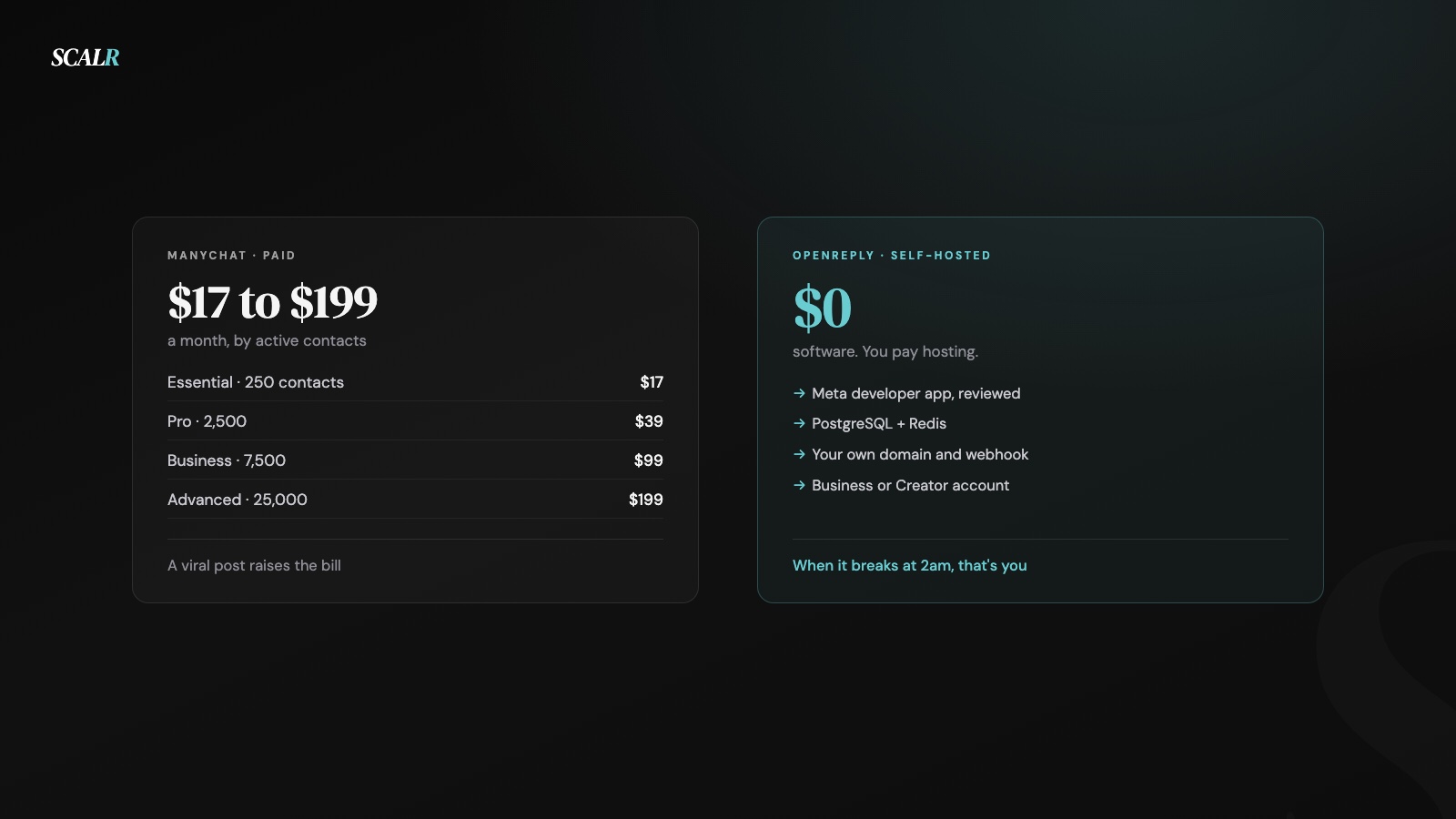
ManyChat charges by active contacts, not by messages or seats. At the time of writing the ladder runs Free (25 contacts), Essential at $17 a month for 250, Pro at $39 for 2,500, Business at $99 for 7,500, and Advanced at $199 for 25,000. Annual billing brings those down to roughly $14, $29, $69 and $139.
Go past your allowance and you pay per extra contact: five cents each on Pro, two and a half on Business.
That pricing model is the thing worth understanding, because it means your bill is tied to your best month. One reel that outperforms drags thousands of new contacts into the account, and the invoice follows. Most people discover this after the good month, not before.
Self-hosting inverts that. Your cost is a server, and a server doesn't care whether a post did four hundred views or four hundred thousand.
What OpenReply actually is
It's an open-source project by Diwen Huang, MIT licensed, that watches comments on your Instagram posts and sends a private reply through the official Meta API when a comment matches a keyword you set. The post that surfaced it described the creator as 17 years old, and I haven't independently confirmed his age, so treat that as the claim it is rather than a fact I checked.
The code being free is real. The repo is public, there are no seat limits and no plan caps.
What's equally real is the sentence in its own README: "OpenReply is self-hosted. You have to deploy your own copy." The demo site isn't a service. Creating an account there will never send a DM for you, and there is no hosted plan to upgrade to.
What running it actually requires
This is the part that decides it for most people, so here is the full list rather than a summary.
- A Meta developer app with Instagram API access, which you create and get reviewed
- A PostgreSQL database
- A Redis instance
- A Resend account for login emails
- Your own domain, pointed at your own deployment
- A registered webhook
- An Instagram Business or Creator account, because a personal one won't connect
None of that is exotic if you already deploy things. All of it is a wall if you don't. And the Meta app review in particular is a process you own from then on, including when Meta changes its requirements.
Where they genuinely overlap
The underlying mechanism is identical. Both use Meta's official API, both are subject to the same platform rules, and both send the same private reply. Nobody is getting an unfair delivery advantage here.
Neither one is magic on reliability either. A paid platform has an outage page and a support queue. A self-hosted app has you. Whether that's better or worse depends entirely on how quickly you personally can fix things.
And both live at the mercy of the same platform. If Meta changes its messaging rules, it changes for both, and being self-hosted means you implement the change yourself.
Which one you should pick
Pick ManyChat if the automation is the point and infrastructure isn't your job. For most creators and small businesses, a few hundred dollars a year to never think about a webhook again is straightforwardly good value. Paying for someone else's uptime is a legitimate purchase, not a failure of nerve.
Pick OpenReply if you already run servers, or if the contact-based pricing is genuinely hurting you. Someone with a large audience and a bill scaling into the hundreds each month has a real financial case, and they usually already have the skills the setup list demands. The code and the setup guide are both at github.com/diwenne/openreply, free to read before you commit to anything.
Do the arithmetic properly before switching. Compare the annual subscription against your own time at whatever your hour is worth, plus the hosting, plus the hours you will spend the first time it breaks during a launch. Plenty of people find the paid plan wins that comparison, and there's nothing embarrassing about that answer.
FAQ
How much does ManyChat cost?
ManyChat's free tier covers 25 contacts, then it steps up through $17, $39, $99 and $199 a month as you grow from 250 up to 25,000 contacts. Pay annually and those drop to roughly $14, $29, $69 and $139. Go over your limit and you'll pay per extra contact too, five cents each on the Pro plan.
Is OpenReply actually free?
Yes, the software's free and open source under an MIT licence, with no seat limits and no plan caps. You still pay for your own hosting, a server, a database, Redis and a domain, so the real cost is running it yourself rather than paying for a subscription.
What do you need to self-host OpenReply?
A Meta developer app with Instagram API access, a PostgreSQL database, a Redis instance, a Resend account for login emails, your own domain, a registered webhook, and an Instagram Business or Creator account, since a personal one won't connect. None of that's exotic if you already deploy things, but it's a real wall if you don't.
Should I switch from ManyChat to OpenReply?
Only if you already run your own infrastructure, or ManyChat's contact-based bill is genuinely hurting you. If nobody on your team can look after a server, keep paying for ManyChat, since a few hundred dollars a year to never think about a webhook is a good trade. If you've already got the skills, OpenReply does the same job for the cost of hosting.
The wider thing this is evidence of
I run comment-to-DM on my own posts, though on neither of these tools, so I don't have a side to sell you here.
What makes this worth writing about is not that a free alternative exists. Free alternatives to paid software have always existed. It's that one person can now build a credible version of a product from a company that has raised $140 million and serves more than a million businesses (press release), and ship it publicly, for nothing.
That gap closing has a consequence for anyone selling software: the feature is no longer the moat. Reliability, support and the fact that nobody has to think about it are the moat, and those are exactly the things the free version asks you to supply yourself.
Whether you can replace a tool you pay for is usually a yes now, so what I'd decide first is whether you want to own the thing you replaced it with.