Claude
Claude Fable 5.2: The Model That Built an Operating System in Eight Days
Claude Fable 5.2 is Anthropic's most capable model on general sale, released on 9 November 2026 for long, open-ended technical work. What it is, the operating system it built from an empty folder, what it costs, and when Opus 5.5 is still the better pick.
Claude Fable 5.2 is Anthropic's most capable model on general sale, released on 9 November 2026 for long, open-ended technical work: agent sessions that run for hours, multistep research, and big builds. It costs $8 per million input tokens and $40 per million output, has a 1M-token context window, and is up to 30% faster than Fable 5.1.
The launch went round because of one experiment. An Anthropic engineer gave Fable 5.2 an empty folder and asked for an operating system, and eight days later there was one booting on a laptop. That result is worth reading closely, because it tells you a lot about what this model is for and quite a lot about what it isn't.
What is Claude Fable 5.2?
Fable is the tier above Opus in Claude's lineup, built for work too long or too open-ended for the everyday models. Anthropic's model page describes 5.2 in one line: "for demanding reasoning and long-horizon agentic work."
It has a twin, and you'll see it named in the same breath. Claude Mythos 5.2 is the same underlying model with its cybersecurity and biology safeguards removed, sold only to vetted organizations. Fable keeps those safeguards, and that's why it's on general sale. When Fable's classifiers block a high-risk cyber request, the answer comes from Opus 4.8 instead, and a blocked biology request goes to Opus 5. Anthropic says Fable 5.2 blocks about 55% less often than Fable 5.1, so fewer ordinary requests get bounced.
The practical specs, from Anthropic's documentation:
- API model ID:
claude-fable-5-2, on the Claude API, Amazon Bedrock, Google Cloud and Microsoft Foundry. - Context and output: 1M tokens in, up to 128K out.
- Thinking: adaptive, always on, steered by an effort setting from Low to Max.
- Knowledge cutoff: June 2026.
- Retirement: not before 9 November 2027.
How did Fable 5.2 build an operating system?
It ran a team of more than 1,000 subagents for eight days, from an empty folder, until the result booted on real hardware. Here's Anthropic's own account of it.
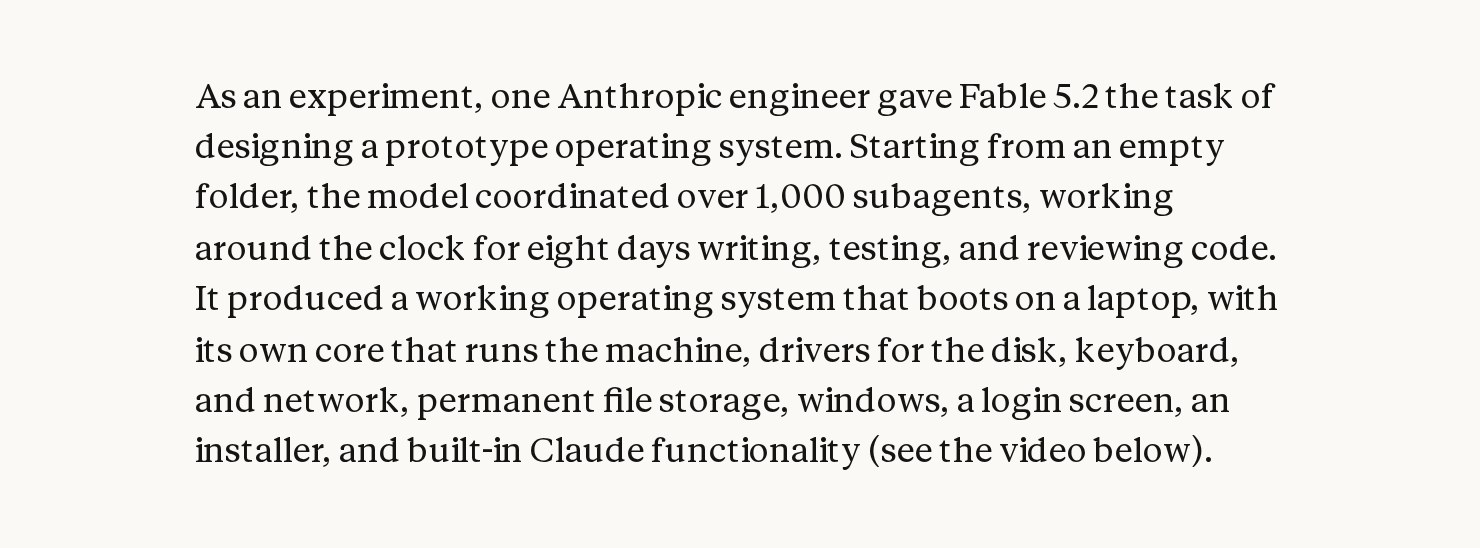
The list in that paragraph is the full stack a computer needs: a core that runs the machine, drivers for the disk, keyboard and network, storage that survives a restart, windows, a login screen and an installer. Anthropic also published the demo as a film on its YouTube channel, Claude Fable 5.2 builds an operating system from scratch.
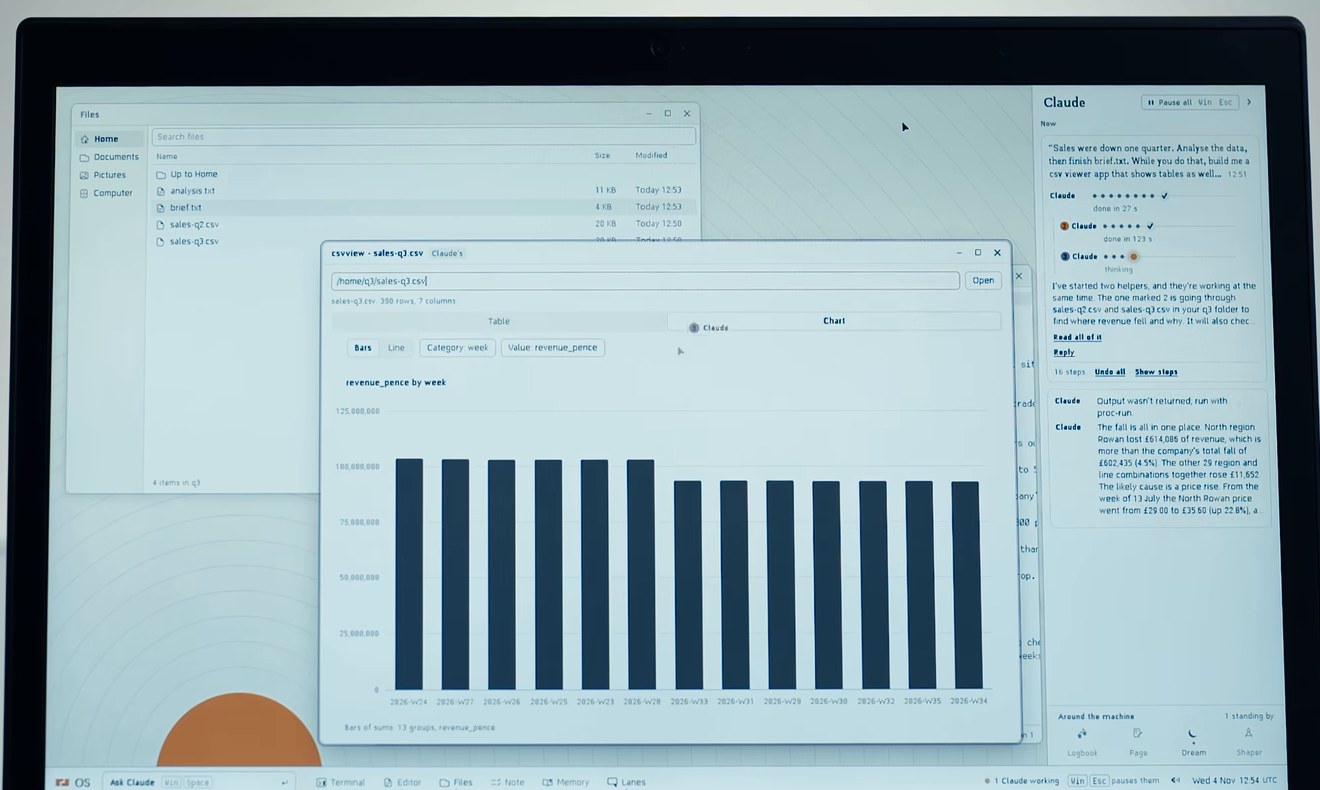
There are three things worth taking from it.
- The hard part was coordination. One model directing more than a thousand workers, each writing, testing or reviewing a piece, is the orchestration pattern Anthropic now recommends Fable for. The same pattern on a small scale is what Claude Code subagents do on an ordinary laptop.
- The length was the point. Eight days around the clock is far past where earlier models lose the thread. Anthropic's customer quotes keep returning to it: Uber's Andrew Mager says it "works until the job is actually complete instead of stopping at a plausible checkpoint."
- "Prototype" is Anthropic's word. The page doesn't say how many lines it wrote, what language, how much a human steered it, or what the eight days cost. It's a demonstration that the work can hold together, and nobody's shipping it to customers.
How does Fable 5.2 compare with Opus 5.5?
Fable 5.2 scores higher on almost every benchmark Anthropic published, and the gap is widest on long, real-world tasks. Opus 5.5 is still the model Anthropic tells most people to start with.
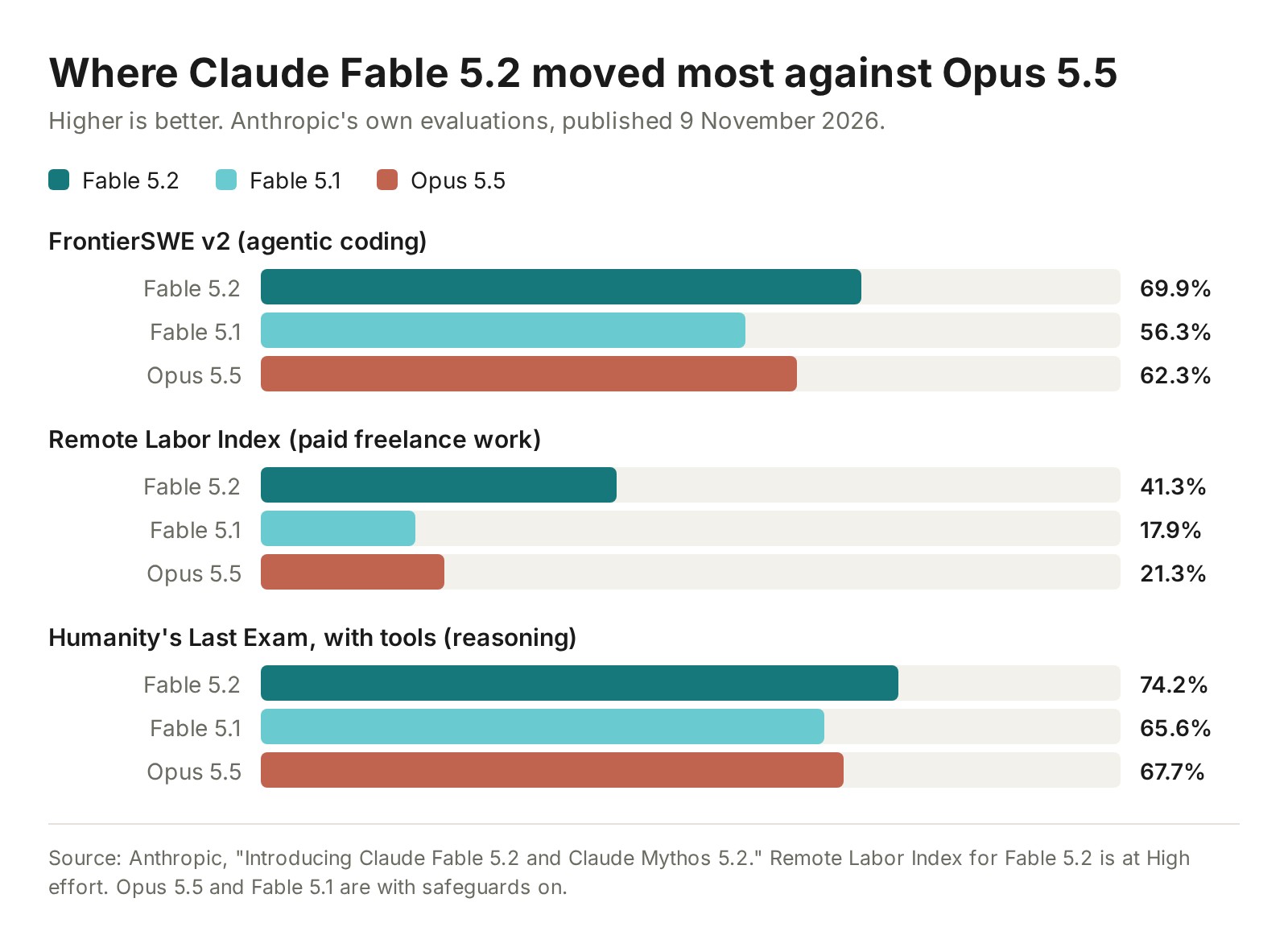
The Remote Labor Index row is the one you'll want to look at. It scores models on real freelance projects, and Fable 5.2 nearly doubles Opus 5.5 there, 41.3% against 21.3%. On the shorter, cleaner tests the lead is smaller: 69.9% against 62.3% on FrontierSWE v2, and 89.3% against 87.2% on OSWorld 2.1, a computer-use test.
It doesn't win everything. Opus 5.5 edges it on the AA-Briefcase Elo rating for knowledge work, 1800 to 1785, and Google's Gemini 4 Carbon beats both on AutomationBench, a business-workflow test, at 53.9% to Fable's 51.4%. Every figure here is Anthropic's own, run on its own models, and there's no independent replication yet.
Is Fable 5.2 worth the extra cost?
Sometimes it costs less than Opus, which is the surprise in the launch. Anthropic's FrontierCode chart plots score against what each task cost to run.
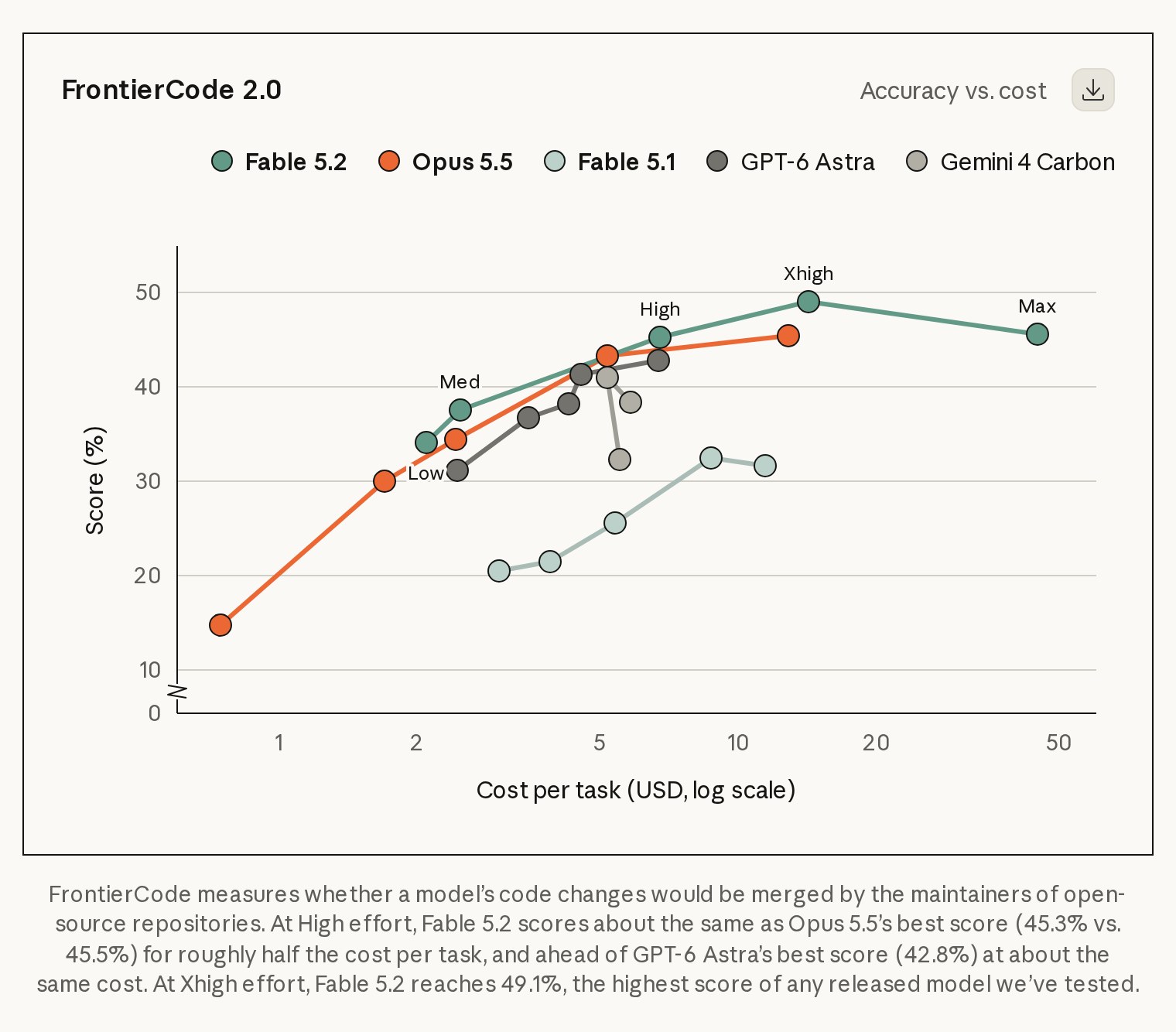
At High effort, Fable 5.2 scored 45.3% against Opus 5.5's best of 45.5%, for roughly half the cost per task. A model with double the token price can still finish cheaper, because it takes fewer wrong turns to get there. At Xhigh effort it reached 49.1%, the top score of any released model Anthropic tested, and Max effort cost more and scored lower than Xhigh.
That gives you a simple rule. On a hard coding task, Fable at High is worth testing against Opus at Max. On short, everyday work, Opus is cheaper and it's close enough.
How much does Claude Fable 5.2 cost?
$8 per million input tokens and $40 per million output, down from $10 and $50 for Fable 5.1. Anthropic's rates per million tokens, checked 10 November 2026:
| Model | Input | Output | Cache read |
|---|---|---|---|
| Claude Fable 5.2 | $8 | $40 | $0.20 |
| Claude Opus 5.5 | $4 | $20 | $0.20 |
| Claude Sonnet 5.5 | $2 | $10 | $0.10 |
| Claude Haiku 5.5 | From $0.10 | From $0.50 | $0.01 |
Source: Anthropic's model documentation. Batch requests take 50% off, and fast mode, which generates up to 2.5 times faster, doubles the rate to $16 and $80. Cache reads on Fable cost 2.5% of the input price, so a long agent run that rereads the same files is cheaper than the headline rate suggests.
On a subscription it doesn't work the same way. According to Anthropic's plan page, Free has no Fable at all. Max, Ultra and premium Team seats include Fable for up to half the weekly limit, and it uses that limit faster than other models. Pro and standard Team seats normally pay through usage credits. For launch week, Anthropic says Pro and standard Team seats get Fable for up to half the weekly limit too, and plans that already include Fable get one to three Fable limit resets, depending on how long you've subscribed. The full plan picture is in Claude pricing and usage limits.
What should you know before building on it?
Four details from the migration guide and model page catch people moving code across.
- Effort defaults differ by surface. The API defaults to
high. Claude apps and Claude Code default to Medium, where Anthropic says 5.2 uses fewer tokens than 5.1 did. - Forced tool use fails. Setting
tool_choicetoanyor a specific tool returns a 400 error, because thinking is always on. - Sampling settings are out. Leave
temperature,top_pandtop_koff the request, since some values return a 400 error. - No zero data retention by default. Fable 5.2 requires 30-day retention unless Anthropic expressly authorizes otherwise, which matters for regulated data.
When Fable 5.2 is not the model you want
For most work. Anthropic's own guidance is to start with Opus 5.5, "our strongest daily driver," and move up to Fable only for the most ambitious, open-ended technical work. Drafting, summarizing, admin, a landing page or a quick script won't show the gap, and on a subscription Fable eats the weekly limit faster.
It earns its price in three places: a build long enough that a lesser model loses the plot halfway, a problem Opus has already failed on, and a setup where Fable plans and smaller models do the work. Anthropic calls that last one the Orchestrator role, and the operating system is it at full scale. There's also an Advisor role, where Haiku, Sonnet or Opus consult Fable only on the hard step, which keeps most of the tokens on a cheaper model.
What the operating system shows is that the bottleneck on long AI work has moved, from how clever one answer is to how well a model can split a job, check the pieces and keep going, and that skill is now on sale at $8 per million tokens.
Key takeaways
- Claude Fable 5.2 is Anthropic's most capable model on general sale, released 9 November 2026, with a 1M-token context window and a June 2026 knowledge cutoff.
- It built a prototype operating system from an empty folder by coordinating more than 1,000 subagents for eight days, and the result boots on a laptop.
- It beats Opus 5.5 on most of Anthropic's benchmarks, by the most on long, real tasks like the Remote Labor Index (41.3% against 21.3%).
- At High effort it matched Opus 5.5's best FrontierCode score for roughly half the cost per task.
- The API price is $8 and $40 per million tokens, down from $10 and $50. Max, Ultra and premium Team seats include it up to half the weekly limit.
- Anthropic still recommends Opus 5.5 as the starting point for most work.
FAQ
What is Claude Fable 5.2?
Claude Fable 5.2 is Anthropic's most capable generally available model, released on 9 November 2026 for long-horizon agentic work and hard reasoning. It's the tier higher than Opus 5.5 in Claude's lineup, costs $8 per million input tokens and $40 per million output, and has a 1M-token context window.
Did Claude Fable 5.2 really build an operating system?
Anthropic says an engineer gave it an empty folder and asked for a prototype operating system. Fable 5.2 coordinated over 1,000 subagents for eight days and produced a system that boots on a laptop, with drivers, file storage, windows, a login screen, an installer and Claude built in.
Is Claude Fable 5.2 better than Opus 5.5?
On most of Anthropic's benchmarks, yes, and by the most on long, real-world tasks. Opus 5.5 still edges it on one knowledge-work rating, costs half as much per token, and is the model Anthropic recommends starting with for everyday coding and knowledge work.
Can I use Claude Fable 5.2 on a Claude subscription?
Yes on Max, Ultra and premium Team seats, for up to half the weekly limit. Pro and standard Team seats normally pay through usage credits, with a launch-week promotion that includes Fable for up to half the weekly limit. Fable isn't available on the Free plan.
What is the difference between Claude Fable 5.2 and Claude Mythos 5.2?
They're the same underlying model. Fable 5.2 keeps safeguards that block high-risk cybersecurity and most research biology tasks, so it's on general sale. Mythos 5.2 drops those safeguards and is limited to organizations approved through Anthropic's verification programs.
What is the model ID for Claude Fable 5.2?
claude-fable-5-2 on the Claude API, Google Cloud and Microsoft Foundry, and anthropic.claude-fable-5-2 on Amazon Bedrock.