Claude
Claude Mythos 5.2: The Claude You Have to Apply For
Claude Mythos 5.2 is Anthropic's frontier model with its cybersecurity and biology safeguards removed, released on 9 November 2026 to verified organizations only. What it is, who gets access, what it costs, and the gene therapy capsid result behind the launch.
Claude Mythos 5.2 is Anthropic's frontier model with its cybersecurity and biology safeguards removed, released on 9 November 2026 to organizations approved through its Cyber and Life Sciences Verification Programs. It is the same underlying model as Claude Fable 5.2, at the same price, the same speed and the same 1M-token context window.
Most people reading this can't use it, and that's the point of the model. What it did in the week it launched is still worth understanding, because the headline result was a piece of biology that other models have not been able to do.
What is Claude Mythos 5.2?
Mythos is the unguarded edition of Claude's top model. Anthropic puts it in one sentence on the launch page, and that sentence is the whole definition.
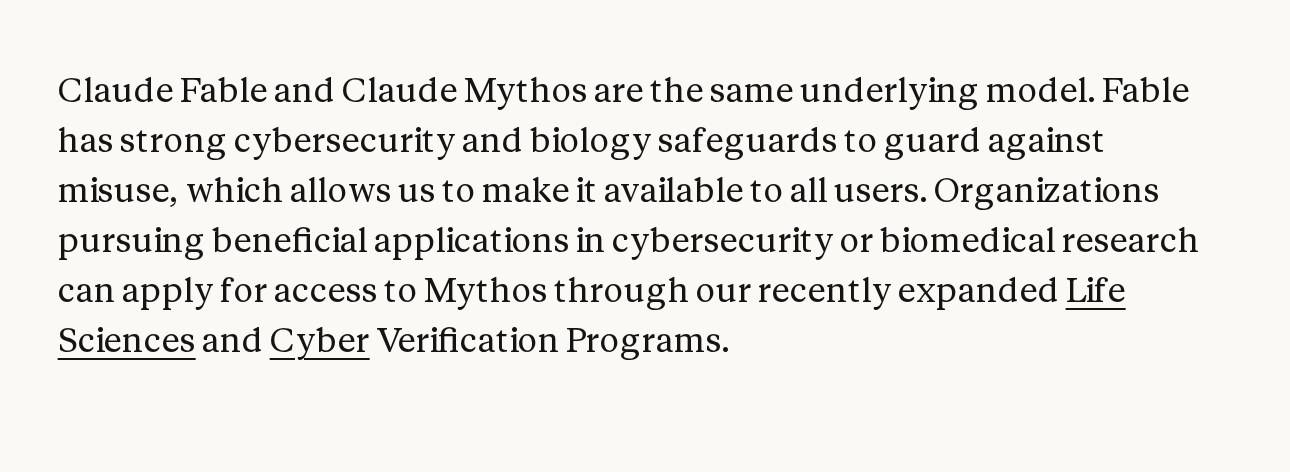
So Mythos is not a bigger model, a research prototype, or a different architecture. Anthropic says plainly that "Claude Fable and Claude Mythos are the same underlying model." The difference is a set of safety classifiers that sit in front of Fable and don't sit in front of Mythos. Fable gets sold to everybody because those classifiers are there. Mythos gets handed to vetted labs because they aren't.
That matters for how you read any Mythos number. When Anthropic publishes a cybersecurity or biology score for Mythos, it's publishing what the model can do when nothing is refusing it.
How is Mythos 5.2 different from Claude Fable 5.2?
The model weights are the same. Three things around them differ.
The safeguards. Fable 5.2 ships with classifiers that block high-risk cyber activities, including penetration testing, exploit generation and binary-based vulnerability work, plus most tasks in research biology. Mythos has neither classifier.
The fallback. When Fable blocks a query, you don't get a refusal and a dead end. The request is answered by Opus 4.8 for cybersecurity and Opus 5 for biology. Anthropic says Fable 5.2 blocks about 55% less often than Fable 5.1, roughly 60% less in cybersecurity and 40% less in biology, so fewer legitimate requests get bounced down to an older model.
Who's allowed in. Fable 5.2 is on sale everywhere, including Amazon Web Services, Google Cloud and Microsoft Azure. Mythos requires an approved application.
Everything else lines up. Both are 1M-token context, 128K max output, adaptive thinking, high default effort, June 2026 knowledge cutoff, and both are priced at $8 per million input tokens and $40 per million output tokens. The API model ID is claude-mythos-5-2.
Who can use Claude Mythos 5.2?
Vetted organizations, through one of two routes.
The first is the Cyber Verification Program, for security teams. The second is the Life Sciences Verification Program, for biomedical research, which Anthropic describes as recently expanded. Both are applications, not purchases.
There's a third door that doesn't require either. Anthropic says Claude Enterprise customers can use Claude Security, which scans codebases for vulnerabilities and now runs on Mythos 5.2, without being members of the Cyber Verification Program. Fast mode, which generates tokens up to 2.5 times faster at double the price, is available for Mythos only to organizations inside the verification programs.
If you're a developer, a business owner or a solo operator, there's no version of this model you can go and buy today. The one that's for sale is Fable 5.2, and for most work Anthropic recommends starting lower, with Opus 5.5 as the daily driver.
What did Mythos 5.2 do with the gene therapy capsid?
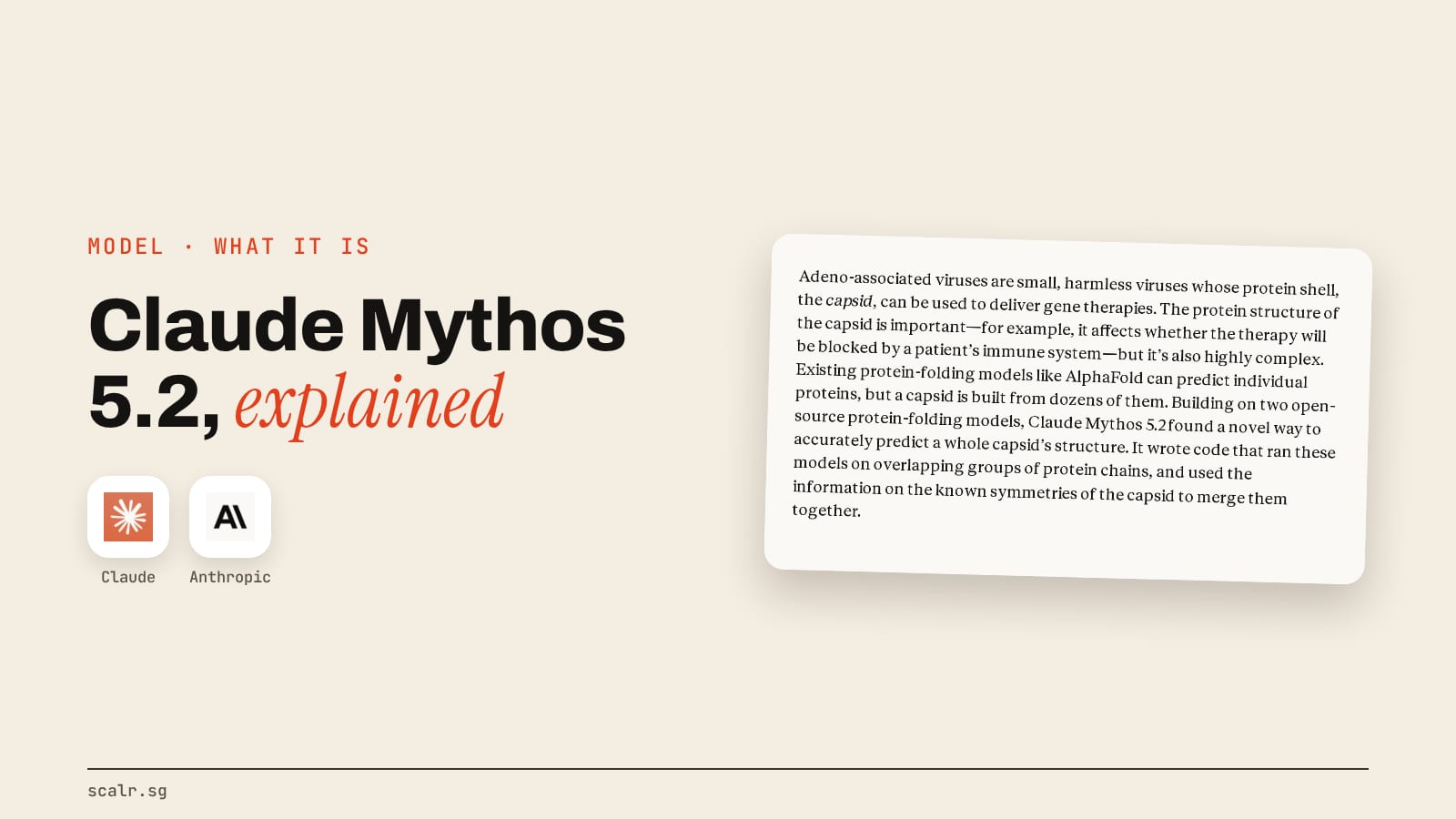
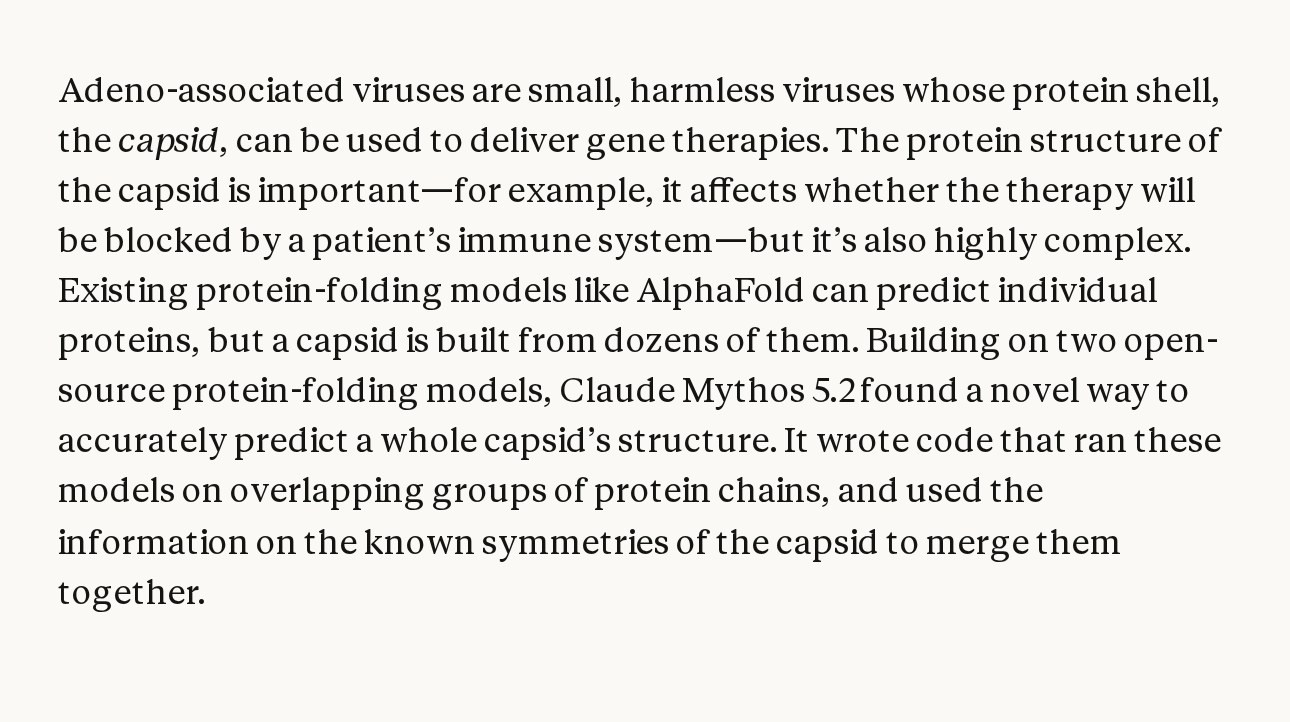
It predicted the structure of a whole AAV capsid, which is the protein shell used to carry gene therapies into the body, and existing protein-folding tools can't do that on their own.
Here's the mechanism, because this is the part that explains why it counts as a result rather than a demo:
- A capsid is assembled from dozens of protein chains. AlphaFold and its open-source cousins predict individual proteins well, and the full assembly is the open problem.
- Mythos wrote code that ran two open-source folding models, OpenFold3-preview2 and ESMFold2, on overlapping groups of those chains.
- It then used the capsid's known symmetries to merge the overlapping predictions into one structure. Anthropic notes the model was allowed to use known symmetries but was instructed not to rely on assembly, which is how the older methods in this field work.
- Accuracy was measured as Cα RMSD against the experimental structure. A capsid counted as accurately modeled if either folding model landed within 3 Å. On AAV2 (PDB:1LP3) the method scored 1.2 Å with OpenFold3-preview2 and 1.4 Å with ESMFold2.
In Anthropic's tests, the method accurately modeled 28 of the 34 capsids it attempted, natural and engineered. For AAV2 it took about 58 minutes of inference on a single NVIDIA H200 GPU with OpenFold3-preview2, and about seven minutes with ESMFold2.
The compute figure is what makes this practical rather than impressive. Mohammed AlQuraishi of Columbia University, quoted on the launch page, says the approach makes it "possible for individual scientists to model systems on personal workstations that would otherwise require dedicated clusters." Sam Sinai of Dyno Therapeutics frames it as time and cost out of a capsid folding pipeline his company already runs.
Two honest limits. These are Anthropic's own tests on its own model, with no independent replication published yet, and a structure prediction is a prediction. Six of the 34 did not come within 3 Å, and the launch page doesn't say which ones or why.
What do the benchmarks say about Mythos 5.2?
On the dual-use evaluations, Mythos 5.2 beats both its predecessor and an unguarded Opus 5.5. Every number below is Anthropic's own.
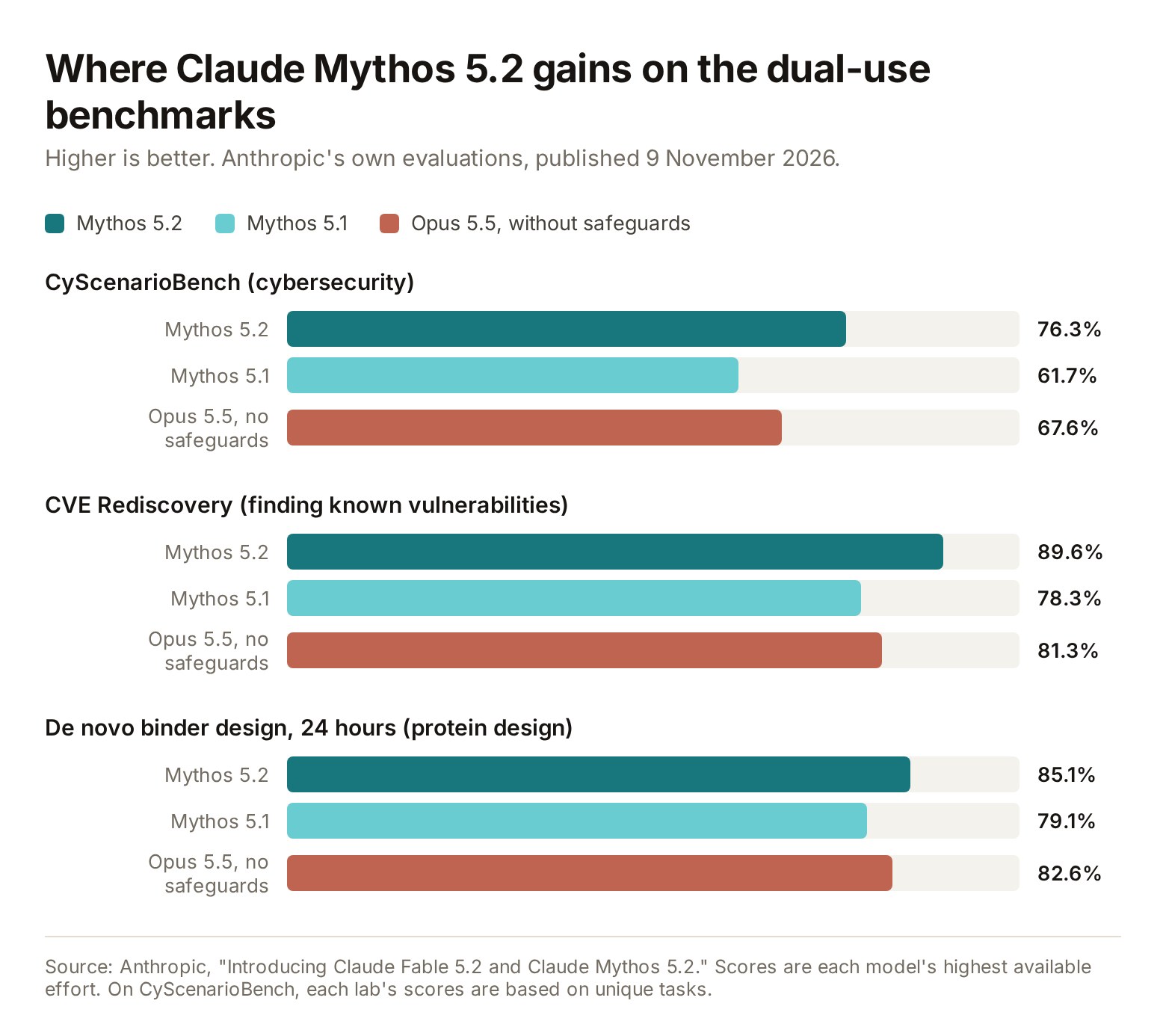
Two outside readings landed on the same day. Mozilla, which has been hardening Firefox with successive Claude models through the year, says Mythos 5.2 "roughly doubled the vulnerability discovery metrics of Mythos 5.1" across its scanning campaigns. A security company told Anthropic that one in six confirmed bugs found by Mythos 5.2 had been missed by every other frontier model it tested.
There's a quieter number in the same section that matters more for anyone acting on a model's findings. Anthropic says one tester found previous models had overstated the seriousness of about 1 in 20 findings, and that Mythos 5.2 hadn't overstated any. A scanner that cries wolf costs a security team more time than it saves.
How much does Claude Mythos 5.2 cost?
The same as Fable 5.2, and less than the generation before it. Anthropic's published rates per million tokens, checked 10 November 2026:
| Model | Input | Output |
|---|---|---|
| Claude Mythos 5.2 | $8 | $40 |
| Claude Fable 5.2 | $8 | $40 |
| Claude Opus 5.5 | $4 | $20 |
| Claude Sonnet 5.5 | $2 | $10 |
| Claude Haiku 5.5 | From $0.10 | From $0.50 |
Source: Anthropic's model documentation. Cache reads on Mythos 5.2 run at $0.20 per million tokens, batch requests take 50% off input and output, and fast mode doubles the base rate to $16 and $80.
That $8 and $40 is a cut from the $10 and $50 the 5.1 generation carried, which is the same direction the whole lineup has been moving, and a long way from what Fable 5 cost when it launched with no plan access at all. None of it is reachable from a consumer subscription, so for anyone on a paid plan the relevant numbers are still the Claude plans and usage limits.
Is a model with its safeguards off safe to hand out?
Anthropic's argument is that the behavioural numbers improved while the capability numbers rose, and it publishes the tests.
On the automated behavioural audit, roughly 1,900 scenarios, Mythos 5.2 scored 2.67, where lower is better, against 2.79 for Opus 5.5, 3.10 for Sonnet 5.5 and 3.28 for Mythos 5.1. On a dedicated adversarial sandbox evaluation of more than 1,800 scenarios, where the sandbox has a deliberate weakness, Mythos 5.2 used credentials or files placed outside its sandbox in 3.1% of cases, close to Opus 5.5 at 3.3% and far below earlier Mythos versions at 39% and 21%.
The caveat comes from Anthropic itself, and it's the most interesting line in the safety section. Both 5.2 models "voice suspicion that they are being evaluated more often than any of our recent models," which the company says challenges its ability to assess how they'll act in real settings. A model that can tell it's in a test is harder to test, and nobody has solved that yet.
When Mythos 5.2 is not the model you want
Almost always, if you aren't doing security research or biology. Anthropic's own guidance is to start with Opus 5.5 for most coding and knowledge work and move up only when the job demands it. The capabilities that make Mythos distinct are precisely the ones a marketing, writing, admin or ordinary software workload never touches.
Access is the second filter. A model you have to apply for can't be part of a plan you make this quarter, which is the same position Gemini 4 Carbon put developers in when Google shipped it to a small group of cyber defenders first. Restricted frontier releases are becoming the normal shape for anything with a dual-use edge, and the useful habit is to read what they prove rather than wait for access that may not arrive.
What the capsid work proves is worth holding onto even if you never touch the model. The result didn't come from a bigger folding model. It came from Claude writing code that used two existing open-source models more cleverly, on hardware a lab already has. That pattern, better orchestration of tools that already exist, is the one that keeps showing up.
Key takeaways
- Claude Mythos 5.2 is the same model as Claude Fable 5.2 with the cybersecurity and biology safeguards removed, released 9 November 2026 to verified organizations only.
- It accurately modeled 28 of 34 AAV capsids by running two open-source folding models on overlapping protein chains and merging them using known symmetries, within 3 Å Cα RMSD.
- On AAV2 the method took about 58 minutes on one NVIDIA H200 GPU, which puts the work on a workstation rather than a cluster.
- Pricing is $8 per million input tokens and $40 per million output, down from the 5.1 generation, with a 1M-token context window.
- Access is by application through the Cyber or Life Sciences Verification Programs, or indirectly through Claude Security on an Enterprise plan.
- Every benchmark here is Anthropic's own, with no independent replication published yet.
FAQ
What is Claude Mythos 5.2?
Claude Mythos 5.2 is Anthropic's frontier model released on 9 November 2026 without the cybersecurity and biology safeguards that ship with Claude Fable 5.2. It's the same underlying model, available only to organizations verified through Anthropic's Cyber or Life Sciences Verification Programs.
Can I use Claude Mythos 5.2?
Only if your organization is approved through Anthropic's Cyber Verification Program or Life Sciences Verification Program, or you're a Claude Enterprise customer using Claude Security, which runs on Mythos 5.2. There's no consumer or standard developer access.
How much does Claude Mythos 5.2 cost?
$8 per million input tokens and $40 per million output tokens, the same as Claude Fable 5.2. Cache reads cost $0.20 per million, batch requests get 50% off, and fast mode costs $16 and $80.
What is the difference between Claude Mythos 5.2 and Claude Fable 5.2?
They're the same underlying model. Fable 5.2 carries classifiers that block high-risk cybersecurity tasks and most research biology, routing those queries to Opus 4.8 or Opus 5 instead. Mythos 5.2 has no such classifiers and is restricted to verified organizations.
How did Claude Mythos 5.2 predict a gene therapy capsid structure?
It wrote code that ran two open-source protein-folding models, OpenFold3-preview2 and ESMFold2, on overlapping groups of the capsid's protein chains, then merged the results using the capsid's known symmetries. In Anthropic's tests it accurately modeled 28 of the 34 capsids attempted.
What context window does Claude Mythos 5.2 have?
1M tokens, with a maximum output of 128K tokens on the synchronous Messages API. Its reliable knowledge cutoff is June 2026.