Gemini
Gemini 4 Carbon: What Google's Newest Model Is, What It Costs, and How It Compares With Claude
Gemini 4 Carbon is Google's strongest model, announced on 28 October 2026 with a cybersecurity and long-task focus. What it is, who can use it today, what it costs and how it lines up against Claude.
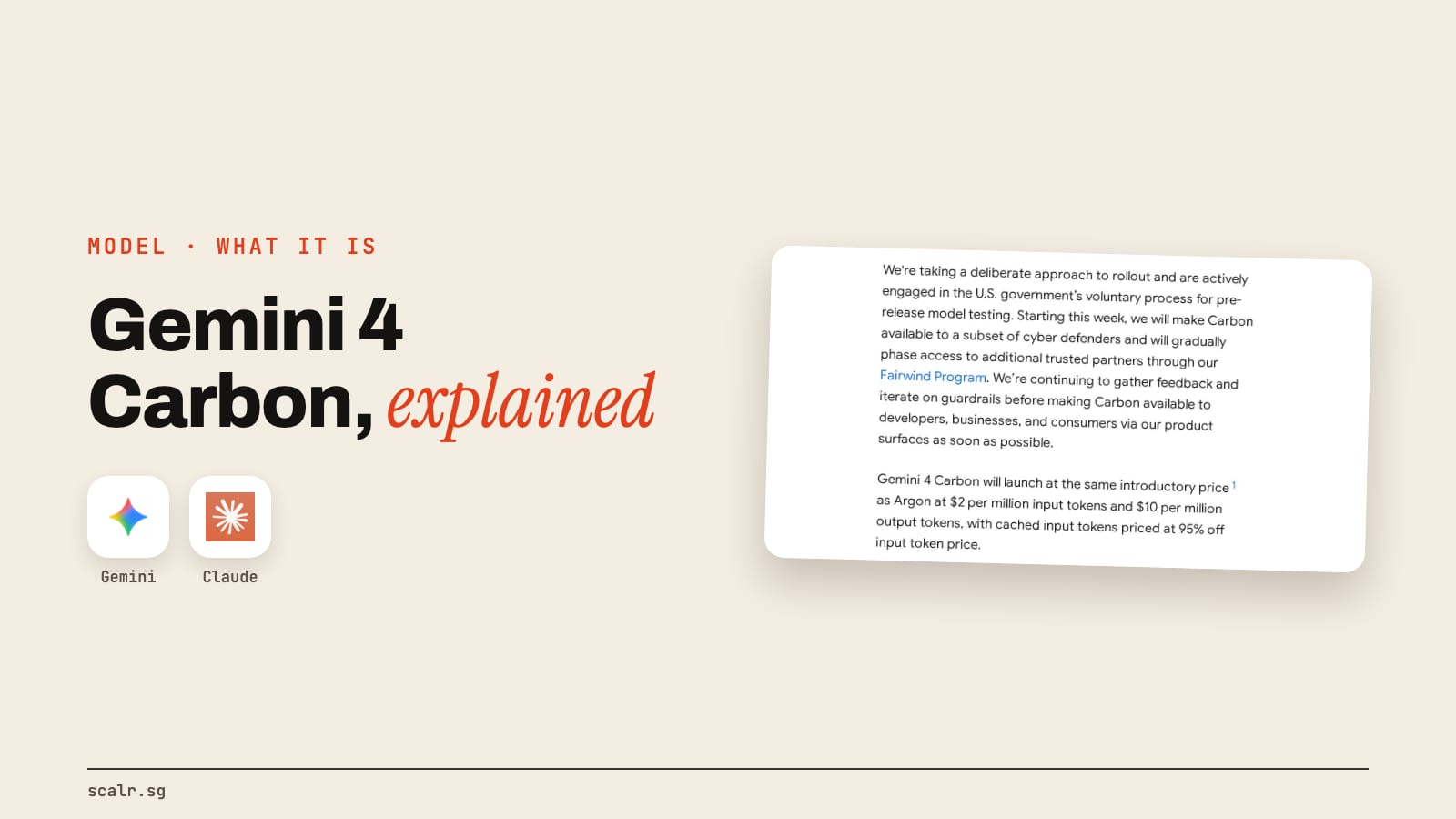
Gemini 4 Carbon is Google DeepMind's newest frontier model, announced on 28 October 2026 and described by Google as its strongest, with state-of-the-art cybersecurity and long-horizon capabilities. Right now only a small group of cyber defenders can use it. Developers, businesses and consumers have no access yet, and Google has given no date.
Carbon is a model you can read about today and mostly can't use, so this page covers what Google has actually said, what it costs, and how it sits next to Claude.
What is Gemini 4 Carbon?
Gemini 4 Carbon is the second model in Google's Gemini 4 family. It builds on Gemini 4 Argon, which Google says launched two weeks earlier, and Google's own one-line description is the clearest summary there is.
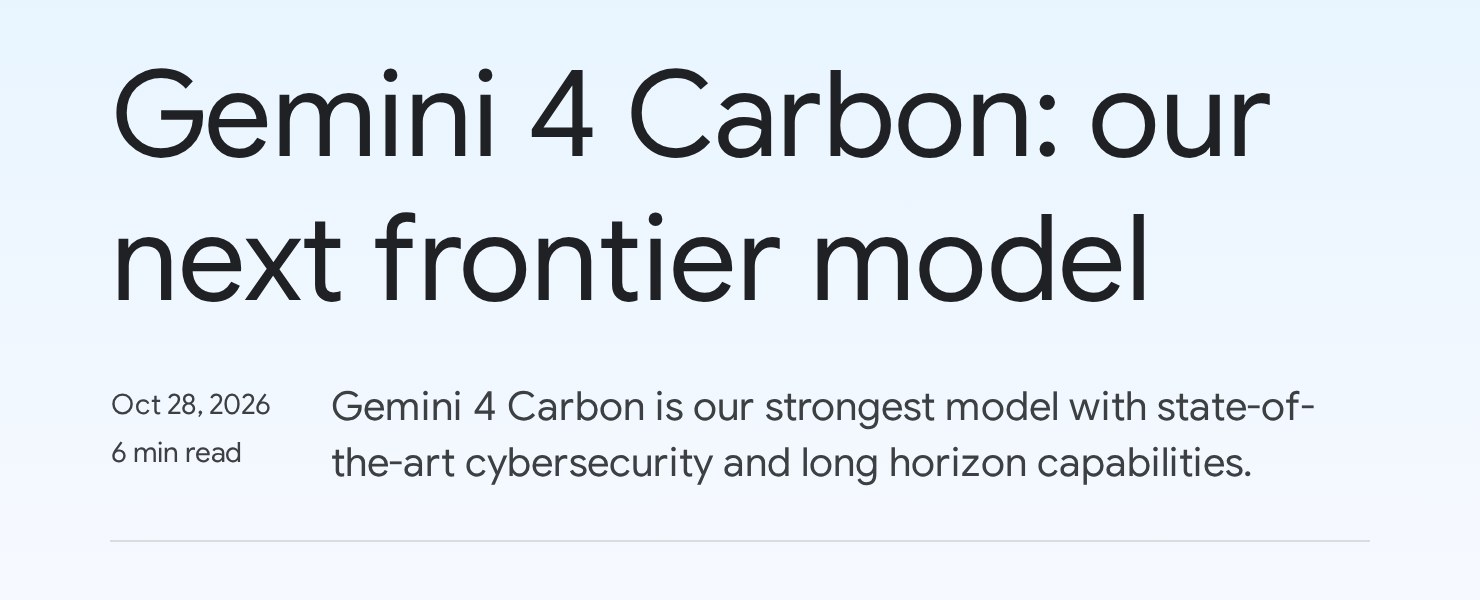
Two ideas carry the announcement. The first is long-horizon work: Google says Carbon is built for sustained agentic workflows, and that its own teams have seen it run for days on multi-step engineering tasks such as root-causing and patching subtle bugs across large codebases. The second is cybersecurity: finding vulnerabilities, checking whether they can be exploited, and writing the fix.
What can Gemini 4 Carbon do, by Google's numbers?
Every figure below comes from Google's own post, so read them as the maker's claims. Google says the cyber benchmarks were run without guardrails.
| What it measures | Carbon's result |
|---|---|
| Artificial Analysis Intelligence Index v5.0 | #1, scoring 59 |
| SEC-bench Pro (finding vulnerabilities) | 88.2%, which Google calls state-of-the-art |
| ExploitGym (exploiting them) | 54.8%, a new state-of-the-art |
| CWE-bench (patching them) | 71.0% |
| WebDev Arena | 1768 Elo, #4, up 89 points |
| Secure code vs Argon (internal) | more than 2x the success rate |
Source: Google's announcement, checked 29 October 2026.
Google also reports behaviour changes, all from its own testing. Successful cheating on Terminal-Bench 4.0 fell to 0.0%, with attempts at 0.4%. High-severity misalignment alerts in live coding dropped by almost 80%. Unsupported claims fell by about half against Argon, and on the Gray Swan prompt-injection benchmark the attack success rate went from Argon's 0.7% to 0.0%.
That last group matters most if you plan to let a model act on its own. Fewer made-up claims and less overreach are the properties that decide whether you can hand an agent a multi-step job. They're also the hardest to verify from outside, because no independent lab has published them for Carbon yet.
Who can use Gemini 4 Carbon today?
Almost nobody. Google says it is making Carbon available "to a subset of cyber defenders" and will widen access to more trusted partners through its Fairwind Program. It is also taking part in the U.S. government's voluntary pre-release testing process.
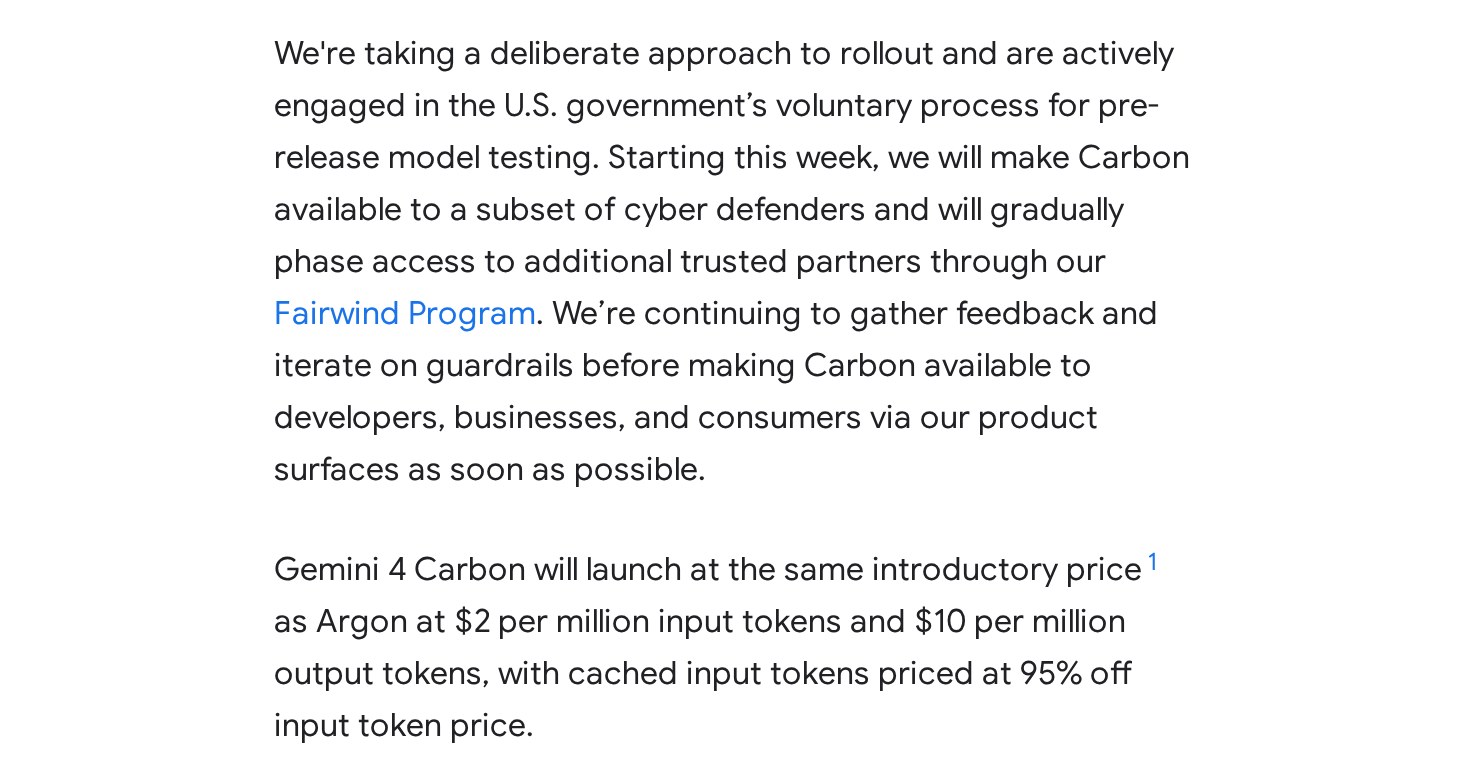
Developers, businesses and consumers come later, "as soon as possible", with no date attached. Argon is further along. Google opened it to developers on 13 October through the paid tier of the Gemini API, so it's the Gemini 4 model a developer can use today.
How much does Gemini 4 Carbon cost?
Google gives an introductory price of $2 per million input tokens and $10 per million output tokens, with cached input 95% cheaper. After the introductory period it goes to $4 per million input and $20 per million output. Google doesn't say how long the introductory period lasts.
For anyone using the app rather than the API, there is no price to quote. Google has not said which Gemini plan will include Carbon, and the announcement doesn't state a context window.
How does Gemini 4 Carbon compare with Claude?
On price, closely. Anthropic's pricing page, checked 29 October 2026, lists these per million tokens:
| Model | Input | Output |
|---|---|---|
| Gemini 4 Carbon, introductory | $2 | $10 |
| Gemini 4 Carbon, after the introductory period | $4 | $20 |
| Claude Sonnet 5.5 | $2 | $10 |
| Claude Opus 5.5 | $4 | $20 |
| Claude Fable 5.1 | $10 | $50 |
So Carbon's introductory price matches Claude Sonnet 5.5 and its later price matches Claude Opus 5.5. Claude's top model, Fable 5.1, costs two and a half times Carbon's later price, which was also the story in what Fable 5 cost when it launched. Anthropic also says Claude's 4.6 and later models, apart from Haiku 5.5, carry the full 1M-token context window at standard pricing, a figure Google hasn't given for Carbon.
On capability, there's no honest head-to-head yet. Google compares Carbon with its own Argon, and with an unnamed "another lab's large frontier model" in one Chrome test, where it says Carbon wrote good patches more than 10 times as well. It doesn't publish a Claude comparison, and the benchmark runs are Google's own. The one external number is the Artificial Analysis ranking, where Google reports Carbon at #1 on version 5.0 of that index.
Three points matter more than the table:
- Price per token isn't price per task. A model that runs for days on a bug can burn far more tokens than a cheaper one that gives up sooner, so the same price can mean very different bills. It's why the price column above is only a starting point. GPT-5.6's three tiers showed the same gap between sticker price and real cost.
- Access is the difference that exists today. Claude's models are on sale now, and Carbon isn't.
- The focus differs. Google leads Carbon's pitch with defensive security. Anthropic describes Claude Opus 5.5 as built for long-running agentic coding and knowledge work, which overlaps on the long-task side but isn't the same headline.
Should you wait for Gemini 4 Carbon?
If you run a business on AI and your work is writing, marketing, research or admin, no. Carbon's announced strengths are security and engineering, you can't reach it yet, and the model you already use won't stop working while Google finishes its rollout.
If you build software or work in security, watch for the general launch and for independent results. Two things would change the picture: a published context window and plan, and a third-party run of the same benchmarks against Claude.
For everyone, the sensible rule with any launch like this is to test the model on one of your own real tasks before moving anything over, because a benchmark shows where a model is strong but not whether that strength touches your work.
FAQ
What is Gemini 4 Carbon?
Gemini 4 Carbon is Google DeepMind's frontier model announced on 28 October 2026. Google calls it its strongest model, with state-of-the-art cybersecurity and long-horizon capabilities, and it follows Gemini 4 Argon.
Can I use Gemini 4 Carbon now?
Not unless you're part of the cyber defender group Google has chosen. Access widens gradually through the Fairwind Program, and Google says developers, businesses and consumers come "as soon as possible" with no date.
How much does Gemini 4 Carbon cost?
The introductory price is $2 per million input tokens and $10 per million output tokens, with cached input 95% off. After the introductory period it is $4 and $20.
Is Gemini 4 Carbon better than Claude?
Nobody can say yet. Google's benchmarks compare Carbon with its own Argon rather than Claude, and no independent head-to-head has been published. On price, Carbon's later rate matches Claude Opus 5.5.
What is the difference between Gemini 4 Argon and Carbon?
Carbon builds on Argon, launched two weeks earlier. Google says Carbon doubles Argon's success rate at generating secure code in internal tests and cuts unsupported claims by about half. Both sit at the same introductory price.
Does Gemini 4 Carbon have a context window?
Google's announcement doesn't state one. Check the model's documentation when it reaches developers.