AI systems
GPT-5.6's Three Tiers, Explained (and When Each One Is Worth It)
GPT-5.6 ships as three separate models, Sol, Terra, and Luna, at three different prices. Here is what each one actually costs, where the benchmark gaps are real, and which one to default to.

GPT-5.6 doesn't ship as one model. It ships as three: Sol, Terra, and Luna, priced five times apart on both input and output, with benchmark gaps that are often much narrower than that price gap suggests. The practical question isn't whether GPT-5.6 is good. It is which tier earns its price for the work you actually do.
What is GPT-5.6, and why does it ship as three tiers?
OpenAI released GPT-5.6 across ChatGPT, Codex, and the API as three separate models under one generation number: Sol (the flagship), Terra (the balanced default), and Luna (the fast, cheap tier). The bare gpt-5.6 API alias routes to Sol unless you specify otherwise. GPT-5.4 retires July 23, 2026. GPT-5.5 stays available alongside all three new tiers, so if you're mid-migration there is no forced cutover date for the model you're already using, only for the one being retired.
The tier split itself is the more interesting decision. Instead of one flagship model and a cheaper "mini" as an afterthought, OpenAI is explicitly selling three price points off the same generation, and betting that most of the market will choose the middle one once they see the numbers.
What do Sol, Terra, and Luna actually cost?
Per million tokens, input and output:
- Sol: $5 input, $30 output.
- Terra: $2.50 input, $15 output.
- Luna: $1 input, $6 output.
Sol costs five times what Luna costs, on both sides of the ledger. That is the number to hold in your head for the next section, because the benchmark gap between the two is nowhere near five times.
How do the three tiers actually perform?
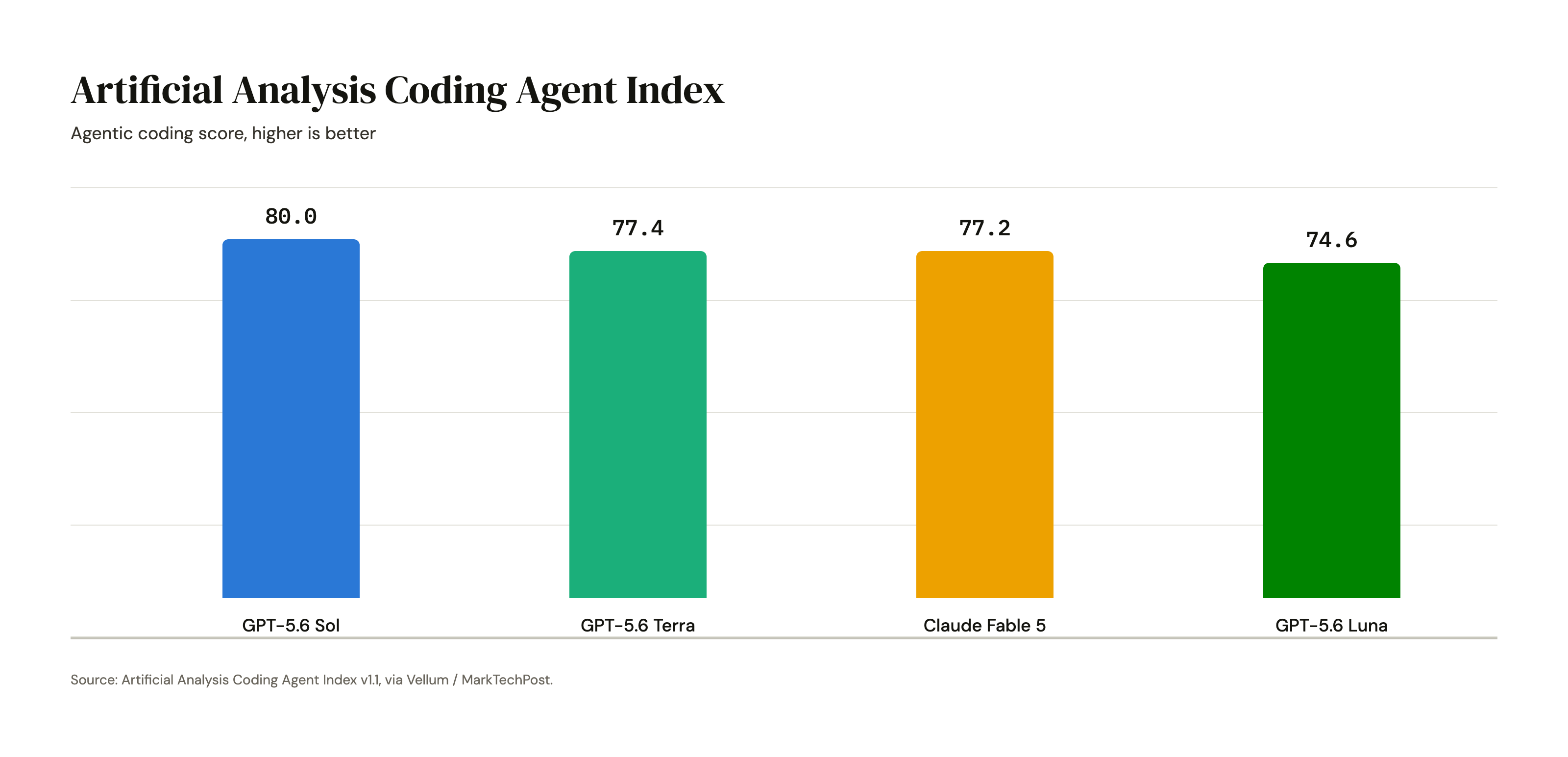
Benchmark scores across the three tiers
- Terminal-Bench 2.1 (agentic terminal work): Sol 88.8%, Terra 87.4%, Luna 84.7%.
- Artificial Analysis Coding Agent Index (agentic coding): Sol 80, Terra 77.4, Luna 74.6.
- Agents' Last Exam (long-horizon professional workflows): Sol 53.6, Terra 50.4, Luna 50.3.
- MRCR long-context recall: Sol 91.5%, Terra 89.6%, Luna a sharp cliff at 41.3%.
- SWE-Bench Pro (pure code generation): Sol 64.6%.
- OSWorld 2.0 (computer use): Sol 62.6%.
- BrowseComp (web browsing tasks): Sol 92.2%.
- ExploitBench 1 (cybersecurity): Sol 73.5%.
Two things stand out. First, on most benchmarks Terra sits within 2 to 3 points of Sol at half the price, which is a genuinely good trade. Second, Luna's long-context recall cliff (41.3%, against Terra's 89.6%) means Luna is fine for short, high-volume jobs like classification or summarising, and a poor choice for anything that needs to remember a long conversation or a large document.
There is also a cost-efficiency angle worth naming separately from raw score. Trilogy AI's cost-per-point analysis puts Luna at roughly 24 benchmark points delivered per estimated API dollar, against 4.5 for Claude Opus 4.8 and 3.2 for Claude Fable 5. Luna's built to win on work done per dollar rather than on capability, and it wins by a wide margin, which is exactly why it exists as a separate tier rather than just a cheaper checkbox on Sol.
Worth noting for anyone comparing across labs: on pure code generation, Claude Fable 5 scores 80.3% on SWE-Bench Pro, still ahead of Sol's 64.6%. If repo-level coding is your primary workload rather than broad agentic work, that gap is worth knowing about before you pick a default. On the Artificial Analysis Coding Agent Index, though, Fable 5 sits almost exactly between Terra and Luna at 77.2, which tells you the two labs aren't measuring quite the same thing, and a single benchmark rarely tells the whole story.
Which tier should you actually use?
- Default to Terra. It matches or comes within a few points of Sol on most benchmarks at half the price. Unless you've a specific reason to reach for Sol, start here.
- Escalate to Sol for long-horizon multi-step workflows, complex terminal operations, security research, or anything using computer-use browsing, where the gap actually opens up. BrowseComp (92.2%) and OSWorld 2.0 (62.6%) are both Sol-only-reported numbers for a reason, that is where the extra reasoning budget earns its keep.
- Use Luna for high-volume, low-complexity work: classification, summarisation, simple extraction. Avoid it for anything that needs to hold a long context in mind, and lean on its cost-per-point advantage when the task genuinely is that simple.
- Ultra mode (Sol only, spawns four parallel subagents) costs roughly three times single-agent Sol for about 3 extra points on Terminal-Bench. Use it when correctness matters more than the bill, not as a default.
My own read, running SCALR mostly on Claude day to day: this is the same shape of decision I make every time I reach for Fable 5 instead of Opus 4.8. Most of what I ship does not need the top tier. It needs "good enough, reliably, at a price that scales." Terra and Luna existing as real, separately priced options, rather than one model you either pay full price for or don't use, is the more honest pricing model. It forces you to actually think about which task you are routing, instead of defaulting to the flagship because it's the only name you remember.
What would a real workload actually cost across the three tiers?
Take a mid-sized agentic coding task: roughly 500,000 input tokens (the model reading your codebase, tool outputs, and context) and 100,000 output tokens (the actual code and reasoning it produces) per run. Run that ten times in a week, a realistic cadence for a small team shipping features.
Same workload, three tiers, per week
- Sol ($5 in / $30 output per million): 5M input tokens = $25, 1M output tokens = $30. Total: $55/week.
- Terra ($2.50 in / $15 output per million): 5M input tokens = $12.50, 1M output tokens = $15. Total: $27.50/week.
- Luna ($1 in / $6 output per million): 5M input tokens = $5, 1M output tokens = $6. Total: $11/week.
Terra costs exactly half of Sol here, which tracks with its pricing. Over a month, that's roughly $220 for Sol versus $110 for Terra, for work that Terra handles within 2 to 3 benchmark points of Sol on most agentic tasks.
The gap only matters if the 2 to 3 points are the ones you actually need. For most day-to-day shipping work, they're not. For a genuinely hard, long-horizon task, they might be exactly the points that make the difference between a working result and one you've to redo, and redoing work is more expensive than the price difference between tiers ever was.
How does GPT-5.6 compare to Claude's frontier lineup?
This landed in the same window as a genuinely eventful stretch for Claude's own frontier model, Fable 5: a launch that benchmarked well above Opus 4.8, a US government shutdown three days later, a restricted return, and now a move off standard subscription access into metered API pricing from July 12. I wrote up that whole arc, with real cost numbers from my own usage, separately, if you're trying to work out what any of this actually costs you month to month rather than just which benchmark wins.
The short version for anyone comparing the two: GPT-5.6's three-tier pricing structure means you can deliberately trade a few benchmark points for a real price cut by defaulting to Terra or Luna. Fable 5 doesn't currently offer that same tier choice, it is one model at one price, and that price is about to become metered API pricing for most subscription users rather than something included in their plan. Which structure suits you depends on whether you would rather choose your price point per task the way GPT-5.6 lets you, or pay one rate for one ceiling the way Fable 5 currently does.
If you want a cheap, fast tier for high-volume simple work with an official price break, GPT-5.6 gives you one in Luna. If your work is genuinely at the coding frontier, Fable 5's SWE-Bench Pro score still leads outright. Neither lab has the complete answer for every workload, which is exactly why a small business should be picking per-task rather than per-lab. OpenAI has since shipped GPT-6 Astra, the release its own president called the start of the AGI era, and the per-task logic below survives it unchanged.
Key takeaways
- GPT-5.6 ships as three separately priced models: Sol, Terra, Luna, five times apart on cost.
- The benchmark gap between tiers is much smaller than the price gap, especially between Sol and Terra.
- Terra is the sensible default for most agentic work; Luna's long-context cliff makes it a poor fit for anything that needs to remember a lot, but it delivers roughly 24 benchmark points per API dollar, the best cost-efficiency of the three.
- Ultra mode triples the cost of Sol for a small performance gain, reserve it for when correctness matters more than budget.
- If you're also weighing this against Claude's lineup, Fable 5 still leads outright on pure code generation, and its own pricing situation just changed on July 12.
FAQ
Which GPT-5.6 tier should I default to?
Terra, for most agentic and coding work. It lands within a few points of Sol on nearly every benchmark at half the price.
Is Luna good for anything beyond cheap, simple tasks?
Yes, for high-volume classification and summarisation where the input is short. It delivers the best benchmark-points-per-dollar of the three tiers. Avoid it for tasks needing long-context recall, where it drops sharply to 41.3%.
Does GPT-5.6 replace GPT-5.5?
GPT-5.4 is being retired on July 23, 2026. GPT-5.5 stays available alongside GPT-5.6's three tiers, so there is no forced migration off GPT-5.5 itself.
Is GPT-5.6 Sol better than Claude Fable 5?
It depends what you're measuring. Fable 5 still leads on pure code generation (80.3% vs 64.6% on SWE-Bench Pro). Sol's strengths show up in terminal-driven agentic work, computer use, and browsing tasks.
Is Ultra mode worth the extra cost?
Only when correctness matters more than budget. It roughly triples single-agent Sol's cost for a few extra points on Terminal-Bench, not a default setting.
Why does Luna score so much lower on long-context recall specifically?
The MRCR benchmark tests whether a model can retrieve specific facts buried deep in a long conversation or document. Luna is built for short, fast, cheap tasks, so this is the one area where its cost savings show up as a real capability cliff, not just a smaller lead.