Singapore
AI Companies in Singapore: Who Is Building What, and Where the Jobs Are
The big AI companies in Singapore include OpenAI, Anthropic, Google DeepMind, Visa, Grab, AWS and Microsoft. Here's what each one actually does here, how many roles each has named in public, and where to look if you want to work on AI in Singapore.
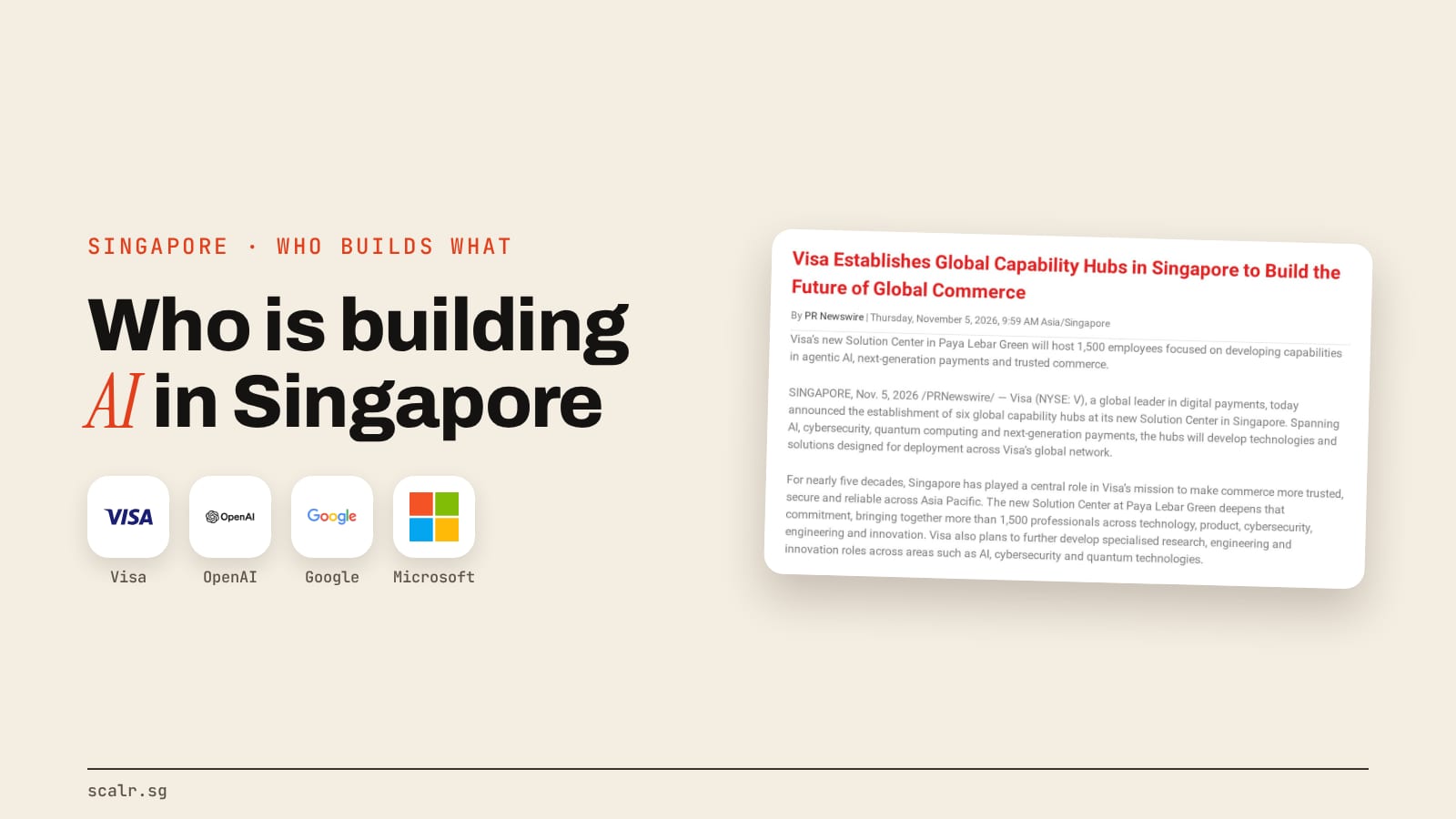
The biggest AI companies in Singapore fall into three groups. Visa and Grab apply AI to their own business here. OpenAI, Anthropic, Google DeepMind and AI Singapore build or adapt AI models here. AWS and Microsoft run the cloud capacity they all run on. Visa is the latest: 1,500 staff in six hubs at Paya Lebar Green.
That last one's why this page exists today. On 5 November 2026 Visa announced six global capability hubs at a new site in Paya Lebar Green. The page will stay useful after the news fades, because people don't stop searching for who does AI here and whether they hire.
The nine, at a glance
- Visa: six hubs and 1,500 staff at Paya Lebar Green
- Grab: training its own AI model at its one-north headquarters
- OpenAI: its first Applied AI Lab outside the US, growing past 200 roles
- Anthropic: its fifth Asia-Pacific office, with a government MOU on AI safety
- Google DeepMind: its first research lab in Southeast Asia
- AI Singapore: free SEA-LION models for Southeast Asian languages
- AWS: S$12 billion more for its Singapore cloud by 2028
- Microsoft: US$5.5 billion on cloud and AI here from 2025 to 2029
- Nvidia: the big "Singapore revenue" figure that isn't really about Singapore
The list is grouped by the kind of work done here, not ranked, because the kind of work decides what the jobs look like. Companies using AI inside their own business come first, then the model makers, then the cloud spend, then one name that looks bigger on paper than it is on the ground.
1. Visa is putting six hubs and 1,500 staff at Paya Lebar Green
It's the newest entry and the largest headcount on the list. Visa's release says the new Solution Center "will host 1,500 employees" working on agentic AI, next-generation payments and trusted commerce.
The six hubs sit under three areas, per TNGlobal's report: AI and commerce (including how AI agents pay merchants safely), next-generation payments (digital money, stablecoins, programmable payments, wallets) and trust and security (cybersecurity, plus quantum computing research for finance). Named local partners include DBS, AXS, Nium and StraitsX.
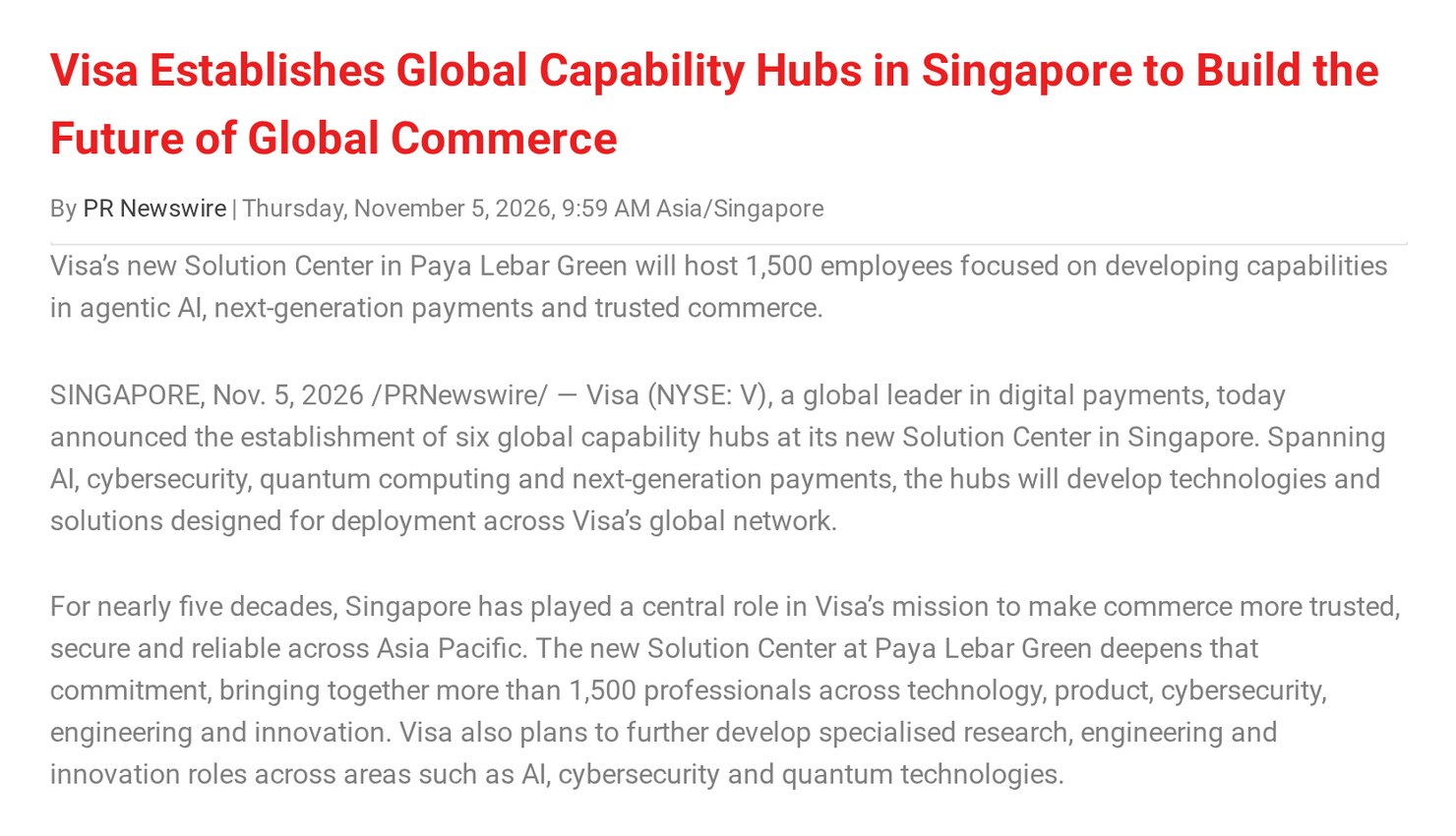
What it requires: read the number carefully. The release says the site is "bringing together more than 1,500 professionals", and Visa has been in Singapore for nearly five decades. The Economic Development Board's Beng Kong Pee said the hubs "will create new high-value jobs for Singaporeans", but nobody has said how many of the 1,500 are new hires and how many already work for Visa here. The figures come from Visa's own release. What's stated is that Visa plans to add specialised research and engineering roles in AI, cybersecurity and quantum.
2. Grab is training its own AI model at its one-north headquarters
Grab's the local name on this list, and it builds AI for its own app rather than selling it. In May 2025 it opened an AI Centre of Excellence in Tower B of its one-north headquarters, with support from Digital Industry Singapore.
The centre is building a specialised foundation model trained on Grab's own data, to predict how riders, drivers and merchants behave. Its public projects include a voice assistant that lets visually impaired users book rides, and flood and road-hazard monitoring with PUB. Grab doesn't only build its own, either: Anthropic says Grab's Claude-based sales assistant saves its sales teams about 40,000 hours a quarter.
What it requires: product, engineering, data science and analytics skills. Grab said the centre would create at least 50 high-value roles by 2025.
3. OpenAI is building its first Applied AI Lab outside the US here
OpenAI first said it would open a Singapore office in October 2024. On 20 May 2026 it went much further: OpenAI for Singapore, a commitment of more than S$300 million signed with the Ministry of Digital Development and Information (MDDI) at ATxSummit.
At its centre is the OpenAI Singapore Applied AI Lab, the company's first outside the US. Its work points at public services, finance, healthcare and digital infrastructure, and the job is putting existing models to work inside companies and agencies rather than training new frontier models.
What it requires: the lab is hiring forward-deployed engineers and technical specialists, people who sit with a client and build the thing that solves the client's problem. OpenAI says the team will grow to more than 200 roles over the next few years.
4. Anthropic opened its fifth Asia-Pacific office here in October
Anthropic opened its Singapore office on 14 October 2026, its fifth office in Asia-Pacific. The same day it signed an MOU with MDDI covering AI safety, model evaluation, responsible adoption, SME adoption and AI skills for public officers.
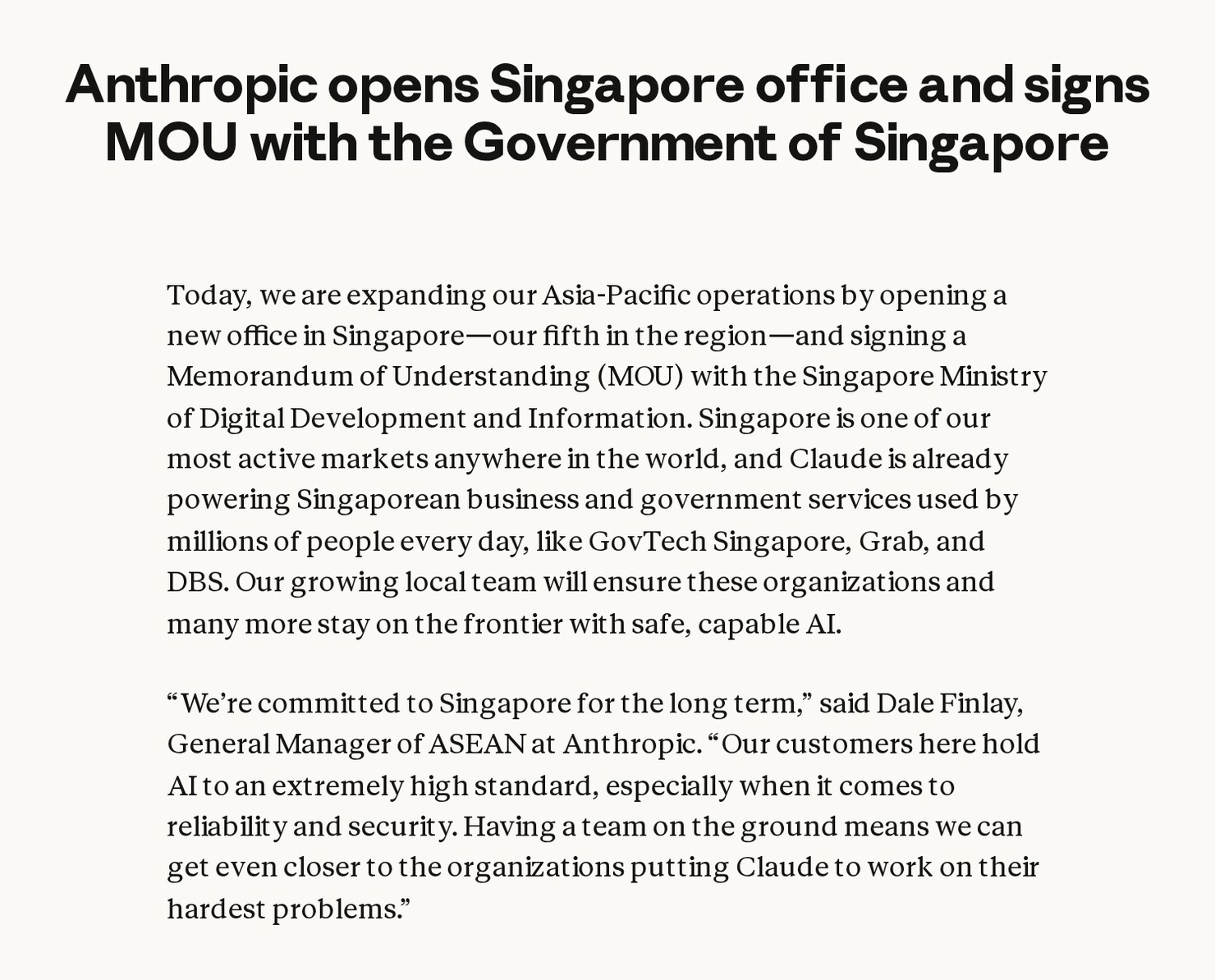
Anthropic's own numbers on Singapore are hard to ignore. Its Economic Index ranks Singapore second of 121 countries for Claude.ai use relative to population, and it says more than 1,500 engineers and technical staff at GovTech Singapore use Claude Code. The office is led by Dale Finlay, Anthropic's general manager for ASEAN.
What it requires: Anthropic says the office is hiring but hasn't published a headcount target. You'll find the roles on its careers page.
5. Google DeepMind opened its first Southeast Asian research lab here
Google DeepMind announced a Singapore research lab on 19 November 2025. It's DeepMind's first lab in Southeast Asia, and the only one on this list doing frontier model research rather than deployment.
The lab works on Gemini, with a focus on making it handle the region's languages and cultures better, and on applying the newest models across Google products and for Google Cloud customers.
What it requires: research scientists, software engineers and what Google calls AI impact experts. Google hasn't disclosed a hiring target or an investment figure.
6. AI Singapore builds free SEA-LION models for Southeast Asian languages
AI Singapore is the national programme, and SEA-LION is its family of language models built for Southeast Asian languages. They're free to download on Hugging Face, and the current v4 line is built on top of other companies' open models, including Google's Gemma, then trained further on regional languages. The approach is described in AI Singapore's SEA-LION paper.
It's the one entry where a Singapore team adapts a model that anyone can download and run themselves.
What it requires: nothing to use, beyond a machine or cloud account big enough to run it. For people who want to work on it, AI Singapore runs the AI Apprenticeship Programme, a sponsored, full-time programme that pays apprentices a monthly stipend.
7. AWS is spending S$12 billion more on its Singapore cloud by 2028
Most of the AI on this list runs in someone else's data centre. In May 2024 AWS said it would invest another S$12 billion in its Singapore cloud region from 2024 to 2028, doubling its total to more than S$23 billion.
That came with AWS AI Spring, a programme lined up with Singapore's National AI Strategy 2.0, including a goal of training 5,000 people a year in AI skills from 2024 to 2026.
What it requires: it's mostly infrastructure money, not AI research headcount. AWS's own study estimates the spend supports about 12,300 jobs a year in local businesses, which counts suppliers and partners, not AWS staff.
8. Microsoft is spending US$5.5 billion on cloud and AI here from 2025 to 2029
In April 2026 Microsoft said it would spend US$5.5 billion on cloud and AI infrastructure and operations in Singapore over 2025 to 2029.
The skills side is what most people will actually touch: free Microsoft 365 Premium with Copilot for tertiary students in Singapore, plus free AI training for teachers and nonprofit leaders.
What it requires: like AWS, it's infrastructure first. There's no AI hiring number attached to it.
9. Nvidia's big "Singapore revenue" number isn't about Singapore
It's the one that gets misread. Nvidia's annual report for the year to January 2025 put US$23.7 billion of revenue, about 18% of the total, under Singapore. The same filing explains why: customers use Singapore to centralise invoicing, while the chips almost always ship elsewhere. Shipments to Singapore were under 2% of revenue. Singapore came up again in November 2026, when a Singapore-based Nvidia customer under investigation sat at the centre of the scandal that ended Jensen Huang's run as CEO, covered in what Nvidia's worst week means for the Anthropic IPO.
What it requires: some scepticism. A large billing number tells you Singapore's a convenient place to send invoices from. It doesn't say much about where AI work or AI jobs are.
Where are the AI jobs in Singapore?
Here's what each company has said in public about roles, and where to look. Every number is the company's own.
| Company | Roles named in public | Where to look |
|---|---|---|
| Visa | 1,500 staff at the site (new hires not split out) | Visa careers |
| OpenAI | 200+ over the next few years, mostly forward-deployed engineers | OpenAI careers |
| Grab | At least 50 at the AI centre by 2025 | Grab careers |
| Anthropic | Hiring, no target published | Anthropic careers |
| Google DeepMind | Hiring, no target published | DeepMind careers |
| AI Singapore | Apprenticeship intakes | AIAP |
For everything else, the government's MyCareersFuture job board lists Singapore roles, and searching "AI" there catches the smaller firms this list leaves out. If the gap is skills rather than openings, the AI courses your SkillsFuture Credit pays for are a cheaper first step than a career switch.
What does this list add up to?
Most of the AI work arriving in Singapore is applied work, where the job is putting models that already exist to use, and that's where most of the publicly named roles sit. OpenAI's lab deploys models, Anthropic's office supports companies already using Claude, Visa builds payment products, and Grab builds for its own app. Model work is the smaller share: Google DeepMind does frontier research here, AI Singapore adapts open models, and Grab trains a model on its own data. The people those teams want can take a model and make it do something useful inside a real business. The same pattern shows up among small firms: IMDA's 2026 report found most adopters still use AI off the shelf.
Key takeaways
- Visa's six Paya Lebar Green hubs will host 1,500 staff, but the company hasn't said how many are new hires.
- OpenAI's Applied AI Lab, its first outside the US, is the clearest public hiring number for AI work: more than 200 roles.
- Anthropic, Google DeepMind and Grab all run AI teams here, and Google DeepMind is the only one doing frontier model research.
- AWS and Microsoft's billions are cloud infrastructure, and Nvidia's "Singapore revenue" is mostly invoicing.
FAQ
Which AI companies have offices in Singapore?
OpenAI, Anthropic, Google DeepMind, Microsoft and AWS all operate in Singapore, alongside Visa and Grab, which run large AI teams for their own products. Anthropic's office opened on 14 October 2026, OpenAI's Applied AI Lab was announced on 20 May 2026, and Google DeepMind's lab was announced on 19 November 2025.
Is Visa hiring 1,500 people in Singapore?
Not exactly. Visa announced on 5 November 2026 that its Paya Lebar Green Solution Center will host 1,500 employees, but the release describes this as bringing staff together and doesn't say how many roles are new. Visa says it plans to add more research and engineering roles in AI, cybersecurity and quantum.
Does OpenAI have an office in Singapore?
Yes. OpenAI announced a Singapore office in October 2024, and on 20 May 2026 it committed more than S$300 million to OpenAI for Singapore. That includes its first Applied AI Lab outside the US, which plans to grow to more than 200 roles, mostly forward-deployed engineers.
What is SEA-LION from AI Singapore?
SEA-LION is a family of free, open language models from AI Singapore, trained to handle Southeast Asian languages better than general models. The current v4 versions are built on other open models such as Google's Gemma and are free to download on Hugging Face.
Where can I find AI jobs in Singapore?
Start with the careers pages of the companies hiring for AI here: Visa, OpenAI, Grab, Anthropic and Google DeepMind. The government's MyCareersFuture job board covers smaller firms, and AI Singapore's AI Apprenticeship Programme is a paid route in for Singaporeans building AI skills.