Singapore
SME AI Adoption in Singapore Hit 23.4%: What IMDA's 2026 Report Shows
IMDA's new report says SME AI adoption in Singapore rose from 14.5% to 23.4% in a single year. The numbers behind that headline, the reason most small firms give for skipping AI, and why most adopters are still testing it.
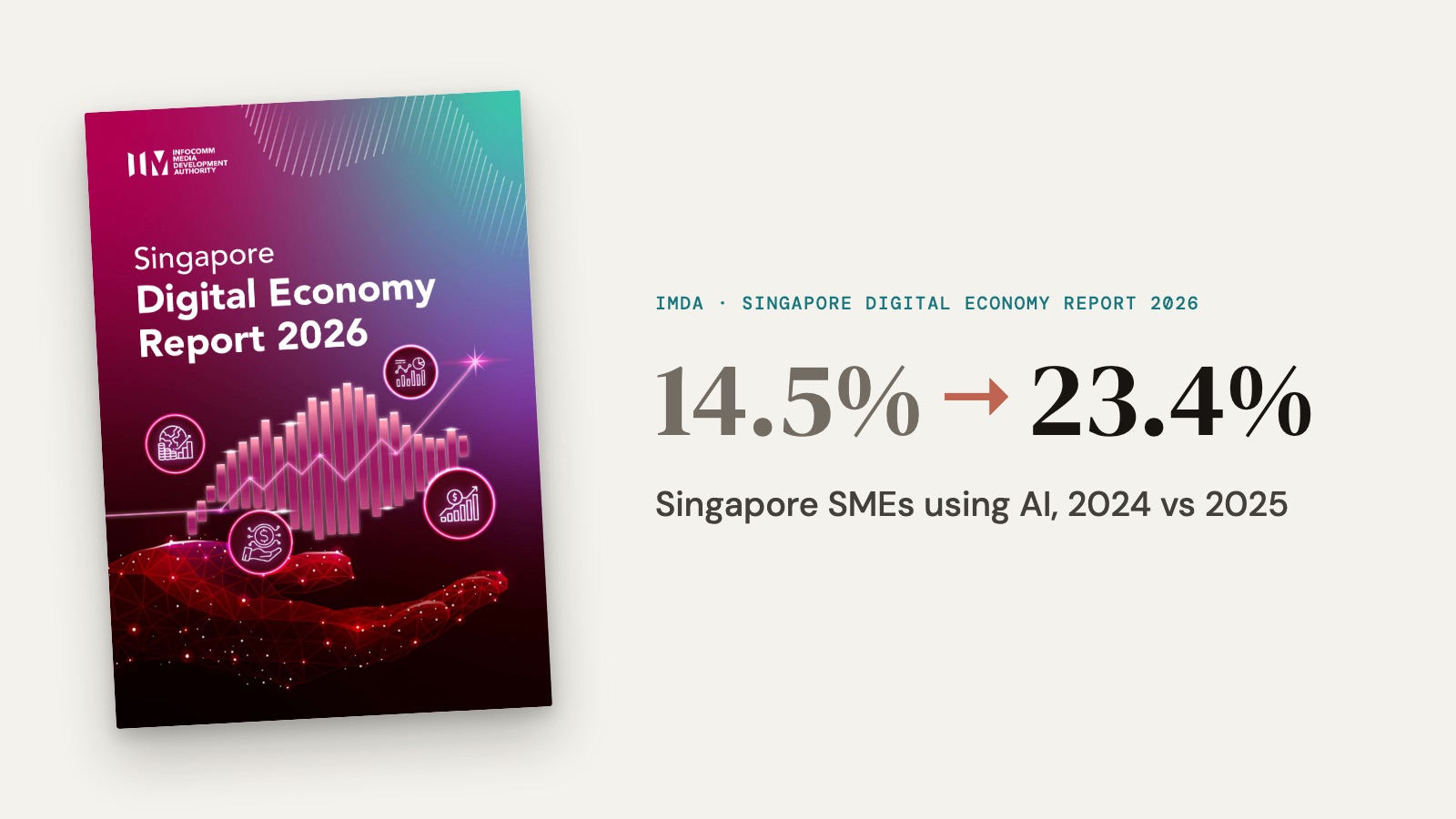
Singapore's SME AI adoption rate rose from 14.5% in 2024 to 23.4% in 2025, according to IMDA's Singapore Digital Economy Report 2026, published on 5 October. Larger firms went from 62.5% to 70.4%. Roughly one in four small businesses now uses AI, and most of them are still using it in its simplest form.
I read the full report rather than the headlines, because the headline number is the least interesting thing in it. The more useful findings sit a few pages in: what the other three in four say when asked why they haven't started, and how shallow most of the adoption still is.
What did IMDA's 2026 report find about SME AI adoption?
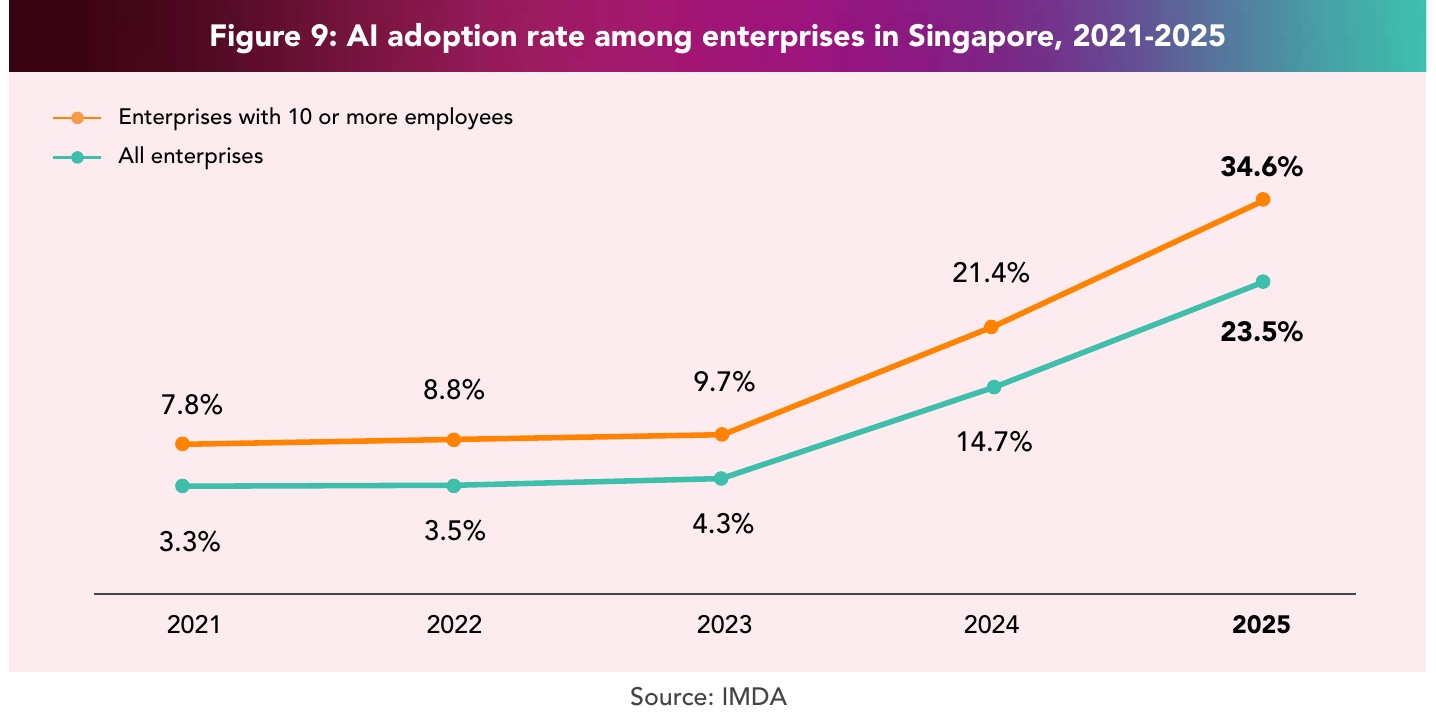
The jump is real and it's recent. Across all enterprises, AI adoption sat at 3.3% in 2021, crept to 4.3% by 2023, then climbed to 14.7% in 2024 and 23.5% in 2025. Among companies with ten or more staff it reached 34.6%, which IMDA puts well above the OECD average of 20.3% and behind only Denmark, Finland and Sweden among the OECD countries with 2025 data.
Here are the figures that matter for a small business, all from the same report.
| What IMDA measured | 2024 | 2025 |
|---|---|---|
| SMEs using AI | 14.5% | 23.4% |
| Non-SMEs using AI | 62.5% | 70.4% |
| All enterprises using AI | 14.7% | 23.5% |
| Enterprises with 10+ staff using AI | 21.4% | 34.6% |
| Workers in AI-adopting firms able to use AI | 66.4% | 71.9% |
The wider economy grew alongside it. The digital economy reached S$144.1 billion in 2025, or 19.3% of GDP, and grew 5.6% against nominal GDP growth of 3.1%. IMDA credits most of the year's digital progress to SMEs, which posted one of their largest jumps in digital adoption intensity in recent years.
Which industries in Singapore use AI the most?
Information and communications leads at 46.8%, followed by professional services at 34.5% and finance and insurance at 27.6%. The more interesting movement is further down the list. Retail went from 8.9% to 18.9% in a year, manufacturing from 8.9% to 18.0%, wholesale from 6.6% to 15.3%, and food and accommodation from 10.3% to 17.7%. Construction barely moved, from 7.4% to 7.6%.
These numbers are for all enterprises, not just SMEs, so read them as a direction for your industry, not its exact SME rate.
Why are most small businesses in Singapore still not using AI?
Because they don't think they're big enough to need it. Among firms that hadn't adopted AI, 54.7% gave "do not see the need due to small business" as a reason in 2025, barely down from 57.4% in 2023.
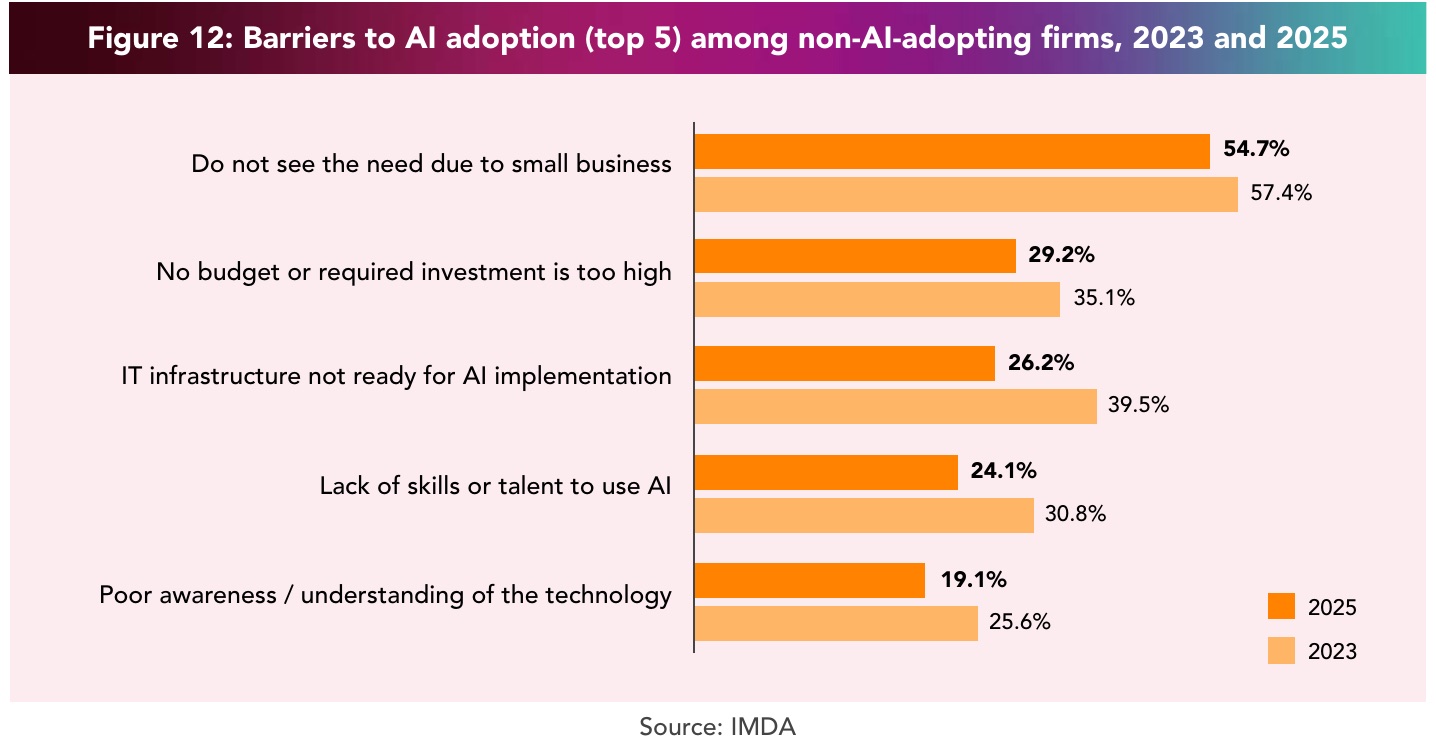
Every other barrier on the list fell much faster. Firms citing IT infrastructure that isn't ready dropped from 39.5% to 26.2%. A lack of skills went from 30.8% to 24.1%, cost from 35.1% to 29.2%, and poor awareness from 25.6% to 19.1%. The practical obstacles are shrinking fast. The belief that AI is only for bigger companies isn't moving.
There's movement underneath that, though. Among firms that hadn't adopted AI, 12.1% said in 2025 they planned to within the next twelve months, up from 5.6% in 2023.
Are Singapore companies getting real value from AI?
Most say yes, mainly in time saved. Among AI-adopting firms, 87.6% reported productivity and process improvements and 44.0% reported lower costs. Fewer reported growth benefits: 28.7% said AI helped them keep existing customers, 27.8% said it helped win new ones, and 24.5% said it contributed to more revenue.
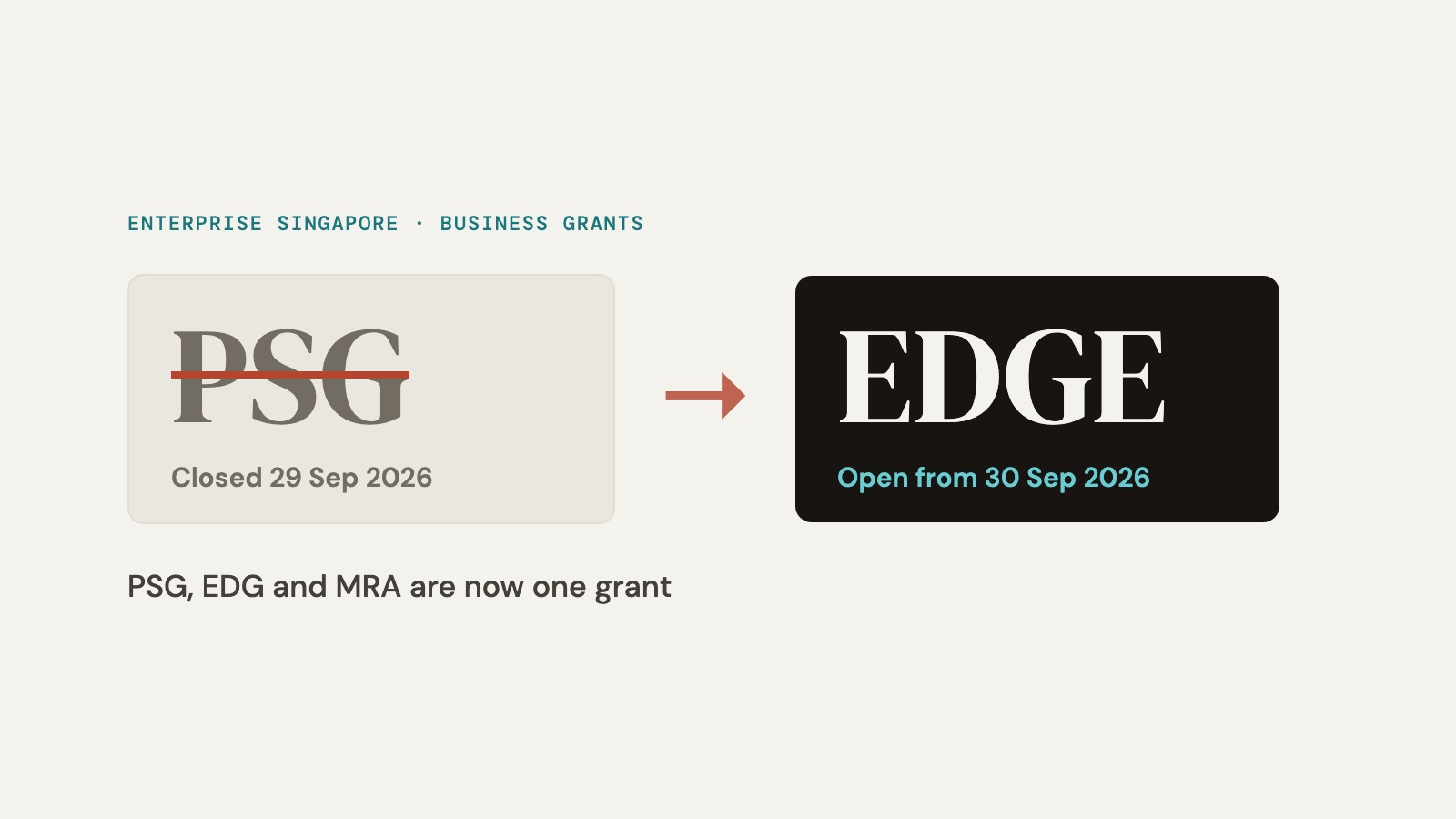
There's one SME-specific number worth knowing. Small businesses that bought AI-enabled pre-approved solutions through the Productivity Solutions Grant reported average cost savings of 49.5% in 2025. IMDA notes that figure is self-declared by the grant applicants, so read it as what owners felt, not an audited result. That grant closed to new applications on 29 September; here's what the EDGE Grant covers now.
How deep does AI adoption go in Singapore companies?
Not very deep yet. Close to nine in ten AI-adopting firms, 89.6%, use commercial AI tools straight off the shelf with no customisation. Only 28.3% have customised a commercial tool, and 23.0% use tools built in-house or by an outside developer for their specific needs.
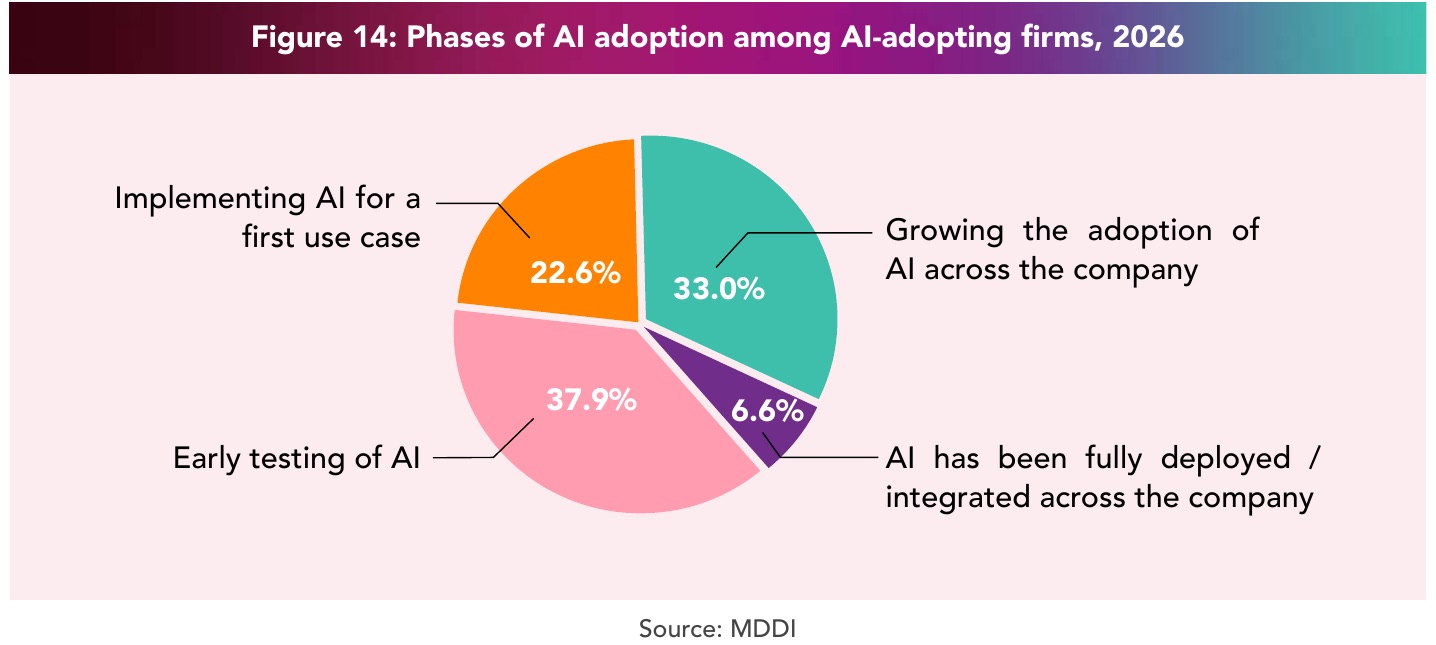
The phases tell the same story. Among firms that use AI, 37.9% are still in early testing and 22.6% are implementing their first use case. A third, 33.0%, are growing AI across the company, and just 6.6% say it's fully deployed.
The worker data lines up with it. 85.7% of surveyed workers used AI at work in 2026, up from 77.6% a year earlier, and most use it daily or weekly. Yet employers said 47.6% of their staff use it only for general tasks, against 19.3% for intermediate tasks and 5.0% who can build or deploy AI for complex ones. More than two-thirds of workers said they need to upskill in AI, while 36.7% had attended any AI training in the past year.
If you've read my piece on the four levels of AI adoption, this is that gap in official numbers. Most adopters are on the first two levels, using a chat tool when they remember to or as part of their day, and a small group has started building AI into how the business actually runs.
What I take from the report
The number I keep coming back to is the 54.7%. I run SCALR by myself. I edit my own videos through an AI pipeline I built, and I post to seven platforms through automation. A business my size is exactly the kind that would tell IMDA it's too small to need AI, and it's the reason I can run at all.
That doesn't mean every small business should rush out and buy a tool. Plenty of problems in a business don't need AI, and the report shows what happens when firms adopt without a plan: nine in ten use something off the shelf, and most are still testing. What I'd watch for is the jump that only a small group has made so far, from using AI to building it into the work. That jump is the work SCALR does: setting AI up inside a business's real day-to-day work, alongside the team that runs it.
Key takeaways
- SME AI adoption in Singapore rose from 14.5% to 23.4% between 2024 and 2025, per IMDA's Singapore Digital Economy Report 2026.
- The top reason non-adopters give is still "we're too small to need it", cited by 54.7%, while cost, skills and IT barriers all fell sharply.
- 87.6% of AI-adopting firms report productivity gains, but far fewer report new customers (27.8%) or more revenue (24.5%).
- 89.6% of adopters use off-the-shelf AI with no customisation, and only 6.6% say AI is fully deployed across the company.
FAQ
What percentage of Singapore SMEs use AI in 2026?
23.4% of Singapore SMEs had adopted AI in 2025, up from 14.5% in 2024. The figure comes from IMDA's Singapore Digital Economy Report 2026, published in October 2026, which reports on 2025. Among larger firms the rate was 70.4%.
What is IMDA's Singapore Digital Economy Report 2026?
The Singapore Digital Economy Report 2026 is IMDA's yearly report on the size of Singapore's digital economy, how far enterprises have digitalised, and the tech workforce. The 2026 edition, published on 5 October 2026, adds a closer look at how enterprises and workers use AI. It's free to download from IMDA's website.
Why don't more Singapore SMEs use AI?
The most common reason is that owners don't see the need because their business is small. 54.7% of non-adopting firms gave that reason in 2025, according to IMDA. Cost (29.2%), IT infrastructure that isn't ready (26.2%), a lack of skills (24.1%) and poor awareness (19.1%) followed, and all four fell between 2023 and 2025.
Which industries in Singapore have the highest AI adoption?
Information and communications has the highest AI adoption at 46.8% of enterprises in 2025, followed by professional services at 34.5% and finance and insurance at 27.6%, per IMDA. Retail, manufacturing and wholesale roughly doubled their rates in a year, while construction stayed near 7.6%.
Is there still government funding for SME AI adoption in Singapore after PSG closed?
Yes. Enterprise Singapore's EDGE Grant replaced the Productivity Solutions Grant on 30 September 2026. It funds up to 50% of qualifying costs for SMEs, within a S$100,000 annual cap, of which up to S$30,000 can go to single-function digital solutions, integrated enterprise systems and pre-scoped equipment. Check your eligibility with Enterprise Singapore before you spend.