SkillsFuture
Your $4,000 SkillsFuture Credit Does Not Expire. Here Are the AI Courses It Pays For.
Every Singapore Citizen aged 40 and above holds a $4,000 SkillsFuture Credit (Mid-Career). It does not spend like the $500 everyone talks about. The AI programmes it actually covers, with the real portal fees.
There's four thousand dollars sitting in a government account with your name on it, and it does not expire. I went looking properly after one too many conversations where someone told me theirs was still untouched. What I found is that most people have the wrong idea about how this one spends. They assume it works like the $500 everybody talks about, so they go hunting for a weekend ChatGPT workshop and get confused when the money won't come out. The $4,000 is fussier than that. It pays for bigger things, and once you know the rule it's a serious amount of money pointed at an AI qualification.
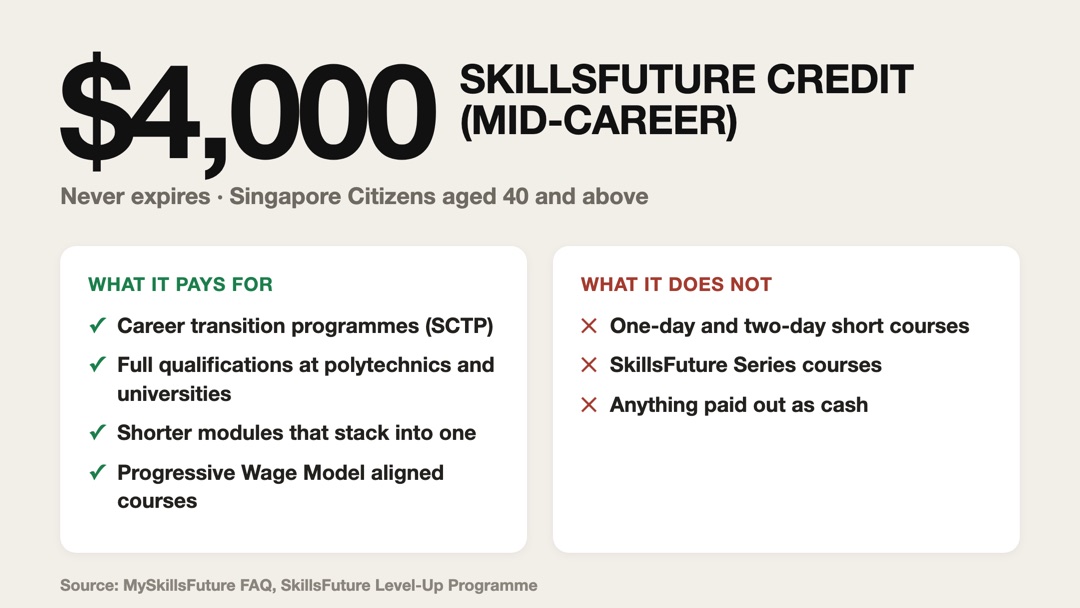
Every Singapore Citizen aged 40 and above holds a $4,000 SkillsFuture Credit (Mid-Career) that never expires, but it only pays for long-form programmes such as career transition programmes and full qualifications, not one-day and two-day courses. The AI programmes it covers are conversion courses, and the good ones leave you a few hundred dollars out of pocket.
Now the details, because the details are the entire difference between claiming this and giving up on it.
What the $4,000 SkillsFuture Credit (Mid-Career) actually is
Two different pots of money share the SkillsFuture name, and mixing them up is what sends people in circles.
The base tier is the $500 SkillsFuture Credit that every citizen gets at 25. It's loose money. It spends on essentially anything in the course catalogue, including the short ones.
The second pot is the one people forget. On 1 May 2024, per the MySkillsFuture FAQ, the leftover balance from the old Additional SkillsFuture Credit was "merged with the top-up of $4,000 to form the new SkillsFuture Credit (Mid-Career)". It goes to Singapore Citizens "aged 40 and above". And the line that matters most: "The SkillsFuture Credit (Mid-Career) and SkillsFuture Credit base tier do not expire."
So there's no deadline pressure on this one. There's only the eligibility rule, and the rule is about the size of the course, not the subject. The FAQ excludes "the shorter one-day and two-day courses, including SkillsFuture Series" from the $4,000. What stays in is substantial: full qualifications at the institutes of higher learning and the shorter modules that stack into one, arts institution qualifications, courses aligned to the Progressive Wage Model, workplace literacy, and the big one for anybody switching lanes, SkillsFuture Career Transition Programmes.
That last category, SCTP, is where the substantial AI programmes live, and it is the one worth understanding first. It is not the only door though. Filter the catalogue and you'll also find Progressive Wage Model courses with generative AI in them, and single university modules that stack toward a bigger qualification, both carrying the mid-career badge at a fraction of the commitment.
People are using it, and not that many of them. In the first year of the top-up, from 1 May 2024 to 30 April 2025, "over 36,000 Singapore Citizens used their SkillsFuture Credit (Mid-Career) with claims amounting to over $24 million", according to a Ministry of Education parliamentary reply in September 2025. Set that against every citizen turning 40, and it tells you how much of this money is still sitting there.
Which AI courses does the $4,000 actually pay for?
Here's the shortlist, and then the detail on each:
- Automation with Artificial Intelligence: Digital Transformation Mastery, Republic Polytechnic
- AI Operations Specialist, NTUC LearningHub
- Design, AI and Technology, Singapore University of Technology and Design
- A part-time diploma or post-diploma certificate in AI at a polytechnic
- The one that doesn't work, and it's the one most people try first
They're ordered by how little you end up paying after everything stacks, cheapest first, because that's the number people actually decide on. The canonical list is bigger than five and it changes as providers add intakes, so the live version is the one to trust: the portal has a filter for exactly this, at courses tagged SkillsFuture Credit (Mid-Career). Add your own subject term to that search and you're looking at your real options. Every fee below is from that portal as of September 2026 and assumes you still hold your full base $500.
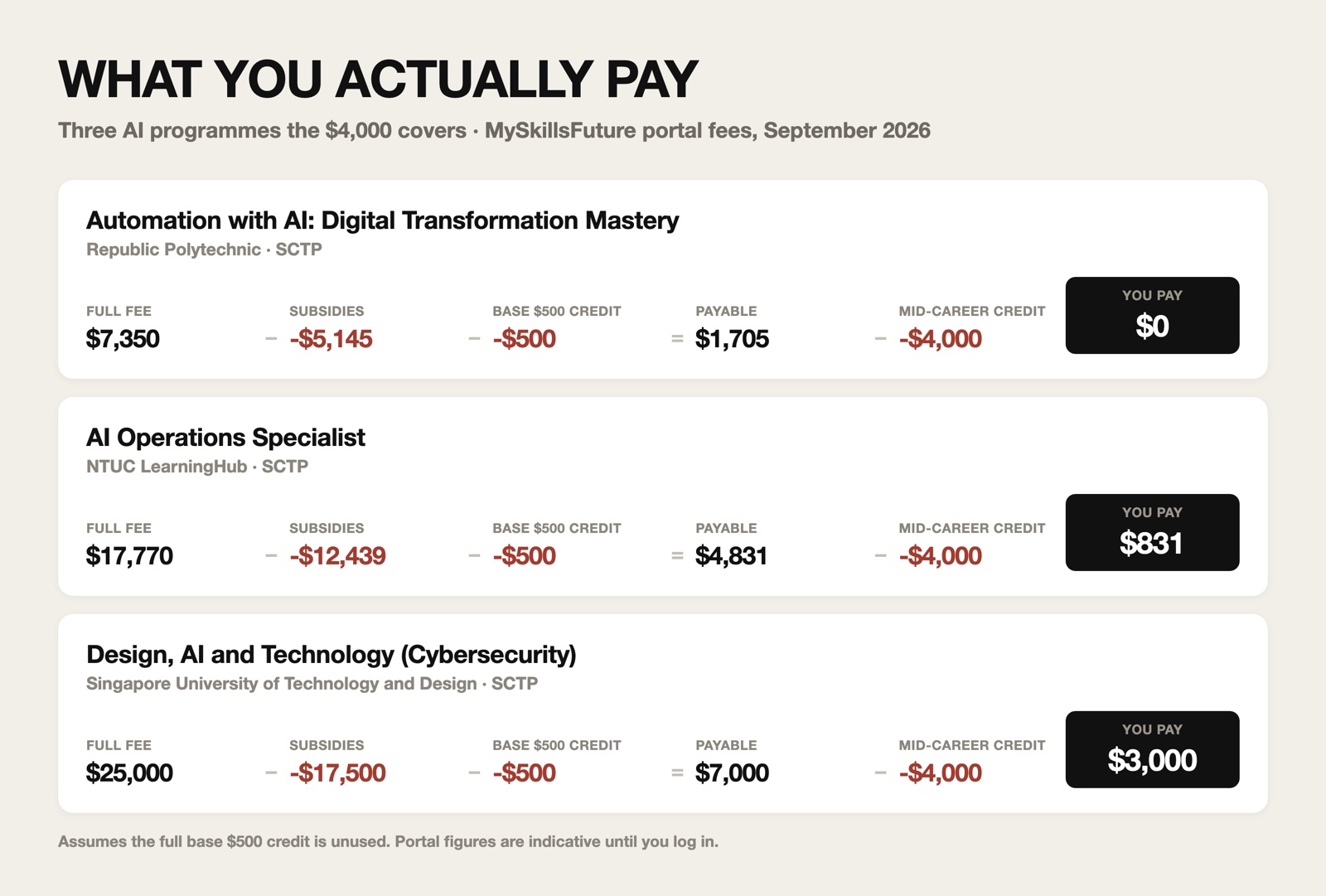
Here is how the money actually stacks on the three named programmes, from sticker price down to what leaves your bank account:
1. Automation with AI: Digital Transformation Mastery, Republic Polytechnic
The credit swallows this one whole. The programme lists a full fee of $7,350. SkillsFuture subsidies take off $5,145, the base credit takes another $500, and the portal shows an estimated payable fee from $1,705. Your $4,000 covers that with change to spare.
It's an SCTP, so it's built as a career conversion rather than an introduction, and it is aimed at the operational side of AI: automating real business processes instead of admiring the technology. If you're full-time on it, the training allowance runs up to $3,000 a month while you study.
What it requires is time. This isn't a weekend. Full-time conversion programmes expect you to actually stop and retrain.
2. AI Operations Specialist, NTUC LearningHub
This is the one I'd look at first if I were switching into AI work and wanted the credential to say something specific. The listing carries a full fee of $17,770. Subsidies remove $12,439 and the base credit removes $500, leaving an estimated payable fee from $4,831. Put the $4,000 against that and you're looking at roughly $831 for a programme with a near eighteen thousand dollar sticker price.
The content is broader than the title suggests. It bundles grounding in business analysis and project management, ECBA and CAPM, alongside large language model work, which is a more honest picture of what an AI operations job is than a pure prompting course would be.
What it requires is that you take the part-time route seriously over several months. There is a part-time training allowance of $300 a month attached while you are on it.
3. Design, AI and Technology, Singapore University of Technology and Design
The premium option, and the one where the credit is a discount rather than a solution. The cybersecurity track lists a full fee of $25,000, with subsidies of $17,500 and the base credit bringing the estimated payable fee to $7,000. The $4,000 leaves you about $3,000 to find yourself.
That's still a university programme at close to a tenth of its list price, and it's the right shape if you want AI attached to a hard specialism rather than AI on its own. Full-time training allowance again runs up to $3,000 a month.
What it requires is genuine out-of-pocket money on top of the credit, and a full-time commitment.
4. A part-time diploma or post-diploma certificate in AI
Beyond the conversion programmes, the credit works on qualifications at the polytechnics and universities: specialist diplomas in applied AI, post-diploma certificates, and the stackable modules that build toward them. The FAQ is explicit that full qualifications and the shorter modules that stack into a full qualification are in scope.
This is the route if you're staying in your job. A specialist diploma typically runs part-time over a year or more in evening modules, so the credit spreads across the stack rather than clearing one invoice.
What it requires is entry criteria. Unlike the conversion programmes, these usually want a relevant diploma or degree plus working experience, so check the prerequisites before you plan around the money.
5. The one that does not work: the short AI course
This is where almost everybody starts, and it's the reason people conclude the money is fake.
The two-day generative AI workshops, the one-day prompt engineering classes, the SkillsFuture Series courses: these are exactly what the FAQ excludes from the $4,000. They're good courses and they're heavily subsidised, but you pay for them with your base $500 credit and the mid-career subsidy, not with the top-up.
Length on its own is not quite the test, which is where it gets slippery. A short course that sits inside the Progressive Wage Model, or a single university module that stacks toward a full qualification, can still carry the mid-career badge. What gets excluded is the standalone one-day and two-day course that leads nowhere in particular. So do not judge by the run time, judge by whether the listing says the credit applies.
So if you've logged in, searched "AI", found a $600 two-day course and wondered why the $4,000 won't apply, nothing's broken. You're looking at the wrong shelf. The top-up is reserved for the substantial stuff, which is a real constraint and also, honestly, the point of it. It was designed to fund a change of direction, not an afternoon.
How do you actually claim it, step by step?
- Log in to MySkillsFuture with Singpass. Your balance is on the first screen, and both pots are listed separately, so you can see the base credit and the mid-career credit side by side.
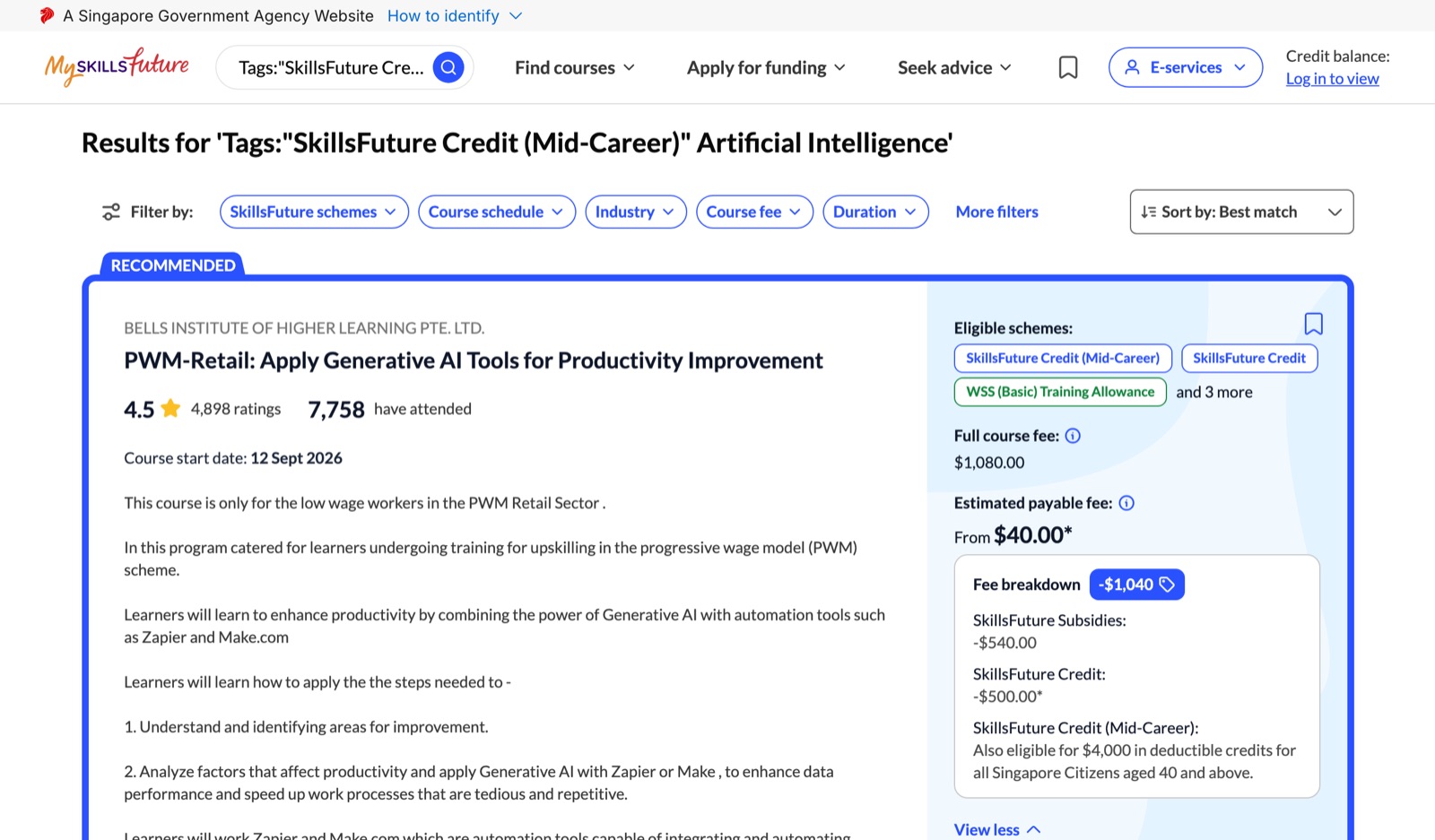
- Filter the catalogue to what the credit accepts. Use the Mid-Career tagged search rather than a plain keyword search. This single step removes almost all of the confusion. Every result then carries a SkillsFuture Credit (Mid-Career) badge, and opening the fee breakdown spells the entitlement out in the portal's own words:
- Tell the training provider you intend to use the credit when you register. The portal asks for this at registration, not after the fact.
- Submit the claim online before the course starts. That timing is a hard rule, and it's where claims fall over.
- Answer the declaration. When you select a course under an SCTP, the portal shows a declaration box asking whether you want to use the SkillsFuture Credit (Mid-Career) for it. Only people enrolled in the SCTP, which the portal describes as a long-form training programme comprising multiple modules, can put the mid-career credit against their nett fees. Say yes here or the $4,000 stays where it is.
One catch worth stating plainly: there's no cash out. The credit pays course fees and nothing else.
Why I care about this one
I'm in the business of getting more out of AI than the person next to me, and the honest thing to say about a subsidy is that it buys access, not advantage. Thirty six thousand people claimed this in a year. If the qualification alone were the edge, that edge would already be crowded.
What actually moves is what you point it at. A conversion programme that teaches you to automate a process is worth more than a certificate that teaches you to describe one, and the gap between those two shows up about six months later in whether anything in your work has changed. I wrote up how I think about that progression in the four levels of AI adoption, and the tools I actually run day to day are listed with honest notes in my AI stack.
It's also not the only money on the table. NTUC members can claim back half the cost of 21 AI subscriptions including ChatGPT and Claude, which I went through in detail in the UTAP AI tools piece. One scheme pays for the training, the other pays for the tools. Between them, Singapore is fairly obviously paying its citizens to get good at this.
FAQ
Do I need to be 40 to get the $4,000 SkillsFuture Credit (Mid-Career)?
Yes. It's for Singapore Citizens aged 40 and above. Under 40, you've still got the base $500 credit.
Does the $4,000 SkillsFuture Credit (Mid-Career) expire?
No. The SkillsFuture Credit (Mid-Career) and the base tier "do not expire", so there's no deadline to plan around.
Can I use the SkillsFuture Credit (Mid-Career) on a two-day AI course?
No. Short courses of one or two days, including SkillsFuture Series courses, are excluded from the top-up. Your base $500 credit covers those.
Is the SkillsFuture Credit (Mid-Career) the same as the $500 SkillsFuture Credit?
No. They're separate balances with different rules, shown separately when you log in. The $500 spends widely, and the $4,000 spends only on qualifying long-form programmes.
How much does Republic Polytechnic's Automation with AI programme cost after subsidies?
The full fee is $7,350, and after subsidies take off $5,145 and the base $500 credit takes another $500, you're left with an estimated payable fee from $1,705. The $4,000 SkillsFuture Credit (Mid-Career) covers that completely, so you pay $0.
The catch with money that never expires
The money does not expire, which sounds like good news and is actually the trap. Nothing forces the decision, so it waits, and it's been waiting since May 2024. Log in and at least look at the number.