Singapore
Singapore AI Grants for SMEs (2026): EDGE, SFEC and EIS, in the Order to Use Them
Singapore runs five separate ways to fund a company's AI adoption: the new EDGE Grant, a S$10,000 SkillsFuture credit that expires on 30 November, and three tax measures including a 400% deduction with no cash option. The real caps and deadlines, and who signs off.

Singapore doesn't advertise this part loudly, but if you run a company here and you've bought anything AI-related this year, there's a real chance you paid more than you had to. I went through the actual scheme pages and the tax guide after noticing how many business owners I talk to have never logged into the Business Grants Portal at all. What's sitting there is five separate mechanisms, from three different agencies: a grant that pays for the tool, a credit that pays for training, a tax deduction for the AI bill itself, another for training your team, and a cash option if you'd rather have money than a deduction. Here they are, in the order you'd actually use them.
Here's the short version. The EDGE Grant pays up to 50% of a pre-approved digital tool, within a S$30,000 yearly digital cap, and the SkillsFuture Enterprise Credit covers 90% of out-of-pocket training costs until 30 November 2026. IRAS then gives a 400% tax deduction on up to S$50,000 of AI spend and up to S$400,000 of training, or a 20% cash option worth up to S$20,000 on spend that isn't AI.
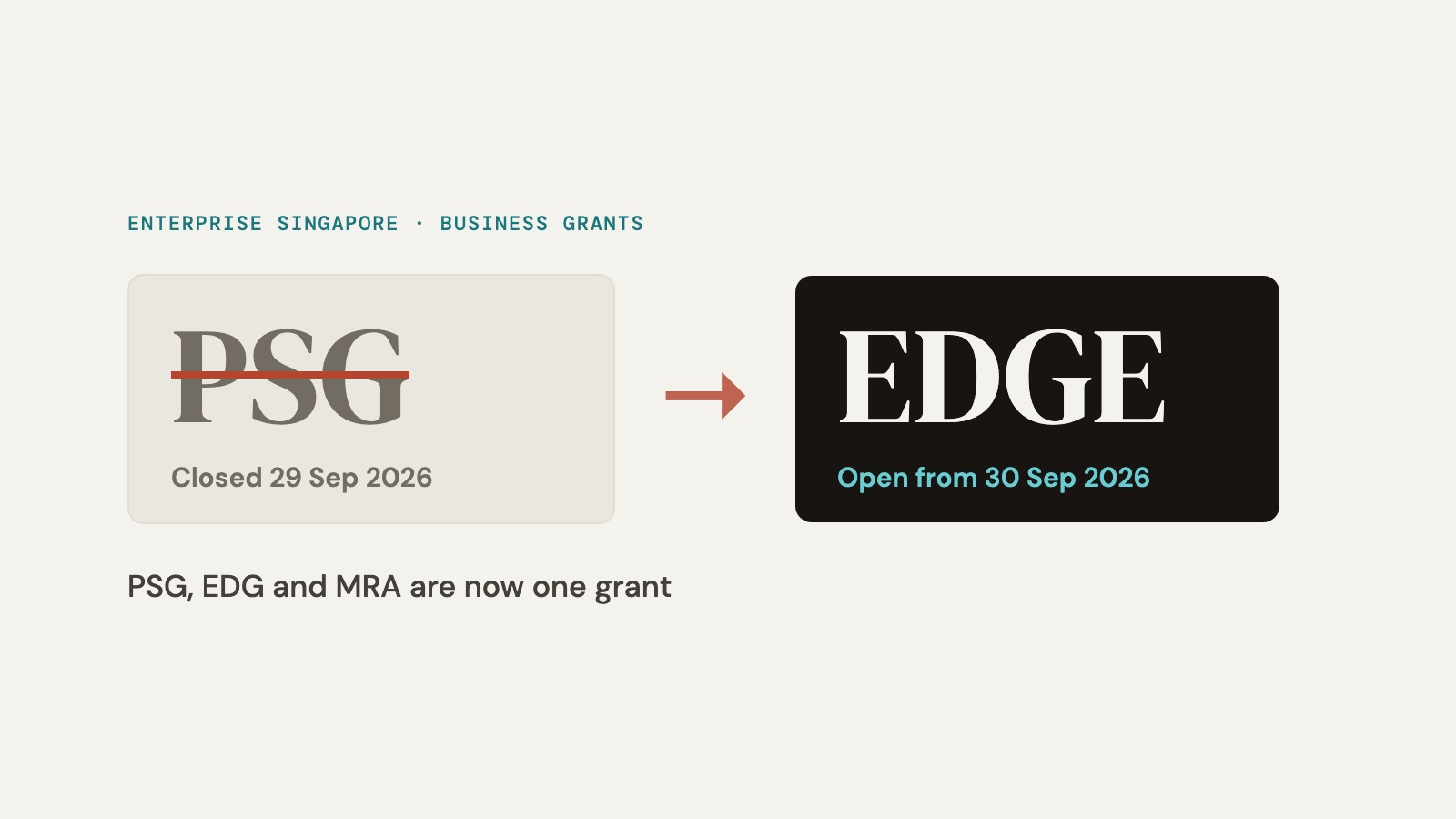
I updated this guide on 6 October 2026. The Productivity Solutions Grant closed on 29 September and the EDGE Grant replaced it the next day, and the SkillsFuture Enterprise Credit no longer tops up the grant. Everything below reflects both, and here's the full PSG to EDGE changeover.
The five, in order
Use them in this order, because the tax deductions are computed on what you actually paid after any grant or subsidy, not on the sticker price. A S$2,000 AI subscription that the EDGE Grant cuts to S$1,000 only has S$1,000 of qualifying expenditure left for the 400% deduction. So apply for the grant before you buy, put the training credit against your team's courses, then hand what's left to your accountant for the two deductions or the cash option at tax time.
Here's the checklist, the actual page this article promised.
| Scheme | What it pays | Cap | Deadline | Where to claim | Who signs off |
|---|---|---|---|---|---|
| EDGE Grant | Up to 50% of a pre-approved digital solution for SMEs | S$30,000 a year for digital tools, inside S$100,000 for all EDGE activities | Ongoing, caps reset every 1 April | Business Grants Portal, with Corppass | Enterprise Singapore (about 1 week for single-function solutions) |
| SFEC | 90% of out-of-pocket on eligible training | S$10,000 one-off (a fresh S$10,000 arrives 1 Dec 2026) | Courses finished and claims in by 30 Nov 2026 | Business Grants Portal / SkillsFuture for Business page | Automatic if eligible, no application needed |
| EIS: AI adoption deduction | 400% tax deduction on AI subscriptions and services | S$50,000 a year | Filed with your YA2027 or YA2028 tax return | Your company's income tax return | Your accountant, filed with IRAS |
| EIS: training deduction | 400% deduction on course fees, plus S$4.50/hour absentee payroll | S$400,000 a year (deduction), S$100,000 a year (wage support) | Filed with your YA2024-2028 tax return | Income tax return, plus a separate absentee payroll claim | Your accountant, with IRAS |
| EIS: cash option | 20% of qualifying spend, paid as cash instead of a deduction (not for AI spend) | S$20,000 a year | Elected after filing your tax return | IRAS's EIS cash payout service | Your accountant, irrevocable once made |
Every figure below has its own source. Check with your accountant before you act on any of it: the numbers are real, but your company's specific situation isn't something an article can see.
1. The EDGE Grant pays for the tool itself, as long as you apply before you spend
Pick a pre-approved digital tool, and Enterprise Singapore pays up to half of it. The EDGE Grant replaced the Productivity Solutions Grant on 30 September 2026, and it goes first for a mechanical reason: you apply before you pay anything, so the government's share never enters your tax working at all. It just makes the bill smaller from the start.
Each company gets one EDGE cap of S$100,000 a year across everything EDGE funds, and digital tools share S$30,000 of it. Each tool category then has its own ceiling. The digital marketing category, for example, covers campaign management software with the cost capped at S$10,000, so an SME gets at most S$5,000 back.
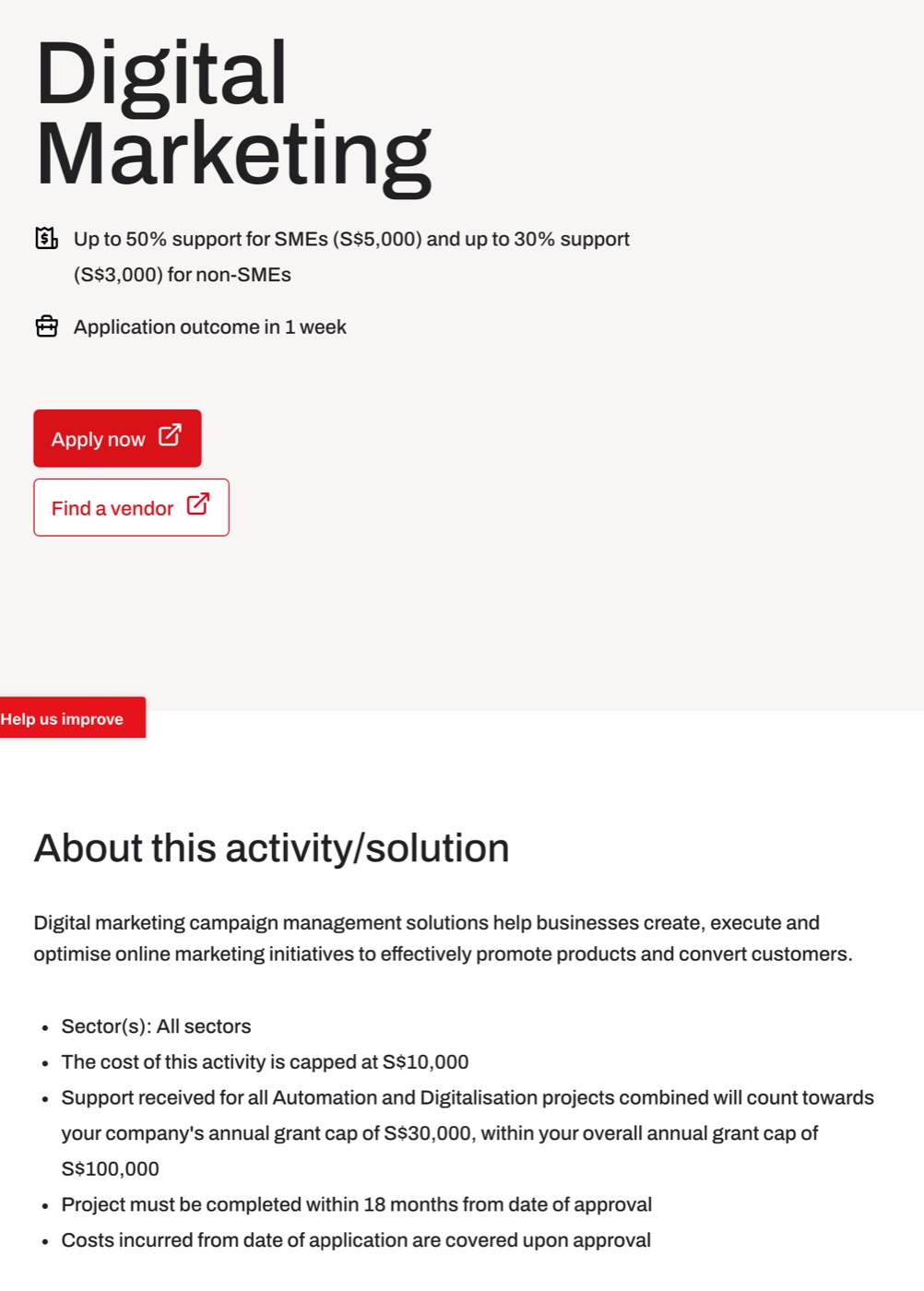
The pre-approved tools now live on IMDA's SMEs Go Digital platform, which lists over 300 of them and runs a GenAI Navigator to match generative AI tools to your business. EDGE's single-function list currently runs to 40 categories, including customer relationship management, e-commerce, digital marketing and an AI accounting automation line.
To qualify, your company has to be registered in Singapore with at least 30% of it owned by Singapore Citizens or PRs, and the SME rate applies if group turnover is no more than S$100 million or the group has no more than 200 workers. For a single-function tool, you pick a solution and get a quote from a pre-approved vendor, build the package on SMEs Go Digital, then apply on the Business Grants Portal with Corppass (the government login that lets a company's staff transact on its behalf), and you'll hear back in about a week. What trips people up is the timing. You can't have paid the vendor anything, not even a deposit, before you submit the application. Pay first and the application isn't delayed, it's void. Once it's submitted, you can pay before approval, at your own risk.
2. The SkillsFuture Enterprise Credit pays for training, and the current one expires on 30 November
If your company qualified, there's already a S$10,000 credit sitting in your Business Grants Portal account, whether you've logged in to see it or not. Nobody applies for the SkillsFuture Enterprise Credit. Enterprise Singapore emailed eligible employers' Corppass administrators, and the credit pays up to 90% of your out-of-pocket cost on supported programmes.

Under PSG, this credit could cover most of what you still owed on a grant-funded tool. That's over. EDGE's own FAQ says "EDGE will not be supportable under SFEC", so for anything new, the credit's job is training: courses aligned with the Skills Framework, with no cap on how much of the credit goes there.
The catch is the date. The current credit expires on 30 November 2026, and a course only counts if its run finishes on or before that day. The redesigned SFEC launches the very next day, 1 December 2026, with a fresh S$10,000 delivered through an online wallet, according to the SSG information memorandum that announced it. Unused credit on the current one doesn't roll over.
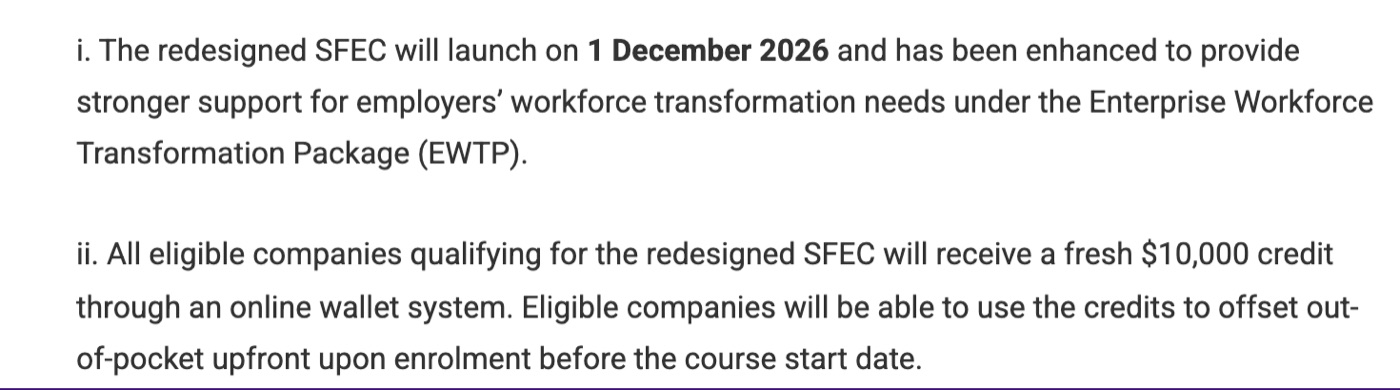
The new version works differently. Per the Ministry of Manpower's factsheet, companies with at least three resident employees get the S$10,000, and it offsets the cost upfront instead of reimbursing you afterwards.
There's nothing to apply for. Log in, check the balance under your SkillsFuture for Business page, and book a course that ends before 30 November if you want the current credit to count.
3. A 400% deduction on your actual AI bill, but only from this financial year
From YA2027 (roughly the year ending in 2026 for most companies) through YA2028, IRAS lets you deduct four dollars for every dollar your company actually spent on AI, on the first S$50,000 of that spend each year. It's new. Budget 2026 added it to the Enterprise Innovation Scheme specifically because the existing categories, R&D, intellectual property, training, didn't have a clean line for what a business actually pays for AI now: subscriptions, licences, and AI business services, per the IRAS e-Tax Guide on the Enterprise Innovation Scheme (third edition, 31 August 2026).
What counts is broader than a single chatbot subscription. The guide's own examples include machine learning models, conversational AI and generative language models, computer vision and natural language processing tools, and the services around adopting any of them, deployment, data and analytics work, even training your staff on the system. What doesn't count is the hardware underneath it: servers, storage and computing equipment are explicitly excluded. IRAS computes this net of any government grant or subsidy, so if EDGE already paid part of the bill, only the part you actually paid yourself qualifies for the 400%.
One catch, and it's the one worth flagging clearly: unlike every other line in the Enterprise Innovation Scheme, there is no cash option here. If your company doesn't have enough taxable profit to use the deduction this year, it can't be converted into a cheque the way training or R&D spend can. It's a deduction or nothing.
4. The same 400%, for training your team, plus a wage subsidy while they're in class
Training gets the same 400% treatment as the AI line, on a much bigger allowance: the first S$400,000 of qualifying training expenditure each year, running from YA2024 through YA2028, so this one has been live for a while and isn't new the way the AI deduction is. The course has to be eligible for funding from SWDA, the agency formed on 1 July 2026 when SkillsFuture Singapore and Workforce Singapore merged, and aligned with the Skills Framework. The IRAS guide points to a live list at go.gov.sg/eis-training rather than naming courses individually, since it changes as providers add and retire intakes.
The part most businesses miss is the wage side. While your staff are actually sitting in an eligible course, not doing their normal job, your company can claim S$4.50 for every hour they're away, called absentee payroll, capped at S$100,000 per company per calendar year according to SSG's own funding revision. It's computed on actual attended hours, not a flat rate, and it doesn't apply to on-the-job training.
Like the AI line, this is net of any grant or subsidy already received for the same course, so if SFEC already covered 90% of a course fee, the 400% deduction only applies to the 10% your company actually paid.
5. Or skip the deduction and take cash instead, if S$20,000 matters more than the tax line
Every qualifying activity in the Enterprise Innovation Scheme except the AI line has a second option: instead of the 400% deduction, convert up to S$100,000 of your combined qualifying spend for the year into cash, at a conversion rate of 20%. That tops out at S$20,000, and the payout itself is not taxable, per IRAS.
This is the item worth being honest about rather than selling. Twenty thousand dollars in cash sounds better than a deduction on a spreadsheet, but the trade only makes sense if your company doesn't have enough taxable profit to use the deduction anyway, because S$100,000 of spend at 400% is a S$400,000 deduction, worth far more than S$20,000 to a profitable company. IRAS describes the cash option as existing "to help small, growing businesses defray the costs of their innovation activities", which is a specific kind of business, not every business. It also doesn't touch the AI deduction at all: that S$50,000 line has no cash option under any circumstance, so this choice only ever applies to training, R&D, IP and innovation-project spend.
To qualify for the cash, your company needs at least three full-time local employees on CPF for at least six months of the year, and at least S$400 of qualifying expenditure. You elect it through IRAS's EIS cash payout service after filing your income tax return and before the filing due date, and the election is irrevocable. Talk to your accountant before picking this over the deduction, not after.
What I'd claim first this month
If I were running a small team through this this month, I'd start with EDGE on whatever AI tool I was already about to buy anyway, because it's the only step that has to happen before you spend, and missing that window means the grant can't help on that purchase at all. Then I'd log into the Business Grants Portal just to check the SFEC number, because most owners I talk to have never looked, and I'd book whatever course was worth doing so it finishes before 30 November. The two EIS deductions I'd hand straight to my accountant along with this article, since they only show up at tax time, and I'd rather someone whose actual job is the tax code decide whether the deduction or the cash option is the better call for my numbers specifically.
There's one thing the two grant schemes won't fund, and that's someone doing the work. EDGE pays for the software and SFEC pays for the course, but neither pays anyone to plan your marketing, make the content or set AI up inside your team. That's the part SCALR does. We're not a vendor for EDGE or SFEC, so our work isn't grant-claimable: you pay us directly, and here's what that looks like.
FAQ
Do Singapore's AI grants and tax deductions stack together?
Partly, and in sequence. The EDGE Grant pays first on a pre-approved tool, and the EIS tax deductions are then computed on what your company actually paid after any grant or subsidy. The SkillsFuture Enterprise Credit no longer tops up EDGE; it now covers eligible training. The EIS cash option replaces a deduction rather than adding to it, and it isn't available for AI spend.
Is the Productivity Solutions Grant (PSG) still available for AI tools?
No. PSG closed to new applications on 29 September 2026, and Enterprise Singapore's EDGE Grant replaced it on 30 September 2026. EDGE funds up to 50% of a pre-approved digital solution for SMEs, within a S$30,000 yearly digital cap.
What if my company has fewer than three local staff, or isn't 30% Singapore-owned?
The EDGE Grant needs at least 30% Singapore Citizen or PR ownership, and the SME rate needs group turnover of no more than S$100 million or no more than 200 workers. The redesigned SFEC goes to companies with at least three resident employees, and the EIS cash option needs three full-time local employees. The two EIS deductions carry no ownership or headcount test, which matters if you don't clear the others.
Are these company AI grants the same as the SkillsFuture Credit I get as an individual?
No, they're different pots. Everything in this article is company money, claimed by the business rather than a person. If you're asking for yourself rather than your company, the SkillsFuture Credit (Mid-Career) and NTUC's UTAP subsidy on your own AI subscriptions are the two that actually apply to a person, not a company.
Does the 400% AI tax deduction apply to last year's AI spend?
No. The EIS AI deduction only covers YA2027 and YA2028, so for most companies that means spend from this financial year onward, not anything already paid last year. The training deduction has been running longer, since YA2024.
What changes next
Three dates are worth putting in a calendar. The current SkillsFuture Enterprise Credit expires on 30 November 2026, the redesigned one with a fresh S$10,000 arrives on 1 December, and EDGE's yearly caps reset on 1 April. The AI deduction runs to YA2028, so it has two tax years left. The schemes keep changing, so treat the numbers above as accurate on the date at the top of this page and worth re-checking against the source pages before you file anything.