Y Combinator
The Class Photo That Built ChatGPT, Reddit and Twitch
Sam Altman, Steve Huffman and Emmett Shear were once eight unknown teams in one room. What that room actually gave them, and the free 15-day build challenge giving the same three things away right now, with the checklist I would run if I were entering.
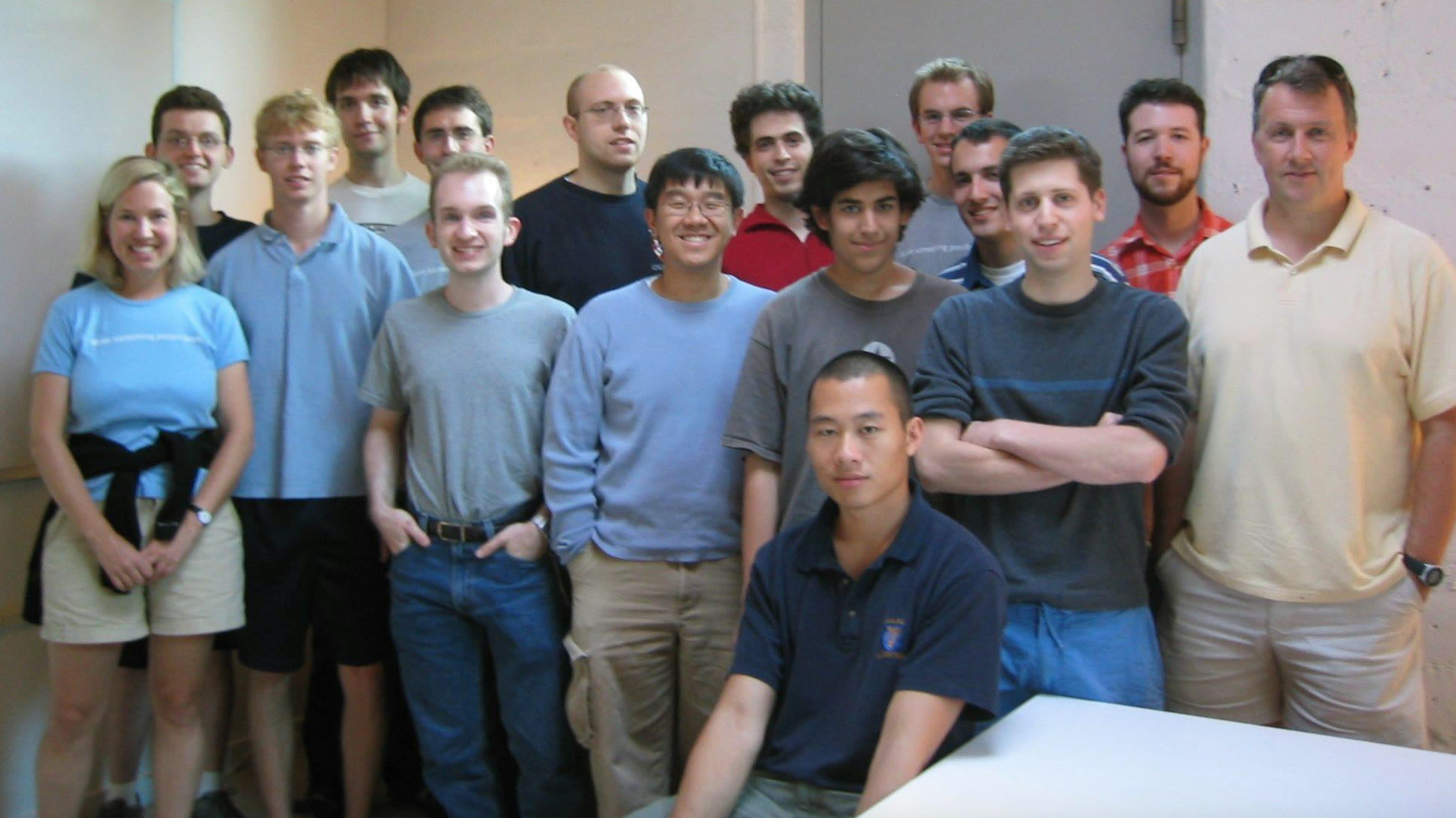
This is one of the most famous class photos in startup history, and almost nobody in it was anybody yet.
That is Y Combinator's first batch, Summer 2005. Eight teams, one room, a few thousand dollars each. The one standing with his arms crossed, right of centre, is Sam Altman, who now runs OpenAI, the company that built ChatGPT. The blonde in glasses towards the left is Steve Huffman, who built Reddit. In the back row is Emmett Shear, whose batch company eventually turned into Twitch.
At the time, none of that had happened. They were a room of people with unfinished projects and a deadline.
Who is actually in that photo?
Three names carry the picture, and each one is checkable.
Sam Altman is in the front, arms crossed. His batch company was Loopt, a location-sharing app that never became a household name. He is now the chief executive of OpenAI, which released ChatGPT in late 2022.

Steve Huffman was 21 and had just co-founded Reddit with Alexis Ohanian. Reddit was in that first batch. Huffman left, came back in 2015, and is still its chief executive.

Emmett Shear was in the same batch with Kiko, a web calendar. Kiko failed and was sold on eBay. The next thing he built with the same co-founder was Justin.tv, which became Twitch, which Amazon bought for just under a billion dollars.

So of the three most quoted names in that photo, one built the wrong product first and one built a product that died and got auctioned off. The photo isn't a picture of people who already knew.
What did that room actually give them?
That's my read, not a claim about what anyone in the photo would say.
Strip away the mythology and a batch is three ordinary things. A deadline, so the work has to exist by a date instead of staying an idea. People watching, so shipping something bad in public costs you something and you care more. And someone further along who will look at what you built and tell you what is broken, before the market does it for you slower and more expensively.
Money and introductions help too, but those three are the part that changes behaviour, and none of them need a room in California in 2005. They're scheduling, an audience, and a mentor, and you can assemble all three in a week if somebody hands them to you.
What is Founding 100?
Founding 100 is a free 15-day online build challenge run by Waycode, and it hands over all three. It runs from 22 October to 6 November 2026, with submissions closing at 23:59 IST on 6 November. Registration is open now through their form.
One thing to be straight about, because the video doesn't have room for it: this is built for India's student and builder base. Waycode's platform is global, the challenge is aimed at builders based in India. If that isn't you, the photo story above is still yours to use. The checklist below works on any deadline you set yourself.
The framing is proof of work rather than pitch decks. You're not asked to have a startup, a co-founder, or an idea worth funding. You're asked to build one real thing in 15 days and show the evidence: a working demo, a repository, a paper, a build log, a dataset, a video, or anything else somebody can inspect. It's judged on whether the work can actually be checked, how technically deep it is, how clearly you explain it, and how original it is.
Two details matter more than the prize list.
The first is that existing projects count. You can continue something unfinished, rebuild something you already made, extend an open-source project, or take an old idea somewhere new. Most people reading this already have a half-built thing sitting in a folder, and that half-built thing is eligible.
The second is that it's solo. There's no team to carry you and nobody else to blame for the parts that don't get done. That's the honest catch, and it's also why a 15-day deadline works on you.
On prizes, the page lists $500, $300 and $100 in Render credits for the top three, plus $50 in credits for general attendees. Render is a cloud host, so those credits pay for running whatever you build rather than landing in your bank account, which for a student with a project to deploy is arguably more useful anyway. Every participant who submits a valid project gets a Waycode participation certificate, top finishers get excellence certificates, and the top 15 get a Waycode Pro Student Pack. There's also an unpaid internship track with CodeWithPurpose India.
I'm one of the mentors reading the builds, which is how this landed on my desk in the first place.
What would I do with 15 days?
This is the checklist I promised in the video, and it works against any hard deadline where the deliverable is evidence rather than a pitch, so nothing here is particular to this challenge.
Days 1 to 2. Write down what finished looks like. One paragraph, in plain words, describing what a stranger will be able to do when you are done. If you can't write that paragraph, you don't have a project yet, you have a topic. Most failed builds fail right here and nobody notices until day 12.
Day 3. Cut it in half. Whatever you scoped, remove half of it, and take out the optional half rather than the hard one. Fifteen days is shorter than it looks once something breaks, and something always breaks. The version of your project that ships is the one you could finish twice.
Days 4 to 10. Build, and post one visible update a day. A screenshot, a commit, a two-line log entry, anything with a timestamp on it. That's the "people watching" part, and you have to manufacture it yourself. A public trail also turns into your build log, which is one of the things you're allowed to submit.
Day 11. Freeze features. No new ideas after this point, no matter how good they are. Everything from here is finishing rather than adding. That instinct to squeeze in one more thing on day 12 is the single most reliable way to submit something broken.
Days 12 to 13. Make it inspectable. This is where most entries lose, because it's the least fun part. Write the README. Say what the thing does, how to run it, what you decided and why, and what it can't do yet. Naming your own limitations reads as confidence rather than weakness, and a judge who can run your project in two minutes will score it above a better project they couldn't get working.
Day 14. Record the demo. Two minutes, unedited, showing the thing actually working, and no slides. If it only works in one specific order, show that order and say so.
Day 15. Submit early, then stop. Don't do it at 23:00 on the deadline. Submit in the morning, then leave it alone. Everything you change in the last few hours is something you haven't tested.
None of that's clever. It's just the order that keeps a deadline from eating you, and it's the same order I use on client work where the deadline is somebody else's launch.
FAQ
Is Waycode's Founding 100 free to enter?
Yes. Founding 100 is a free 15-day online build challenge run by Waycode, and registration is open now through their form.
When does Founding 100 run?
From 22 October to 6 November 2026. Submissions close at 23:59 IST on 6 November.
Who can enter Founding 100?
It's aimed at students and builders based in India, and it's solo, so you enter on your own rather than as a team. You don't need a startup, a co-founder or an idea worth funding.
Can I enter Founding 100 with a project I've already started?
Yes. Existing projects count, so you can continue something unfinished, rebuild something you made before or extend an open-source project.
What are the Founding 100 prizes?
The top three get $500, $300 and $100 in Render cloud credits, and general attendees get $50 in credits. Every valid submission gets a Waycode participation certificate, the top 15 get a Waycode Pro Student Pack, and there's an unpaid internship track with CodeWithPurpose India.
Who was in Y Combinator's first batch photo?
Among the fourteen people in the Summer 2005 photo are Sam Altman, now chief executive of OpenAI, Steve Huffman, who co-founded Reddit, and Emmett Shear, whose later company became Twitch.
The part I would actually take from that photo
The reason the Summer 2005 photo keeps circulating is that it flatters the idea of being picked. Fourteen people in a room, and look what happened to them.
The more useful reading is the opposite. What they got was structure, and structure is now something you can join for free, from anywhere, in about two minutes. The scarce thing was never the room, it was a reason to finish.
If you're building something and it's been sitting unfinished for months, the deadline is the product and everything else is decoration.