Claude Code
Agent Reach Gives Your AI the Platforms Everyone Else Is Locked Out Of
One free CLI that lets your AI read LinkedIn, Instagram, Reddit, X, YouTube transcripts and more, with no per-platform API bill. What it covers, the one-line install, and twenty things to ask it once it is running.
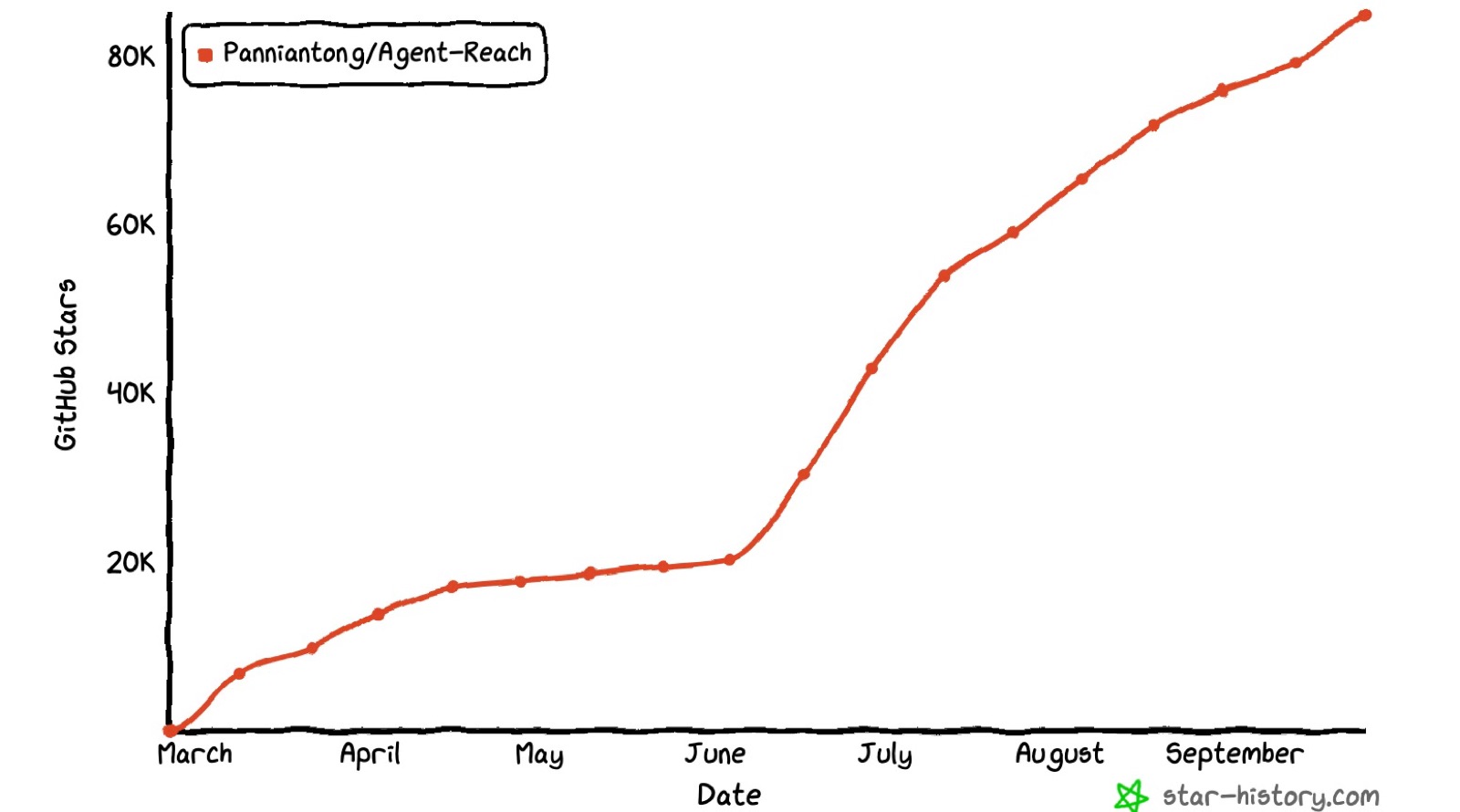
Agent Reach is a free, MIT-licensed command-line tool that lets your AI read the platforms it normally cannot: LinkedIn, Instagram, Reddit, X, YouTube transcripts, GitHub, RSS and a good deal more, with no API key and no per-platform bill. It installs in one line, and it went from nothing to about 85,000 stars in six months.
Your AI can write you a scraper in thirty seconds and still not read most of the internet, and this is the half of that problem nobody solves by trying harder.
Why can't my AI read the web already?
Two separate walls, and people tend to blame the wrong one.
The first is that the platforms with the good data do not want to be read. LinkedIn, Instagram, Reddit and YouTube all serve something different to a logged-out robot than they do to you, and a naive fetch gets a login page or an empty shell. Nothing is broken. You're just not welcome.
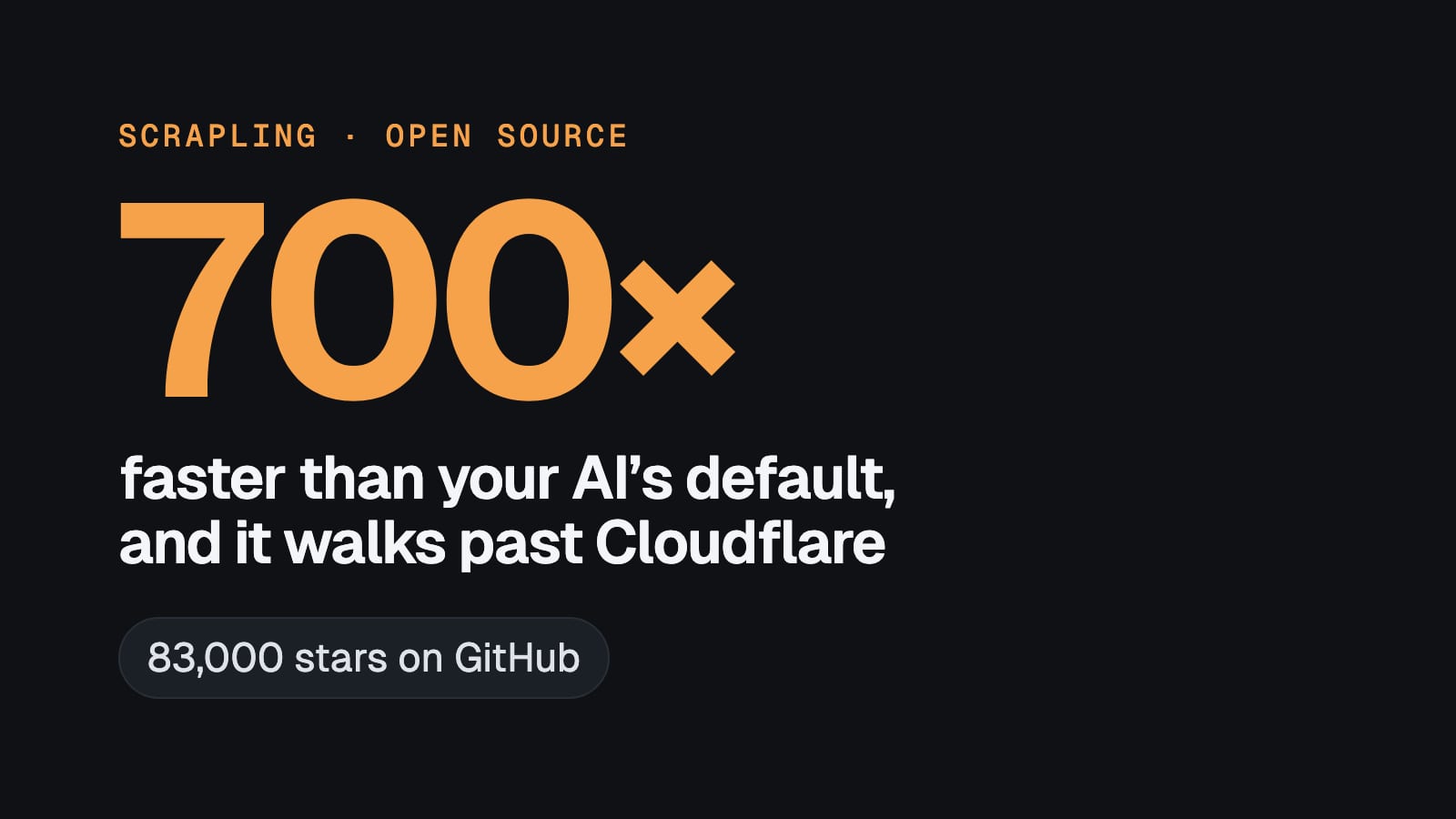
The second is that ordinary sites increasingly sit behind Cloudflare, and a scraper that announces itself as a script gets a challenge page rather than the content. Your agent then reports back, very confidently, that the page was empty.
These need different answers. This piece is about the first one, which is the harder of the two and the one more people hit.
Agent Reach: reading the platforms that block everyone
Agent Reach describes itself as a way to "give your AI agent eyes to see the entire internet", and the honest version of what it does is narrower and more useful than that sounds. It's a single command-line tool that knows how to read a long list of platforms that would otherwise need an API key each.
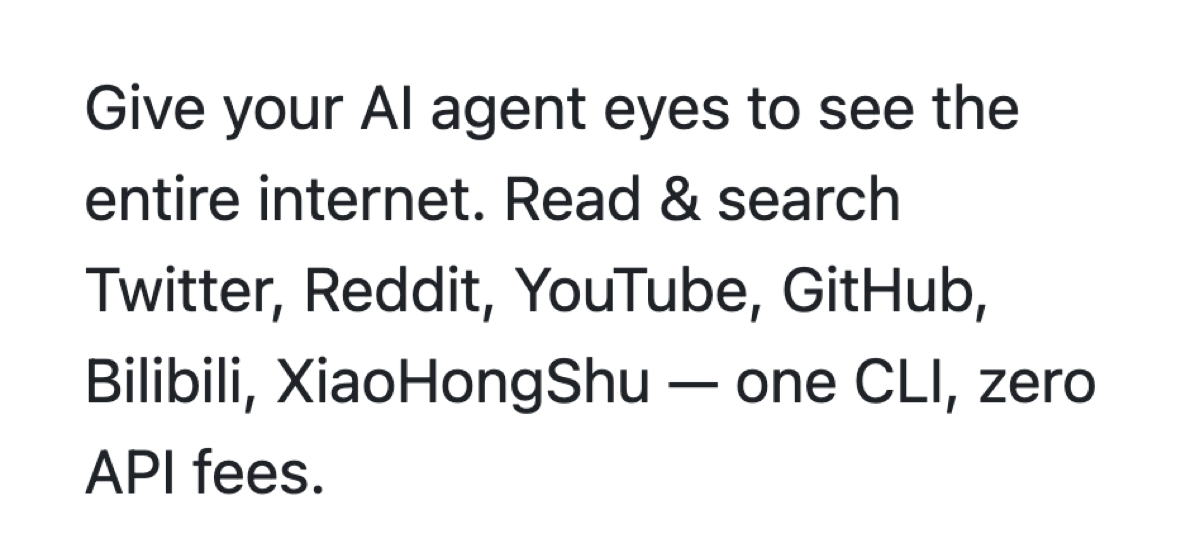
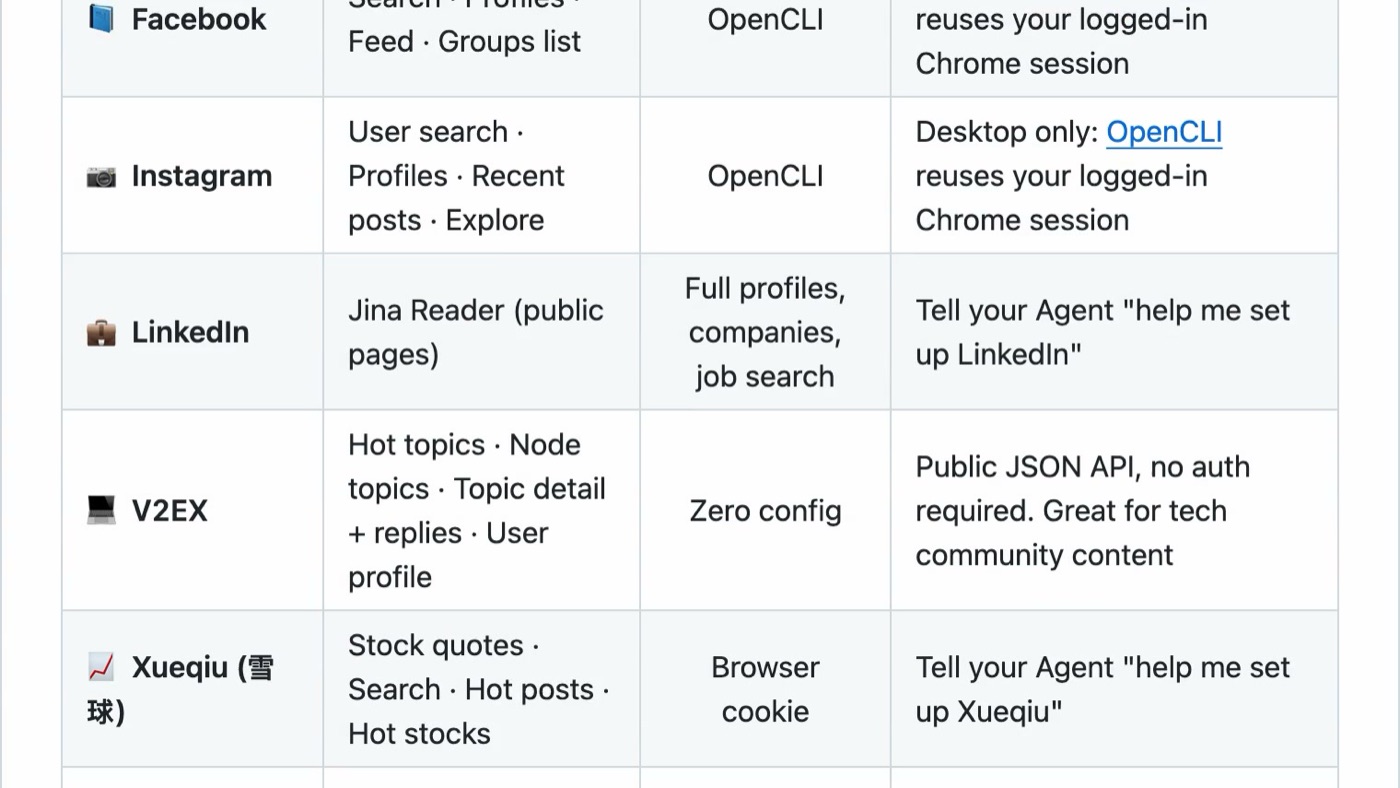
The covered list runs well past the ones in that description. It reads web pages, YouTube subtitles and search, RSS feeds, GitHub repos including private ones with auth, X posts and timelines, Reddit posts and comments, Facebook profiles and groups, Instagram profiles and posts, LinkedIn public pages and job search, plus a set of Chinese platforms that most Western tools ignore entirely: Bilibili, XiaoHongShu, V2EX, Xueqiu and 小宇宙 podcasts with audio transcription.
It's MIT licensed, and at the time of writing it's on about 85,000 stars, up from roughly 83,000 when I filmed.
Installing it is genuinely one line, and the line is a little unusual because you hand it to your agent rather than to a terminal.
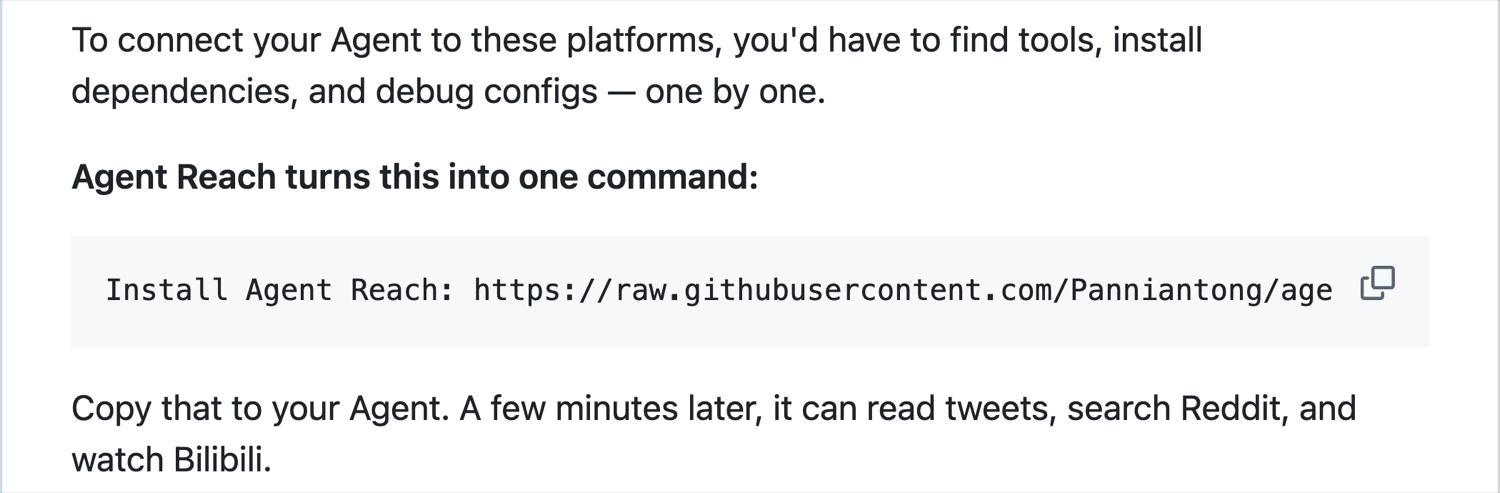
You paste the install request with the URL of the project's install.md into Claude Code, and it reads the document and sets itself up. That's the whole setup.
What changes afterwards is the kind of question you can ask. "Pull the transcript of this YouTube video and tell me what the three claims are." "Find what people on Reddit are actually saying about this product, not the reviews." "Check what's trending on Instagram for this term." Those all used to be a research task you did yourself and pasted in.
The other thing worth saying plainly is the "zero API fees" part of that description. Reading X through its official API starts at $100 a month on the Basic tier and climbs steeply from there, and Reddit began charging for API access in 2023, which is what killed most of the third-party apps built on it. Agent Reach routes around the per-platform bill entirely, and that is the honest reason it picked up 85,000 stars this fast.
Twenty things to ask it once it's installed
These are the ones I promised in the video, grouped by what they get you. Paste and edit.
Research a topic properly
- "Search Reddit for what people actually complain about with [product], and separate the complaints from the compliments."
- "Find the three most-discussed posts on [topic] this month and summarise where people disagree."
- "Pull the last twenty posts from this X account and tell me what this person keeps coming back to."
- "Search the web semantically for [question] and give me the five best sources, not the five most SEO-optimised."
- "Read this subreddit's top posts this year and tell me what the recurring unsolved problem is."
Get the content out of video
- "Pull the transcript of this YouTube video and give me the three claims it actually makes."
- "Get the transcripts of these five videos on [topic] and tell me what they all agree on and where one of them is an outlier."
- "Find YouTube videos on [topic] from the last month, read their transcripts, and rank them by how much real detail they contain."
- "Transcribe this podcast episode and pull out every specific number or date mentioned."
Watch a market or a competitor
- "Read this company's LinkedIn page and their last month of posts, and tell me what they're positioning around right now."
- "Search LinkedIn job listings for [role] at companies in [industry] and tell me what tools keep appearing in the requirements."
- "Check what's trending on Instagram for [term] and describe the format the top posts share."
- "Read the last thirty days of this Facebook group and tell me what people are asking for that nobody is selling."
- "Find every mention of [brand] across Reddit and X in the last week and sort them by sentiment."
Read code and documentation
- "Read this GitHub repo's README and issues and tell me what it does not do yet."
- "Compare these two repos on the same problem and tell me which is more actively maintained and why."
- "Read the open issues on this project and find the three that would block me from using it in production."
Keep up without doom-scrolling
- "Read these five RSS feeds and give me one paragraph on anything genuinely new since yesterday."
- "Follow these three X accounts for the week and give me a Friday summary of anything they announced."
- "Before you go and read anything, tell me which sources you plan to check and why those ones."
That last one is worth keeping for the same reason it was worth keeping in my student prompts. An agent that tells you where it's about to look gives you a chance to redirect it before it spends twenty minutes reading the wrong corner of the internet.
What Agent Reach does not do
It reads platforms. It does not get you past the anti-bot layer on an ordinary website, which is a different wall and a different tool. If what you want to read is a pricing page or a directory sitting behind a Cloudflare challenge, Scrapling is the one for that, and the two do not conflict: Agent Reach is a CLI your agent calls, Scrapling is a library your code imports.
FAQ
Do I need API keys for Agent Reach?
No. That's the main reason it exists. It reads the platforms it covers without a per-platform API key or bill, where reading X through the official API starts at $100 a month.
How do I install Agent Reach?
You paste the install request, with the link to the project's install.md, into Claude Code, and it reads the document and sets itself up. There's no separate installer to run.
Can Agent Reach get past Cloudflare on ordinary websites?
No, that's a different wall. Agent Reach reads walled platforms like LinkedIn, Reddit and X. For a normal site behind a Cloudflare challenge, Scrapling is the tool, and the two work side by side.
Is it allowed to read LinkedIn, Reddit and X with Agent Reach?
Reading a platform through a tool it didn't sanction is usually against that platform's terms of service, whatever the tool's licence says. That's your call to make, and it matters more when the work is for a client.
What I'd be careful about
Two things, and neither is a reason not to use them.
Reading a platform through a tool it didn't sanction is usually against that platform's terms of service, whatever the tool's licence says. That's a decision you're making, not one the install line makes for you, and it matters more the moment you're doing it for a client rather than for yourself.
The other is rate. Both of these make it trivially easy to hammer a site harder than a human ever would. Slow it down. The fastest way to lose access to a source permanently is to take it at full speed on day one.
Neither of these tools is impressive on its own. What they change is the assumption underneath everything else you build, which is whether your agent can go and look at something or has to be told. Once it can go and look, most of what you were pasting in by hand stops needing you. I wrote up the five free tools I already plug into Claude Code if you want the rest of that setup.