SEO
The Free SEO Audit Skill I Run Inside Claude Code
Claude SEO is a free, open source skill that audits a whole website and hands back a prioritized list of what to fix first. Here is how I installed it, connected it to Search Console, and the exact commands to run it yourself.

A few weeks ago I sat down to work out what a proper SEO audit for scalr.sg would cost if I paid someone else to do it. The quotes run wider than I expected, and most of them land in the middle of a range I didn't know existed. Then I found a free skill that runs the same kind of audit from inside Claude Code, installed it in a few minutes, and ran it against my own site before I filmed a word about it.
Here's the short version. Claude SEO is a free, open source skill for Claude Code that checks a website across technical SEO, content quality, schema markup and AI search readiness, then hands back a prioritized list of what to fix first and why. It installs in one command and connects to Google Search Console for real data on your own pages, not a guess.
It won't get you ranked by Friday. What it gets you is closer to the list a consultant charges for, for free, on your own machine.
How much does an SEO audit cost?
This is the part that sent me looking in the first place. Ahrefs polled 439 SEO service providers and found costs usually run from $250 to $10,000 a month, with 63% of businesses landing somewhere between $500 and $5,000. Agencies average around $3,209 a month, consultants about the same, and freelancers roughly $1,349. None of that is a one-off audit fee either. It is the ongoing retainer, month after month, before you have decided whether the findings are even worth acting on.
A single audit, the kind that tells you what is broken before you commit to a retainer, is usually the first thing an agency sells separately, and it isn't cheap either. That's the gap Claude SEO is built to sit in.
What is Claude SEO, and how is it different from the tools I already know?
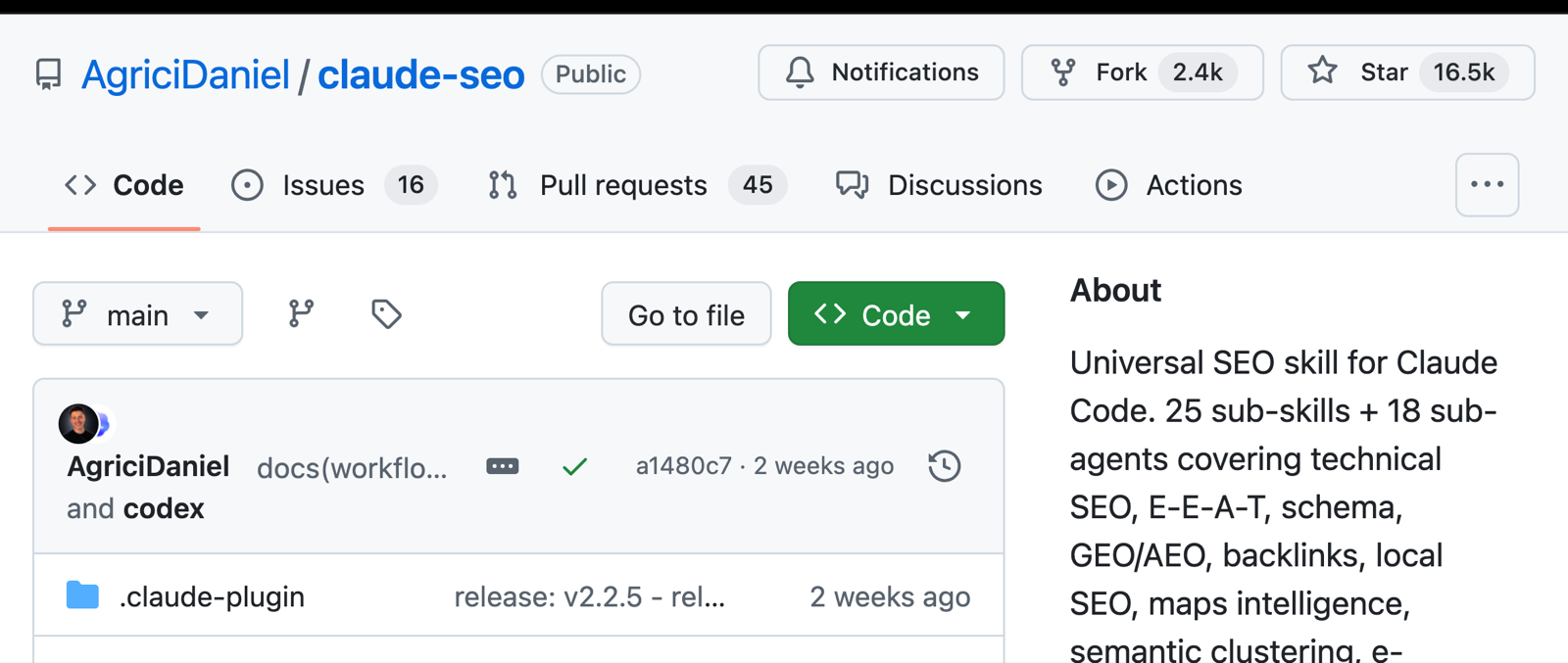
It is built by Daniel Agrici, MIT licensed, free, and fully open source. Under the hood it runs 25 sub-skills and 18 specialist agents in parallel, covering technical SEO, E-E-A-T content quality, Schema.org markup, AI search optimization, local SEO, ecommerce and international SEO. Every audit produces a prioritized action plan, and every recommendation in that plan carries the reasoning behind it and a way to check later whether the fix worked. As I write this it has just over 16,000 stars on GitHub, which for a one-person open source project is a real signal that people are actually running it, not just bookmarking it.
I already use Google Search Console and PageSpeed Insights, and the project's own FAQ is honest about where it does and doesn't compete. It isn't trying to out-crawl Screaming Frog, which is purpose-built as a link-graph crawler, and it doesn't carry its own backlink index the way Ahrefs Site Audit does. What it adds is a conversational, LLM-native audit that sits inside the same Claude Code window I already work in all day, with every recommendation grounded in Google's own published guidance rather than an SEO blog's best guess.
How do you install Claude SEO?
If you are already running Claude Code 1.0.33 or later, the plugin route is the fastest, three lines:
/plugin marketplace add AgriciDaniel/claude-seo
/plugin install claude-seo@agricidaniel-claude-seo
/seo setup
That last line matters. It creates an isolated Python environment inside Claude's own plugin data and installs the Chromium browser the audit uses to render pages, so it never touches your system Python or your PATH. You can check it worked at any time with /seo doctor.
If you would rather install it by hand, or you are on an older Claude Code version, the manual route works the same way on Mac, Linux or Windows:
git clone --depth 1 https://github.com/AgriciDaniel/claude-seo.git
bash claude-seo/install.sh
Either way, the only real requirement is Python 3.10 or newer and the Claude Code CLI itself. Everything else, including the Search Console connection below, is optional.
How do you connect it to Google Search Console?
This is the step that turns a generic crawl into an audit of your actual site, with your actual traffic behind it. Run:
/seo google setupThat opens a credential wizard with four tiers, and you don't need all of them. Tier 0 needs nothing but a free API key and already unlocks PageSpeed Insights and Chrome UX Report data. Tier 1 adds Search Console once you connect your Google account, which is what pulls in your real queries, catches pages Google can't properly index, and checks your sitemap status. Tier 2 adds Google Analytics traffic data if you want it, and Tier 3 adds Keyword Planner search volume if you're running paid campaigns too. I stopped at Tier 1 for my own run. Every credential is stored locally with locked-down file permissions, never checked into the project, and nothing leaves your machine except the calls Google's own APIs need to answer.
What do you type to run the audit?
Once it is installed and Search Console is connected, the command is one line. For my own site it was:
/seo audit https://scalr.sgThat's the whole prompt. Swap in your own domain and it runs the same way, fanning out across the sub-skills in parallel so a full site audit finishes in minutes rather than the hours a manual crawl takes. If you want to go narrower first, /seo page https://yoursite.com/some-page runs the same depth of analysis on a single page, and /seo schema https://yoursite.com checks just your structured data.
What does the report give you back?
This is the part that made the retainer conversation make sense to me. The output isn't a wall of jargon. Every audit writes a real markdown report, plus a full PDF and a machine-readable JSON file, all saved locally. A schema audit, for example, opens with a summary table: how many structured data blocks it found, which schema types are present, how many critical issues, how many warnings, how many checks passed, and an overall letter grade. A full site audit goes further, walking technical SEO, content quality and AI search readiness the same way, then closing with the actual punch list: what to fix first, in priority order, and the reasoning behind each item, not just the instruction.
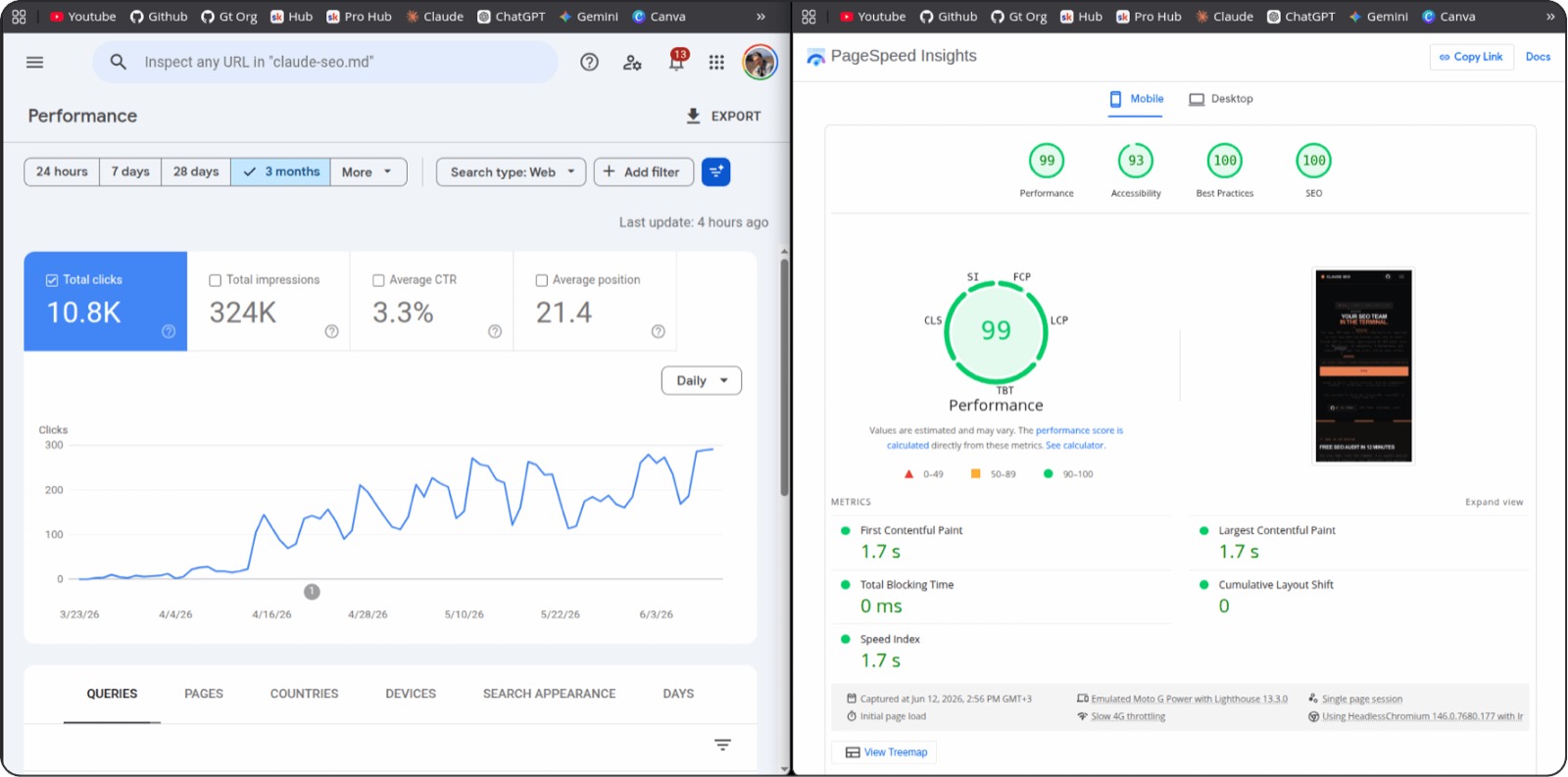
The maintainer's own published example is the clearest proof this is not just theory. A site that started three months before the audit and kept running this workflow week over week saw its Search Console clicks and impressions climb steadily over that stretch, alongside a 99 out of 100 PageSpeed performance score.
Here is my own, so you are not taking the shape of it on trust. I pointed it at scalr.sg, let it run across all 23 pages, and it came back with a health score of 74 out of 100.
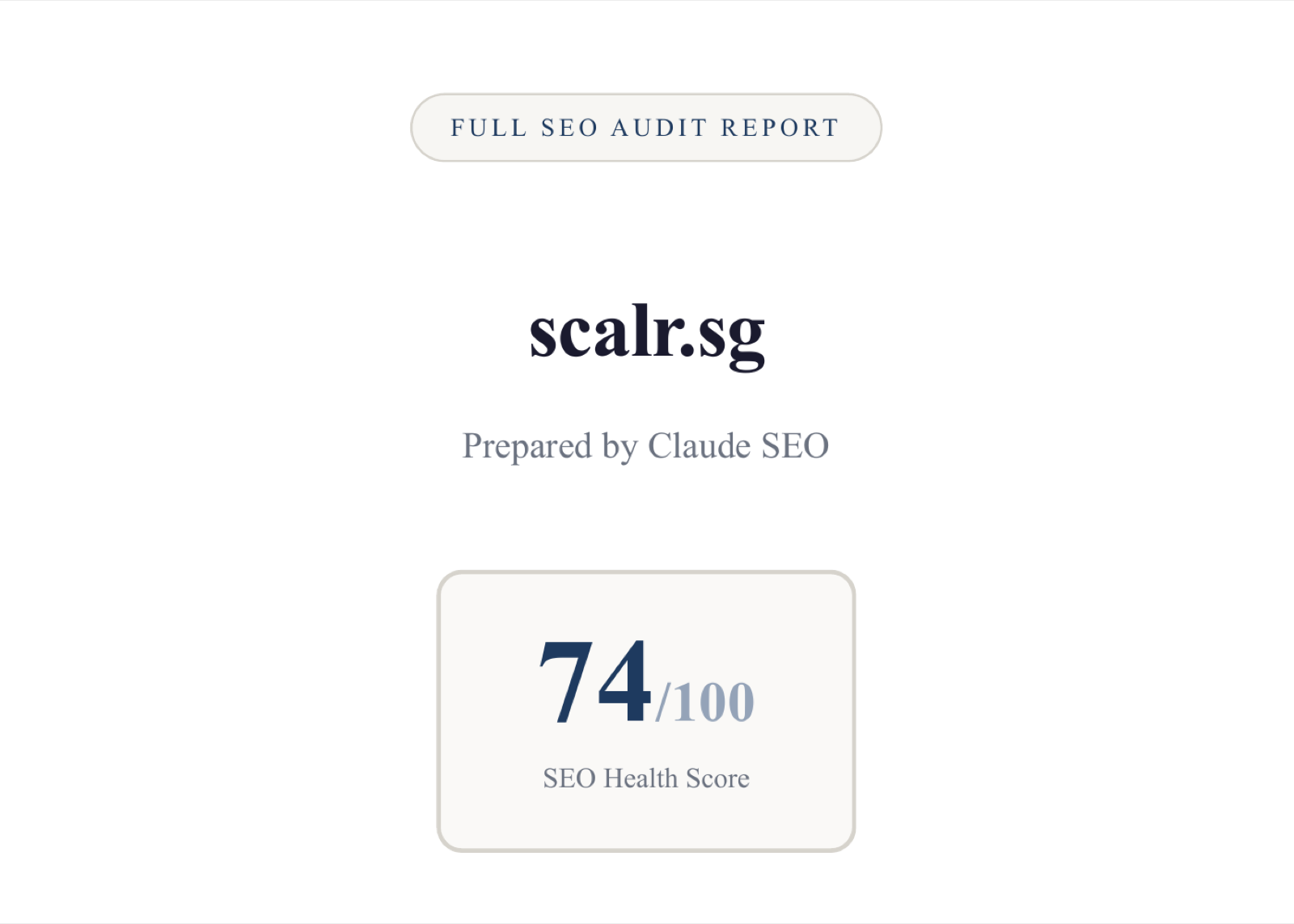
That score on its own would be the useless part. What makes it worth the twenty minutes is the eleven pages behind it.
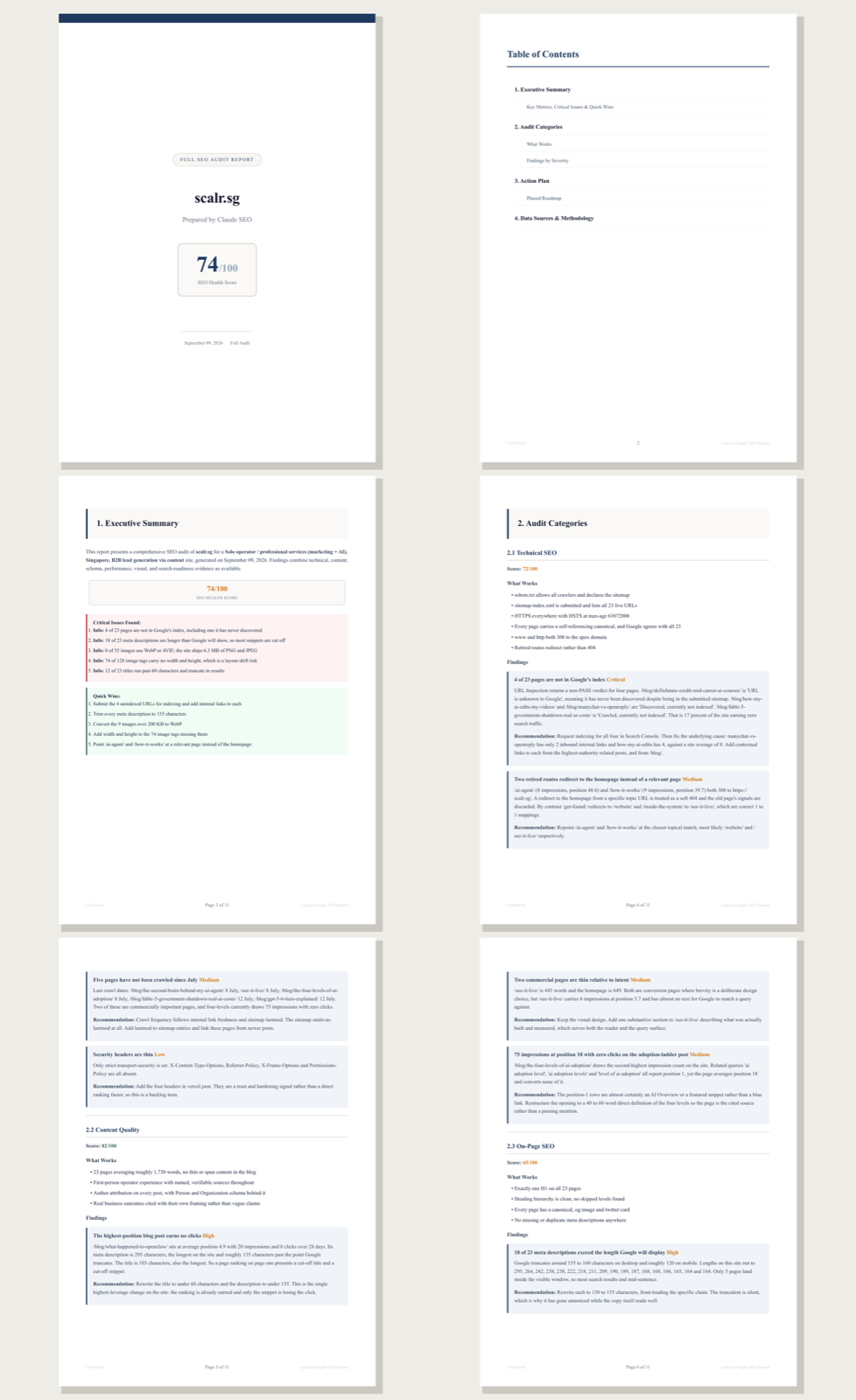
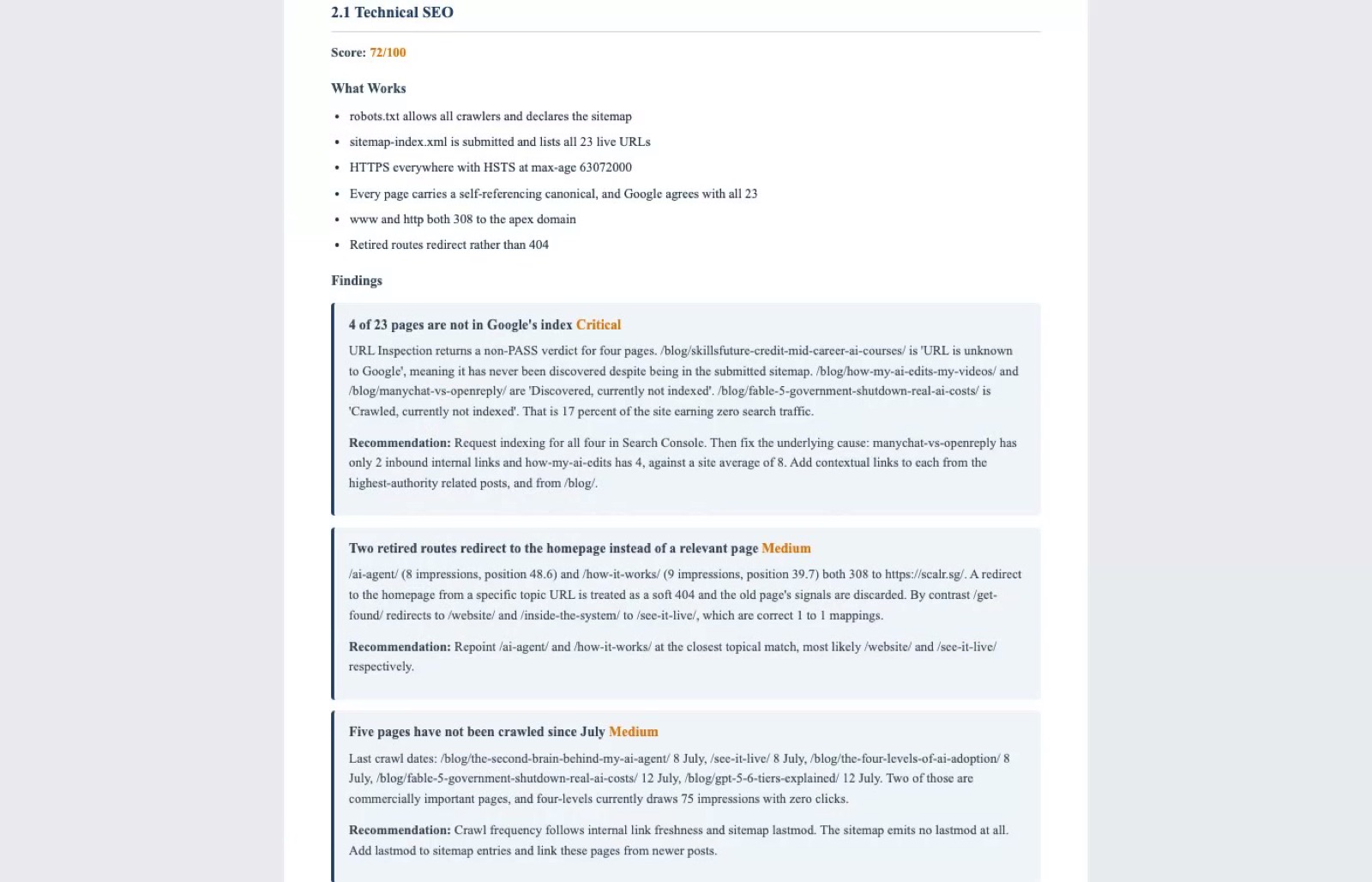
The findings are specific enough to act on without a translator, and each one carries the reason and the fix rather than just a flag:
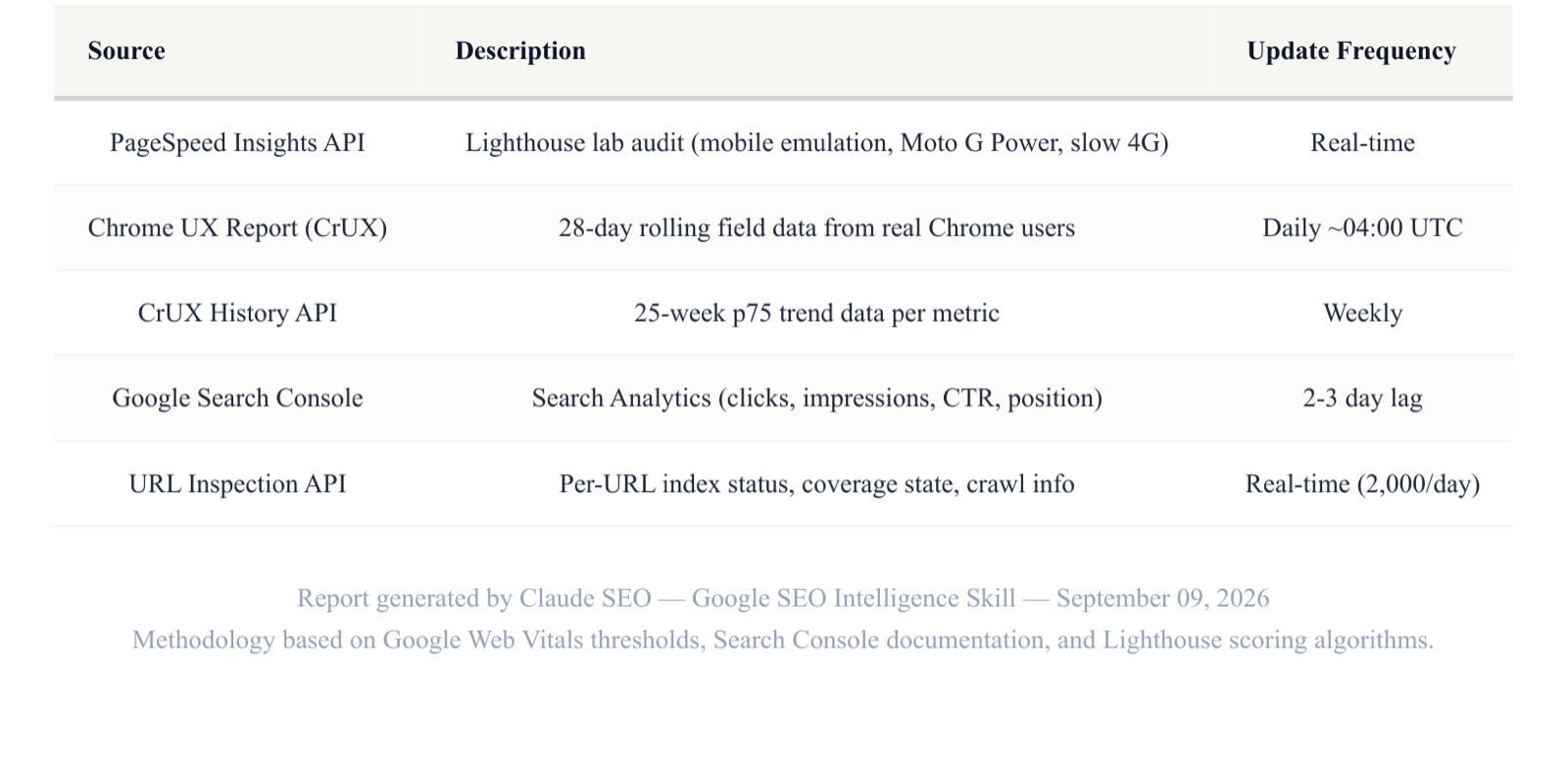
It also names where every number came from, which is the thing most paid audits do not do:
If you run the two commands above on your own site, this is genuinely what comes back.
The catch, and the honest limit
One catch. This needs Claude Code running on a computer. There is no version of this you run from your phone, and if you have never opened a terminal before, the install step alone will take longer than it should.
And the bigger honest limit: this will not get you ranked by Friday. SEO was never a switch you flip. What you get is the list a paid consultant would hand you after a few thousand dollars and a couple of weeks, for free, in about fifteen minutes, with the reasoning attached so you understand why each item matters instead of just being told to trust it.
Key takeaways
- Claude SEO is a free, MIT licensed, open source skill for Claude Code, over 16,000 stars, built by Daniel Agrici.
- Real SEO retainers run $250 to $10,000 a month, per Ahrefs' survey of 439 providers, with most businesses between $500 and $5,000.
- Install with
/plugin install claude-seo@agricidaniel-claude-seothen/seo setup, or clone the repo and runinstall.shby hand. - Connect Search Console with
/seo google setup, then run the audit itself with/seo audit https://yoursite.com. - The report is a real markdown, PDF and JSON output: a grade, the issues found, and a prioritized fix list with the reasoning behind each item.
- It needs Claude Code on a computer, and it will not get you ranked overnight. It gets you the list, not the rankings.
FAQ
Is Claude SEO free?
Yes. It's MIT licensed with no per-domain pricing and no telemetry, and the core plugin and all 25 sub-skills run without paying anything. A few optional extensions wrap paid services like DataForSEO or Ahrefs if you already have accounts with them.
Does Claude SEO replace hiring an SEO consultant?
Not entirely. It replaces the audit, the hours someone spends crawling your site and writing up findings. Deciding a competitive strategy and writing the content is still a person's job.
Does Claude SEO need Google Search Console connected?
No. It runs on public page data alone, and connecting Search Console upgrades the findings from an educated guess to your real queries and real indexing status.
What does an SEO retainer cost from an agency?
Agencies average around $3,209 a month, per Ahrefs' survey of 439 SEO service providers, with freelancers running closer to $1,349. That's the ongoing retainer figure too, since a single one-off audit is usually sold as a separate item that agencies don't price cheap.
What health score did scalr.sg get from Claude SEO?
74 out of 100, from a run across all 23 pages on scalr.sg. The eleven pages of findings behind that score are what made it worth the twenty minutes, each one naming the issue, its severity and the fix.
Why I bothered with this one
I build websites for a living now, and the honest truth is that SEO has always been the part I take on faith the most. Someone hands you a report full of scores and jargon, and you either trust them or you don't, because checking their work yourself would cost almost as much as just paying them. What I liked about running this myself is that the reasoning ships with the finding. It doesn't just say fix your schema markup, it tells you what is missing and why it matters, so I could actually argue with it if I disagreed, instead of taking someone else's word for it.
I don't think a free skill replaces a good SEO consultant's judgment. I do think it changes who gets to see the starting point before they pay for one.